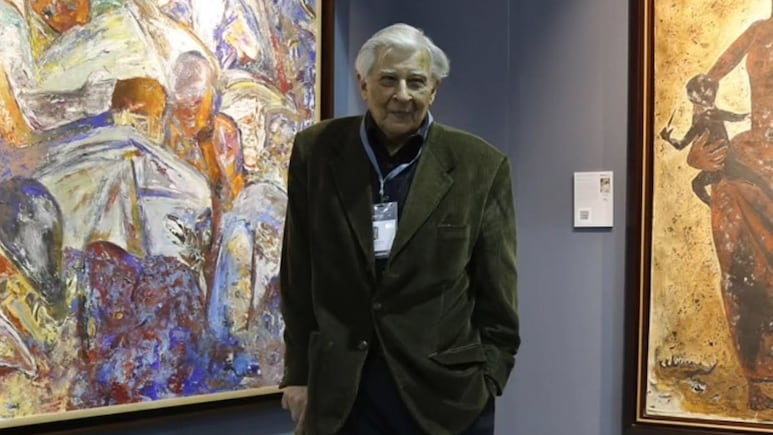
- Krishen Khanna honoured with the Lifetime Achievement Award at the NDTV Masterstroke Art Awards
- His art often reflected social issues and urban life, using various mediums
- He was awarded the Padma Bhushan in 1999 and had over 40 solo exhibitions
Krishen Khanna, the oldest living artist in India, was conferred with the Lifetime Achievement Award in Art at the NDTV Masterstroke Art Awards. His son and daughter, Karan and Rasika, accepted the award on his behalf.
Thanking the jury and NDTV for conferring the Lifetime Achievement Award to Krishen Khanna, Karan Khanna said, "We are also very appreciative of the fact that NDTV has always been the flag-bearer in promoting and recognising the rich talent and heritage of our country. And lastly, I would like to dedicate this award to all the artists and artisans of our country who pursue their passion unflinchingly."
Krishen Khanna's Early Life
Born in July 1925 in Lyallpur, Pakistan, Krishen Khanna was exposed to art quite early. In 1930, his father went to England to pursue his doctorate, and upon his return, he brought copies of Leonardo da Vinci's Self-Portrait and The Last Supper.
When he was 13, he received the Rudyard Kipling Scholarship and travelled to Britain to study art at the Imperial Service College in England. When times were tumultuous during World War II in 1942, Krishen Khanna passed the Oxford and Cambridge School Certificate examination.
In 1946, he completed his B.A. Honours in English Literature from Lahore. He started working at Kapoor Art Works, where he learnt painting and printing. He used to earn Rs 350 a month. On August 12, 1947, his family came to India by car.
He started working as an officer at Grindlay's Bank, Mumbai, and met S. B. Palsikar. At an exhibition at the Bombay Art Gallery, he met F. N. Souza, a founding member of the Bombay Progressive Artists' Group, which comprised maestros like H. A. Gade, M. F. Hussain, K. H. Ara, S. H. Raza, and Sadanand Bakre.
Krishen Khanna's Art
Krishen Khanna's work, News of Gandhi's Death, was displayed in the Golden Jubilee Exhibition of the Bombay Art Society. Dr Homi Bhabha was reportedly the first person to buy his painting, Spring Nude, in the late 1940s for Rs 225. He worked at the bank till 1961 before devoting his life to art.
He used figurative elements that commented on social issues, urban life, and the conditions in which humans live. Later, he used oil colours, acrylic colours, ink, and pencil to bring his art to life. His early works portrayed the lives of fishing communities. In the 1960s, he created abstract art to portray middle-class culture using the Japanese sumi-e (ink-brush) technique.
In 1974, his Truck Series gained attention. It symbolised a world moving towards catastrophe with advancing technology, leaving moral and social contexts behind to decay and decompose.
Krishen Khanna has held more than 40 solo exhibitions in India and abroad, displaying his art and earning numerous recognitions. Not to mention the multiple international exhibitions he participated in. In 1999, he was conferred the Padma Bhushan, the third-highest civilian award in India.
In 2010, around 120 of his artworks were displayed in a retrospective exhibition at the Lalit Kala Akademi galleries in Rabindra Bhavan, New Delhi. His works have been part of collections at the Museum of Modern Art, the National Gallery of Modern Art, the Jehangir Nicholson Art Foundation, and Bharat Bhavan, among others.
Krishen Khanna played a crucial role in shaping contemporary Indian art as we know it. While there are many things one can learn from the 100-year-old artist, one that everyone should remember is his belief that "The function of art is not decorative. True art defeats time, place and people. Art must go beyond a pretty picture," as he said in an interview with The Times of India.
Also Read | NDTV Masterstroke Art Awards: Full Winners' List
Track Latest News Live on NDTV.com and get news updates from India and around the world
