





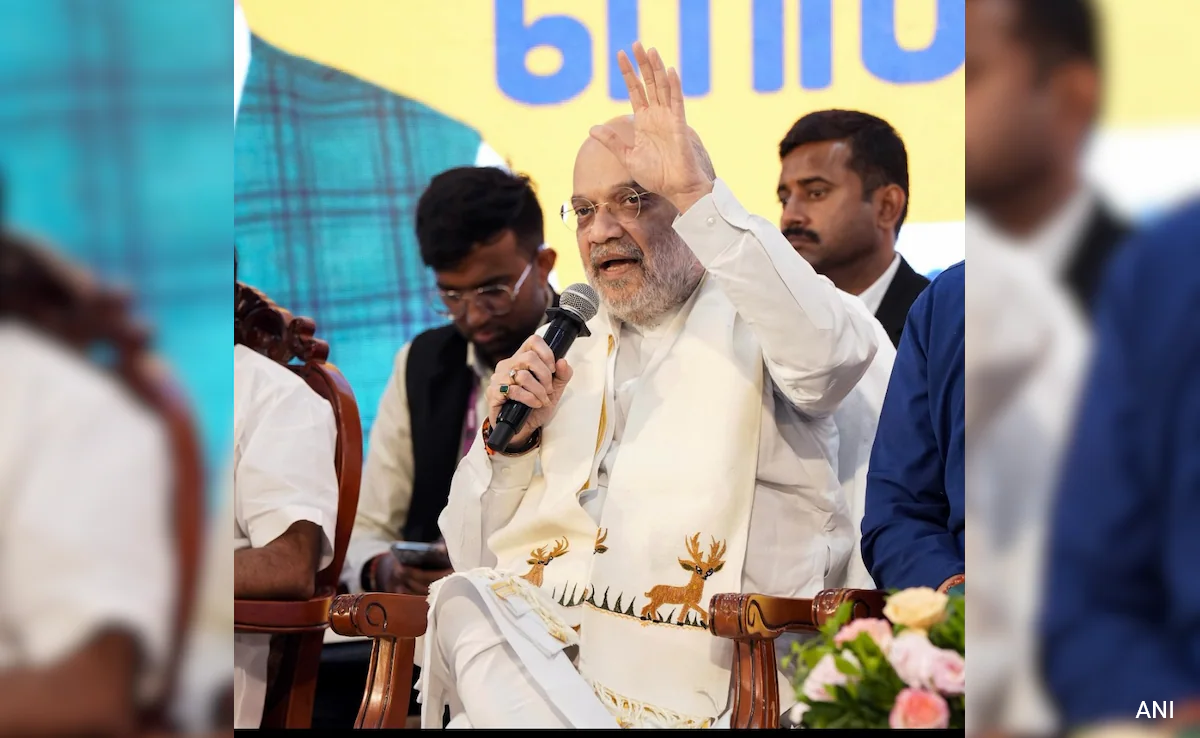
When Union Home Minister Amit Shah arrived in Thiruvananthapuram to launch the BJP's Mission 2026 — “We Want a Developed Kerala” — the message was clear and unusually ambitious for a party that has long struggled for space in the state.
The intent was underlined by the campaign slogan “Marathathu Ini Marum” — what never changed will now change, signalling the BJP's push to challenge Kerala's political order ahead of the 2026 Assembly elections.
-

-
 "High Inflation Is Like Tax On Everyone": RBI Governor At NDTV World Summit
 -
 AI Agents To Outnumber Humans Soon? What Futurist Mike Walsh Told NDTV
 -
 This Delhi Boy Has 3 Michelin Stars. His Heart Still Goes To Rajindar Da Dhaba
 -
 Ashwini Vaishnaw Explains Semiconductor Complexity: 'Everything On This Tiny Nail'
 -
 Indian-Branded Mobile Phones By October 23, 2028, Says Ashwini Vaishnaw
 -
 AI Law In India Soon? What Ashwini Vaishnaw Said At NDTV World Summit
 -
 'Need To Look At Next 10 Years': Bondada Chairperson To NDTV On Solar Energy
 -
 World's 1st AI Actor Tilly Norwood Was Asked If She Knew Hindi. A Conversation Followed
 -
 AI Law In India Soon? What Ashwini Vaishnaw Said At NDTV World Summit
 -
 Iran's Supreme Leader's Representative Says India Can Play 'Big Role' In Middle East Peace
A Bigger Political Goal
Addressing more than 2,000 BJP-elected local body representatives, Shah spelt out the party's long-term aim without hesitation. The BJP, he said, is not contesting elections merely to increase vote share, but to work towards a future where Kerala has a BJP Chief Minister.
In the same address, Shah launched a sharp attack on Kerala's dominant political formations, alleging that “match-fixing” between the LDF and the UDF has led to years of development stagnation. According to him, while power alternates between the two fronts, governance priorities remain largely unchanged, resulting in delayed infrastructure projects, policy inertia and lost economic opportunities.
The BJP's pitch, Shah argued, is to disrupt this closed political cycle by offering voters a development-centric third option under the leadership of Narendra Modi.
From Margins To Momentum
Electoral data suggests the BJP's confidence is not without basis. The NDA's vote share in Kerala has risen steadily, from around 3% in 2001 to 12–15% between 2016 and 2021.
While this growth has not translated proportionally into Assembly seats, the party's organisational base has remained intact, even after repeated defeats.
The clearest signs of momentum are visible in urban Kerala. In the Thiruvananthapuram Corporation, the BJP emerged as the principal opposition in the last two local body elections. In the most recent contest, it secured 50 of the 101 wards, marking history of electing the first mayor.
Across all six municipal corporations, the BJP-NDA combine crossed a 23% consolidated vote share, reinforcing its belief that urban voters, especially the youth, are more receptive to its development narrative.
Amit Shah pointed out in 79 gram panchayats BJP came second and all this shows the BJP is not just urban centric.
Sabarimala And Shifting Equations
The Sabarimala issue continues to be viewed within the party as a slow-burn political factor rather than a short-term mobilisation tool. While its electoral impact varies by region, the BJP believes it has helped build a durable connection with sections of Hindu voters, particularly in southern Kerala.
Recent local body election data also points to a vote shift among sections of the Ezhava OBC community, traditionally a Left-leaning base. Even limited movement here could prove decisive in closely fought constituencies as the OBC community constitutes 26 per cent of the hindu community.
Interestingly the top leaders of the party, K Surendran, V muraleedharan, Sobha Surendran also are from the OBC community who have displayed their political acumen on the ground.
For the first time, BJP also included two Christians leaders among the top rank of the party. Shone George and Anoop Antony, who are state secretaries of the party, are constantly in touch with minority communities for its outreach. The appointment of George Kurien as union minister has also kickstarted high level intervention for the community in New Delhi.
Seats On The Radar
Thiruvananthapuram district has emerged as the BJP's primary battleground. Constituencies such as Nemom, Vattiyoorkavu, Kazhakootam, Thiruvananthapuram Central, and Attingal are now considered competitive.
In Attingal, former Union minister V Muraleedharan polled over 3 lakh votes in the last Lok Sabha election, finishing third but within striking distance of the top two candidates. The BJP sees such performances as proof that it can act as a strategic disruptor, cutting into traditional vote banks. BJP's vote share increased from 24.97% in 2019 to 31.64% in 2024 in Attingal.
In north Kerala, Manjeswaram in Kasaragod remains symbolic. BJP leader K Surendran once lost there by just 80 votes, underscoring how narrow margins can alter political outcomes.
Minority Outreach And New Signals
With nearly 48% of Kerala's population comprising Christians and Muslims, minority outreach has become a key component of the BJP's strategy. The victory of Suresh Gopi in Thrissur is widely seen as a breakthrough, particularly in terms of Christian community engagement.
Gopi won the Thrissur Lok Sabha seat in 2024 with 412,338 votes (37.8% vote share), marking the party's first-ever parliamentary victory in Kerala by a margin of 74,686 votes. The staggering lead was seen as a matter of hindu consolidation cutting across caste.
While incidents involving attacks on Christians elsewhere in the country have affected the party's image, the Kerala leadership, led by figures such as Rajeev Chandrasekhar, has maintained consistent engagement with church leadership, reiterating its development-first pitch.
Why Does This Visit Matters?
Amit Shah's visit is less about immediate electoral promises and more about organisational signalling. His interactions with NDA leaders and state functionaries are expected to finalise candidate strategies and sharpen booth-level planning, using data drawn from the last three election cycles.
Whether that ambition translates into seats remains uncertain. But Shah's message was clear: The BJP no longer sees Kerala as a symbolic battleground, it sees it as an unfinished political fight that it's ready to fight till its achieved.
Track Latest News Live on NDTV.com and get news updates from India and around the world

