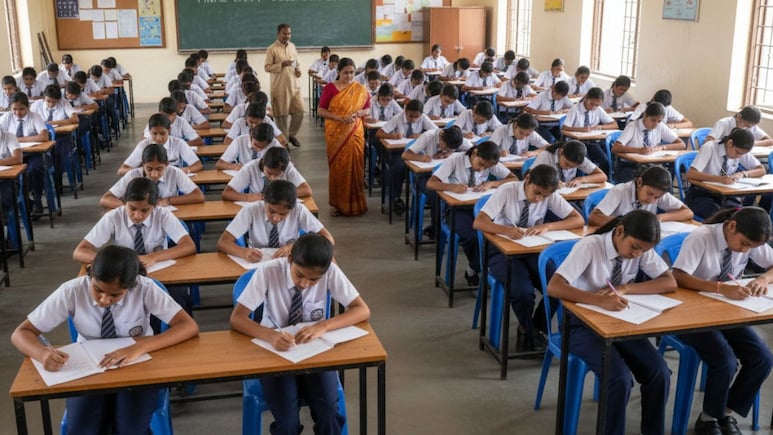
CBSE Class 10 Science Exam 2026: The Central Board of Secondary Education (CBSE) on Tuesday conducted the Class 10 Science examination from 10.30 am to 1.30 pm at centres across India and abroad. For the first time, the Class 10 Science paper was divided into three distinct sections - Physics, Chemistry and Biology - ensuring balanced coverage of all three core disciplines.
Students were provided an additional 15 minutes before the begining of the examination to read the question paper. The reading time allowed them to understand the structure, analyse the questions and plan their responses before beginning to write.
According to the revised exam pattern, the theory paper was conducted for 80 marks and comprised 39 compulsory questions. Each section featured a mix of question formats, including multiple-choice questions (MCQs), assertion-reasoning questions, short-answer and long-answer questions, numericals, diagram-based and case-study questions.
Paper Balanced, In Line With Syllabus
Subject experts who analysed the paper after the examination described it as well-balanced and aligned with the prescribed syllabus. The paper included conceptual, application-based and competency-oriented questions.
Vineeta Kadwane, subject matter expert at Lancers Army Schools, rated the difficulty level as moderate.
"The CBSE Physics, Chemistry and Biology sections were overall well-balanced and aligned with the prescribed syllabus. The paper reflected a mix of conceptual, application-based and competency-oriented questions," she said.
She noted that the Physics section required conceptual clarity, with a few questions demanding careful analysis. However, students who had practised regularly and focused on fundamentals would have found it manageable.
"Chemistry was comprehensive yet fair. The questions covered key areas and included both objective and descriptive formats. Students who thoroughly revised NCERT textbooks and practised structured answers would have benefited," she added.
According to her, the Biology section was comparatively direct and student-friendly, with diagram-based and case-study questions assessing understanding rather than rote learning.
Praneet Mungali, educationist and Trustee at the Sanskriti Group of Schools, Pune, said the introduction of subject-wise sections for the first time made the paper structured and fair.
"Most questions were direct, familiar and based on standard classroom practice. The subject-wise arrangement helped students maintain focus and manage time effectively. Conceptual clarity was sufficient to answer the majority of questions, with limited emphasis on higher-order thinking," he said.
Priyanka Sahu, subject matter expert at Seth MR Jaipuria Schools, said the clearly defined three-section format made the paper more organised and easier to navigate.
"While the paper was manageable, it appeared slightly lengthy due to the combination of MCQs, assertion-reasoning items, competency-based questions, numericals and diagram-based problems. Students who maintained steady pacing and effective time management were better positioned to complete it comfortably," she said.
She added that the Biology section included familiar diagrams and reasoning-based questions from the textbook. Chemistry was largely straightforward, featuring standard reactions and concepts from NCERT chapters. Physics included a few numerical and ray-diagram questions that required careful application of formulas but followed the expected board pattern.
"The availability of internal choices in several questions provided flexibility and helped reduce examination pressure. Competency-based questions were included as per the latest guidelines but were balanced and not excessively challenging," she said.
Warsha Sawant, TGT Science at Seth Anandram Jaipuria School, Lucknow, described the question paper as largely direct and NCERT- and exemplar-based, with limited emphasis on higher-order or complex application-based questions.
The overall difficulty level ranged from easy to moderate, making it accessible to students with basic conceptual clarity, she said.
According to her, the Physics section included questions directly from NCERT and exemplars and maintained a balance between theory and numericals. The Chemistry section was easy to moderate, with experiment-based questions incorporated. Biology questions were mostly based on the prescribed syllabus and similar to sample papers, with several memory-based and previous-year question patterns observed.
"The case-study questions were clear and self-explanatory, making them easy to attempt. Several diagram-based questions were straightforward, helping students score well," she added.
Sumeet Mehta, CEO and Co-Founder of LEAD Group, said the Class 10 Science paper clearly prioritised conceptual clarity over rote learning.
"All sections emphasised competency-based formats, including assertion-reason, case-based and reasoning-driven questions.
Physics, in particular, stood out, with 12 out of 25 marks allocated to higher-order thinking skills (HOTS), making analytical ability and numerical application critical for performance," he said.
"While Biology (30 marks) and Chemistry (25 marks) were moderately difficult, Physics (25 marks) was the most demanding due to its strong analytical focus. Biology drew a significant portion of its marks from one major unit, whereas Chemistry and Physics had a more even distribution of 5-7 marks across different chapters," he added.
Sarita Singh, Head of the Science Department at DPS Sector 45, Gurugram, said the paper was well-balanced and aligned with the syllabus. Students who thoroughly covered the NCERT textbooks are likely to perform well, she said.
