





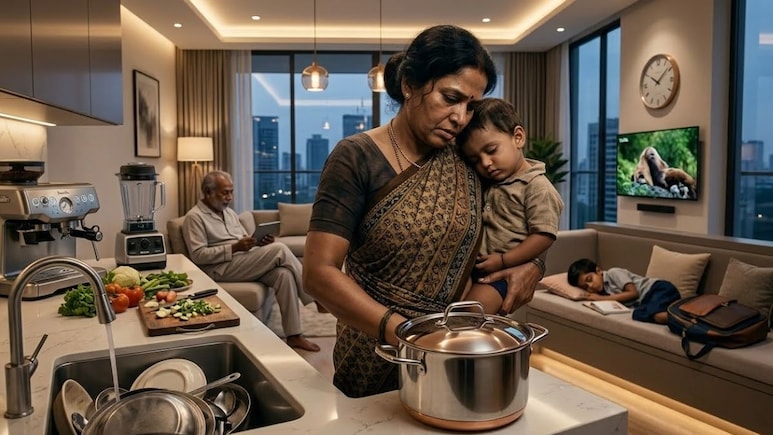
In a significant observation underscoring the economic and social value of unpaid care work, the Supreme Court has noted that employed women, on average, work longer hours than employed men.
The court made the observation while elaborating on the rationale behind extending maternity benefits to all adoptive mothers irrespective of the age of the adopted child.
The ruling has struck down the provisions of law which barred maternity leave for women who adopted children above the age of three months.
While emphasising that there is no difference between biological and adopted children, the top court quoted poet Fleur Conkling Heyliger: "Not flesh of my flesh, nor bone of my bone, But still miraculously my own. Never forget for a single minute, You didn't grow under my heart, but in it."
The ruling shines a spotlight on what it termed the "institutional invisibility" of household and care work - tasks that are fundamental to the functioning of families and, by extension, the broader economy.
Double Burden
Quoting studies by the International Labour Organization (ILO), the bench of Justices JB Pardiwalah and R Mahadevan noted that employed women tend to spend more time working than men once unpaid domestic labour is factored in.
This, it said, reflects deeply entrenched societal norms that place the burden of household responsibilities and caregiving primarily on women.
"It is not an unknown phenomenon that women often sacrifice earnings and career progression for childbirth and childcare," the court observed.
The judgment emphasised that care work, ranging from feeding and bathing children to managing medical visits and daily household needs, is indispensable but often goes unrecognised and uncompensated.
"There is no doubt that every member of a household benefits from the care work within households and, ordinarily, it is undertaken by women," the court said.
While emphasising that parenting is a shared responsibility and not just that of a woman, the court urged the Centre to bring in a policy for paternity leave for men.
Importantly, it added that women's unpaid labour is not merely a private matter but a critical contributor to the economy.
"The care provided within the home enables other members of the household to participate productively at their workplace," the bench headed by Justice JB Pardiwalah noted, calling its economic significance "considerable" despite being frequently overlooked.
The court also invoked the concept of the Wollstonecraft Dilemma, a framework that captures the tension between recognising women's role as caregivers and ensuring their equal participation in the workforce.
The court explained that women are often expected to fulfil two competing roles: a primary caregiver and an equal participant in professional life.
Treating women identically to men without accounting for these realities, it said, would perpetuate structural inequality.
At the same time, it cautioned that acknowledging differences must not come at the cost of equal opportunity.
Why Maternity Benefits Matter
The bench described maternity benefits as a tool of "substantive equality," aimed at balancing these competing expectations. By providing economic protection and institutional support, such benefits enable women to remain integrated in the workforce while fulfilling caregiving responsibilities.
The judgment also clarified that caregiving demands are not limited to biological motherhood. In the case of adoption, especially, the court noted that responsibilities can be equally, if not more, intensive, as the child requires time and care to adjust to a new environment.
"The initial months following the arrival of a child, whether by birth or adoption, require time, attention, and rearing responsibilities," the court said, adding that the absence of adequate support places an "unreasonable burden" on women.
The Supreme Court stressed that expecting women to maintain the same level of professional output immediately after welcoming a child, while simultaneously handling intensive caregiving responsibilities, is unrealistic and inequitable.
"Maternity benefits are nothing but an expression of treatment grounded in equity and a substantive approach to equality," the court said.
Track Latest News Live on NDTV.com and get news updates from India and around the world

