





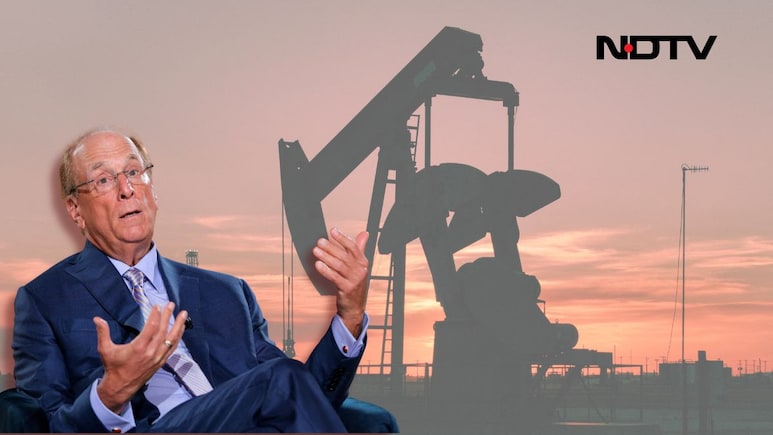
- Oil prices could go above $150 per barrel if the US-Iran conflict drags into April
- How will it impact global economy? A stark and steep recession, says Larry Fink, CEO of BlackRock
- Oil sits at the centre of the global economy. Therefore, at $150, there would be a global shock.
Global markets gasped for breath when Brent crude crossed the $110 per barrel-mark last week. Trillions were wiped out in a single trading session. Now, a new report from trade intelligence platform Kpler has estimated that oil prices could go above $150 per barrel if the US-Iran conflict drags into April.
How will it impact global economy? A stark and steep recession, says Larry Fink, CEO of BlackRock, an American multinational investment management corporation. Talking to BBC, Fink said, "If Iran remains a threat and oil prices stay high it will have profound implications for the world economy."
Why $150 Is A 'Danger Zone'
Oil sits at the centre of the global economy. It fuels transport, powers factories, and indirectly drives food prices. When crude spikes sharply, the shock spreads quickly. Therefore, at $150, there won't be a gradual adjustment, but a global shock.
Here's how the jump typically plays out:
| Channel | What changes | Why it matters |
| Fuel prices | Petrol, diesel surge | Immediate hit to household budgets |
| Transport | Airfares, logistics costs rise | Goods become more expensive |
| Manufacturing | Input costs jump | Companies cut margins or raise prices |
| Inflation | Broad-based price rise | Central banks forced to act |
Inflation: The First Domino
The first visible impact is inflation. Fuel becomes expensive overnight, but the second-order effects are worse.
- Vegetables cost more due to transport
- Cab fares and delivery charges go up
- Electricity tariffs rise in some regions
For energy-dependent countries like India, which import most of their crude, this acts like a tax on the entire economy. Fink calls rising energy prices a "regressive tax" because lower-income households feel it the most.
Besides, interest rates will stay higher for longer. Central banks, including the RBI, don't have many options when inflation spikes.
- Rate cuts get delayed
- Borrowing becomes expensive
- Home loans and EMIs stay elevated
This is where the slowdown begins to show up in real life. People spend less, companies invest less.
Global Growth Takes A Hit
High oil prices have historically preceded economic slowdowns. At $150:
- Airlines cut routes or raise fares sharply
- Auto demand weakens due to high fuel costs
- Small businesses see margins shrink
For exporters, there's a double blow, global demand weakens just as costs rise.
Stock Markets: Bloodbath At $150
Markets are already "in a huddle," trying to price in worst-case scenarios.
What typically happens:
| Sector | Likely impact |
| Oil producers | Gains from higher crude prices |
| Airlines | Sharp losses |
| Paint, chemicals | Margin pressure |
| FMCG | Demand slowdown risk |
| Banks | Asset quality concerns if slowdown deepens |
This doesn't automatically mean a 2008-style crash. According to Fink, there are "zero similarities" with the global financial crisis. But when volatility spikes, confidence drops.
Sharing his insights, Siddharth Maurya, Managing Director of Vibhavangal Anukulkara, said, "For aviation, logistics and chemical companies, crude oil prices would define their profitability,. For construction, engineering and manufacturing companies, the cost of their raw materials would increase. The companies would increase their rates to preserve their profitability. The central bank would have to increase their rates to fight inflation. This would increase the price of oil, food and household products in the economy. This is especially true for import dominated economies like India. For it, it would increase the fiscal deficit, weaken the currency and increase the price of oil and food."
India's Problem: The Import Bill
India imports over 80% of its crude. At $150:
- Current account deficit widens
- Rupee faces pressure
- Government may cut fuel taxes or increase subsidies
That creates a fiscal balancing act: protect consumers without blowing up the budget. Ironically, $150 oil also speeds up the transition away from oil.
- Solar and wind become more attractive
- EV adoption gets a push
- Countries rethink energy security
Fink's view is pragmatic: use what you have, but move aggressively toward alternatives.
The Fork In The Road
Right now, markets are pricing two extreme outcomes -- there's very little middle ground.
| Scenario | Oil trajectory | Economic impact |
| Conflict de-escalates | Oil falls below pre-war levels | Relief rally |
| Conflict drags on | Oil stays near $100-$150 | Recession risk |
"The anticipated increase in crude oil prices is bound to severely affect the world economy, where inflation reduces growth. Energy prices would increase across the board. The costs of transport, manufacture and food would all rise, leading to an overall increased inflation all over the world. For decades, these types of oil price shocks have increased stagflation, where price growth occurs, but overall economic growth slows. These will increase oil prices by at least $150, which would increase inflation across the globe. This is incorporated in the prediction of global economies, in which oil prices, above $150, would increase the inflation, but reduce economic growth, leading to an extremely likely recession, if the oil prices remain above $150 for months," warned Maurya.
What it means for you if oil hits $150 and stays there:
- Your monthly budget tightens
- Loan costs remain high
- Job market becomes uncertain
- Investments turn volatile
It doesn't happen overnight, but the pressure builds quickly. "Fundamentally, oil at $150 doesn't simply increase fuel costs; it alters inflation, policy, and the direction of the markets all at once," added Maurya.
Track Latest News Live on NDTV.com and get news updates from India and around the world

