





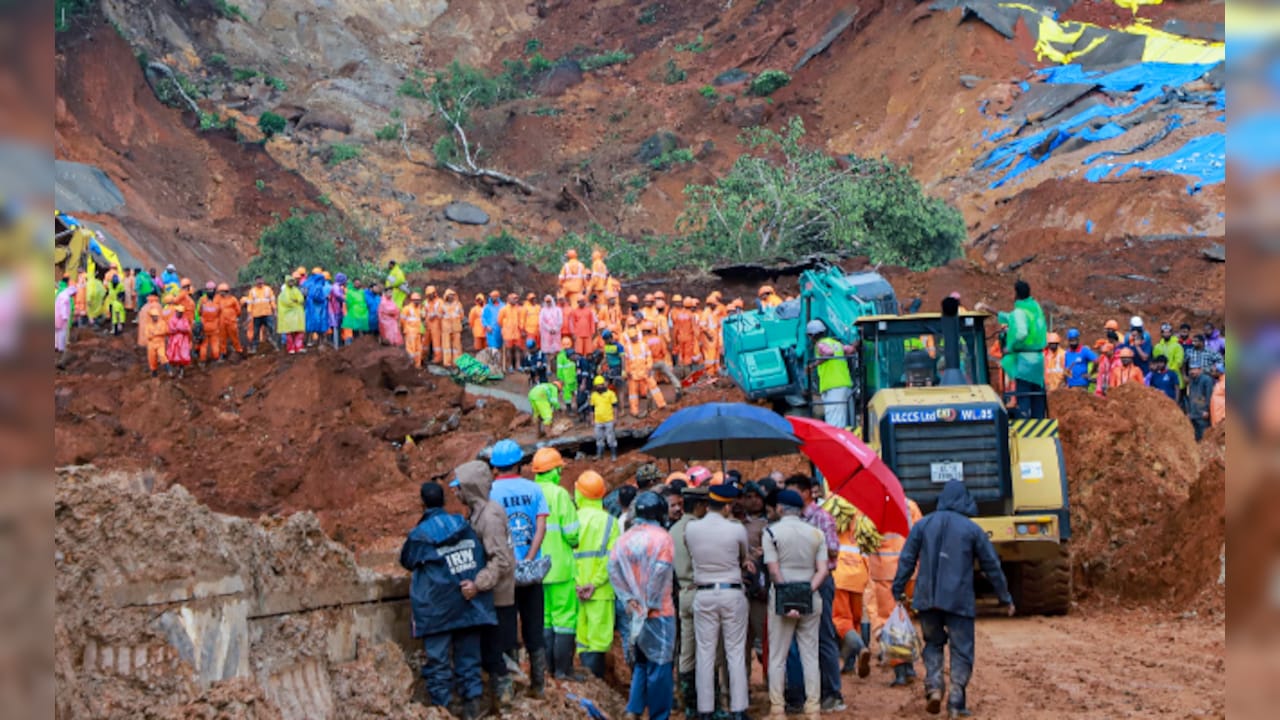
The landslide at a tunnel project site in Kerala's Wayanad was a disaster waiting to happen. Six people were killed in the mishap on Tuesday.
NDTV has accessed an internal report prepared by Dilip Buildcon Limited (DBL), the sub-contractor in charge of Tunnel work at Wayanad, which shows that the hillside above the Wayanad tunnel's North Portal was already breaking apart. The document was jointly prepared and signed off by DBL's own senior geologist Raju Sagar, GSI's A Ramesh Kumar, and the Authority Engineer Dr H K Singh of Turkish Engineering Consulting & Contracting.
This tunnel project has two ends: a South Portal on the Kozhikode side at Anakkampoyil, and a North Portal on the Wayanad side near Kalladi-Meppadi. The landslide struck at the North Portal, at the spot where the mouth of the tunnel is meant to be. This report is the geological and geotechnical assessment of that very portal.
The report tells a disturbing story. Engineers who inspected the site between June 3 and June 11 found that the hillside above the tunnel mouth was made up of a very thick layer of loose, silty soil, roughly 35 metres deep on the left side, sitting above the harder rock. This kind of soil drains water poorly. In heavy rain, water gets trapped inside, and the soil grows heavier, weaker and more prone to sliding. To hold this mass in place, the company had cut the slope into steps, sprayed it with a thin layer of concrete known as shotcrete, and driven in metal anchoring rods called soil nails. But by the time of this inspection, the report records, that slope was already failing. The engineers saw cracks widening across multiple levels of the cut face, saw earth slumping along the benches, muddy water seeping out, and cavities forming inside the soil itself.
Read | Bigger Disaster Still Looms: Experts' Warning After Wayanad Landslide
The most alarming detail is this: the engineers could hear water flowing underground, in the gap between two of the slope's support levels. It means water has carved a hidden path through the loose soil and is quietly washing the hillside away from the inside, even when the surface still looks solid. The report warns that this kind of internal erosion can rapidly weaken a slope and lead to sudden failure.
The report does not treat both sides of the portal as equally safe. It singles out the left-hand slope as carrying a distinctly higher risk than the right, and states in plain terms that this slope, under the prevailing rainfall, "may culminate in sudden slope failure at any time."
The safety systems meant to prevent such a collapse were themselves not working. Drainage holes had been drilled into the slope to relieve the water pressure building up inside the soil, but the report notes that very few of these holes on the high-risk left slope were actually functioning. The instruments that give early warning of a slope about to fail, such as piezometers that measure underground water pressure, had not yet been installed. The only monitoring device in use was, in the engineers' own admission, not accurately reflecting the distress they could see and hear on the ground.
Read | Why Wayanad's Deadly Landslide Was More Than A Natural Disaster
Trial blasting for the tunnel was carried out on three separate days within this same window, June 5, June 6 and June 11, while the slope was already showing distress. Interestingly, the report concludes that the blast vibrations recorded were within safe limits and that the cracking was driven mainly by heavy rainfall rather than the blasting.
The report also prescribed a series of measures. It recommended building stone-and-wire retaining structures called gabion walls along the left-wall slope to support the exposed soil, covering the bare earth with protective matting and laying tarpaulin continuously from the top of the slope to the bottom, anchored securely, and cutting lined channels to carry rainwater safely away from the slope instead of letting it soak in.
It recommended field tests to check whether the existing soil nails and drainage holes were working under saturated conditions. It also flagged a further hazard: a concrete-mixing plant positioned close to the distressed slope, whose weight and heavy vehicle traffic, in the engineers' own words, threatened the stability of the cut slope, and which they recommended be moved away.
NDTV reached out to Dilip Buildcon, the Konkan Railway Corporation and the project's Authority Engineer.
"The report was to study the impact of blasting in the area. We completely stopped work in this portal after the report," an engineer working with Konkan Railways claimed.
When questioned why shortcrete method was used, they claimed along with shortcrete, concrete rods, each bearing 12 metres in length distanced at 2 metres were also injected into the soil.
"The landslide that occured above the site couldn't be held by any safety measure," he stated.
When pressed on why the sensitivities of monsoon and the fragility of the land were not taken up with proper study, the engineers defended that all standard practices were put in place.
However, the engineers couldn't give a convincing response on why gabion walls and other structures to hold the soil excavated in the area were not made as per required standards, where soil was stored. They also were unclear in their response whether they faltered in preparation of the region for tunnel blasting work at the north portal and whether it was a mis-calculation.
What was striking was the contractor stating proper land allocation for excavated soil was not provided by the government. "We need the soil to be used after the tunnel work. The government didn't allot us land on time for storing soil," the engineer stated.
"200 workers at the south portal ran away to their homes after this incident due to fear. We will not move forward unless the expert committee set up by government is convinced with our measures," he said.
The internal report therefore predicted the mishap. The contractor stopped work as document predicted calamity six days before the District Collector's June 20 stop-work order. It therefore looks like the engineers were waiting for the monsoon to pass.
Track Latest News Live on NDTV.com and get news updates from India and around the world

