



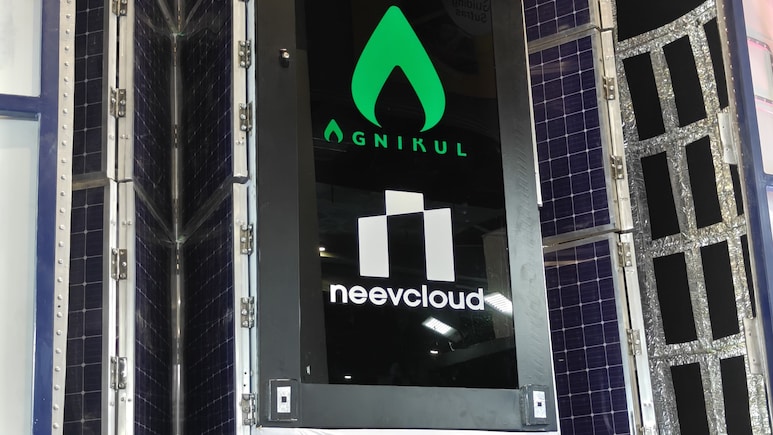
- Agnikul Cosmos aims to convert its rocket's last stage into India's first space data centre
- NeevCloud plans to run AI computing in orbit, powered by solar energy and space cooling
- Space data centres reduce Earth-based power and cooling needs using radiative cooling
For years, Elon Musk and SpaceX have talked about putting data centres in space. This year, Indian start-ups are preparing to try. On a rocket that has never reached orbit before, Chennai-based Agnikul Cosmos is attempting a radical first, transforming the last stage of its Agnibaan rocket into a functioning data centre in space.
As the company readies its maiden orbital launch, it has found a bold partner in NeevCloud, which is betting on this high-risk mission to run artificial intelligence from orbit, powered by the Sun and cooled by the cold vacuum of space.
India's private space sector is preparing for one of its boldest experiments yet, an attempt to place India's first data centre in space, and an AI infrastructure company which wants to use space itself as the next frontier for computing. India's first data centre in space will be done by transforming the last stage of the Agnibaan rocket into an experimental AI compute platform. A truly waste-to-wealth idea and rocket reusability taken to the next level.
The plan is audacious. On Agnikul's maiden orbital mission, the last stage of the Agnibaan rocket will not be discarded as space debris. Instead, it will be repurposed and transformed into a satellite-like platform, hosting an experimental space-based data centre module. If the mission succeeds, it could mark India's first real attempt at orbital AI computing, at a time when companies like SpaceX and Elon Musk have only spoken about the idea but not yet flown hardware.
"This is not just about launching a rocket," says S. Nani, avionics engineer at Agnikul Cosmos. "We are planning for an orbital launch where we extend our last stage to serve as a data centre, which can deploy in low-Earth orbit."
A High-Risk First Orbital Flight
For Agnikul, the stakes could not be higher. The start-up, incubated at IIT Madras, successfully conducted a suborbital mission in 2024 but has not yet achieved a successful orbital launch. The upcoming mission will therefore be its first true test of reaching orbit, and it is choosing to carry a high-visibility experimental payload.
That payload is essentially the rocket's upper stage itself, redesigned to function like a satellite. Solar panels mounted on either side will generate power, while the structure houses computing hardware supplied by NeevCloud.
"On top of the last stage, there is a black-coloured structure, that is where the data centre comes," Nani explains. "Exactly what you see in the model (displayed at Bharat Mandapam) is what we are planning to fly."
The concept is reminiscent of ISRO's PSLV-Orbital Experimental Module (POEM), where the fourth stage of the PSLV is converted into an orbital platform for experiments. Agnikul's approach follows a similar philosophy but pushes it further, into active compute and AI services. "Our upper stage will be converted into a satellite after its operation," Nani says. "For our developmental flight, we are aiming for one to three months in space."
Why Put A Data Centre In Space
The idea of space-based data centres has been discussed globally for years, particularly by SpaceX's Elon Musk. But so far, it has largely remained a theoretical concept but for minimal experiments in the USA by Axiom Space and Starcloud. Agnikul and NeevCloud now want to turn that idea into workable, scalable hardware.
The motivation is straightforward. Data centres on Earth consume enormous amounts of electricity and water, primarily for power and cooling. Space, proponents argue, offers two things almost for free: solar energy and radiative cooling.
"The main advantage that comes from a data centre in space is energy generation," says Nani. "Energy comes directly from the Sun. We don't have to use resources the way we do on Earth."
Solar panels in orbit can receive sunlight for much longer periods than ground-based installations. At the same time, cooling, one of the biggest costs of terrestrial data centres, can be handled through radiation of heat into deep space.
"In space, there is no conduction and no convection," Nani explains. "We have to radiate whatever heat is generated. The radiating surfaces face deep space, which is very, very cold. That helps in dissipating heat without complex cooling systems."
In simple terms, one side of the module faces the sun and generates power; the opposite side faces deep space and sheds heat.
NeevCloud's Big Bet
For NeevCloud, the experiment is part of a much larger vision. The Indore-based company already operates data centres across several Indian states and claims over a decade of experience in building and running compute infrastructure. Space, it believes, is the next logical extension.
"We are not just building a data centre in space, we are building an entirely new layer of orbital inferencing infrastructure," says Narendra Sen, founder and CEO of NeevCloud.
The initial module will be modest by terrestrial standards - weighing around 250 kilograms and carrying AI inferencing chips rather than massive training clusters. But Sen insists the long-term ambition is far bigger.
"Over time, we want to scale this into a constellation," he says. "Our roadmap looks at 600 or more such orbital edge data centres over the next few years, providing continuous AI inferencing from space."
According to NeevCloud, the key advantage lies in latency and reach. Large parts of the world, especially in the Global South, are far from major data centres. Placing compute in low-Earth orbit, Sen argues, can bring AI services closer to users in remote regions, border areas and maritime zones.
"Our use cases are for people who are not connected, border areas, maritime autonomous vehicles, drones and unmanned systems," Sen says. "From low-Earth orbit, latency can be less than half a second. That opens up new possibilities."
Betting On A Maiden Launch
There is no denying the risk. NeevCloud is placing expensive AI hardware on a rocket that has never reached orbit before. When asked whether this is biting off more than can be chewed, Sen is philosophical.
"Someone has to bet," he says. "Somebody once bet on me and put capital on me. I have to do the same. We have confidence in the Agnikul team. They have leaders from ISRO and a very experienced engineering group."
The cost of the hardware alone, Sen says, runs into several crores of rupees, mostly driven by the AI chips. For the first mission, even a few months of operation would be enough to validate the concept.
"The first launch will be shorter," Sen admits. "The production-ready versions are where we look at three to five years of life."
From Launch Company To Orbital Infrastructure
For Agnikul, the collaboration signals a strategic expansion beyond just launch services. Srinath Ravichandran, co-founder and CEO of Agnikul Cosmos, sees this as a natural evolution.
"As with all rockets, with more launches, we naturally leave behind upper stages in orbit,"Srinath says. "Our convertible upper-stage technology lets these stages stay active and functional, turning them into usable assets."
Instead of becoming debris, Srinath argues, upper stages can be transformed into orbital infrastructure platforms capable of hosting compute, sensors or other payloads.
"That's the next step for a space transportation company," he says. "You build, launch, recover, and then extend into orbit."
Beating The Talk With Hardware
What makes the Agnikul-NeevCloud experiment particularly striking is the timing. For years, Elon Musk and SpaceX have spoken publicly about the idea of space-based data centres, citing cheap solar power and cooling as key advantages.
Now, an Indian start-up, on its very first orbital attempt, is preparing to fly actual hardware.
If the Agnibaan mission succeeds, it will not suddenly revolutionise global computing. The first module is small, experimental and time-limited. But symbolically, it would be significant, demonstrating that India's private space sector is willing to experiment at the cutting edge, even at considerable risk.
Space is the last frontier, and Indian entrepreneurs are now looking to maximise opportunity from space. Whether the experiment succeeds or fails, one thing is already clear: while some of the world's biggest names are still talking about space data centres, Indian start-ups have moved a step further, they are ready to launch.
Track Latest News Live on NDTV.com and get news updates from India and around the world

