





Known globally as India's gleaming "Millennium City", Gurugram presents an astonishing economic paradox. Located just 30 kilometers south of Delhi, the national capital, it serves as a premier satellite city and a financial powerhouse within the National Capital Region (NCR). Gurugram alone contributes an impressive 0.6% to India's National Gross Dependent Product (GDP) - amounting to a staggering Rs 2 lakh crore and funnels roughly 50% to 60% of the entire state revenue of Haryana. It holds the rank of India's third-highest per capita income destination, trailing closely behind only Chandigarh and Mumbai.
The city's corporate footprint is massive, housing over 25,000 corporate offices, including approximately 250 (50%) of the coveted Fortune 500 companies. As a crucial IT, banking, financial, and BPO hub, alongside the vital Gurugram-Manesar-Bawal automobile belt-one of the largest automotive manufacturing ecosystems in the country-the city produces cars, motorcycles, scooters, and their auxiliary components.
From high-end software development to telecom equipment, electrical goods, and luxury real estate, epitomised by a DLF Camellias penthouse selling for a historic Rs 190 crore in 2024, Gurugram's DLF Cyber City rivals premium international landscapes. Furthermore, Hurun India's Rich List highlights that 23 billionaires in Gurugram hold personal wealth exceeding Rs 1,000 crore, while the average cost of a standard flat stands at Rs 1 crore.
Read: Rains Bring Flooded Roads, Uprooted Trees, Traffic Jams Across Delhi-NCR
Yet, when the skies open up, this hyper-modern economic titan is brought completely to its knees by fundamental infrastructure failures. The historic district, whose roots trace back to the Mahabharata era when King Yudhishthira reportedly gifted the village to Guru Dronacharya as part of the ancient Kuru Kingdom, routinely morphs into an absolute urban nightmare during the monsoon season. Live Updates
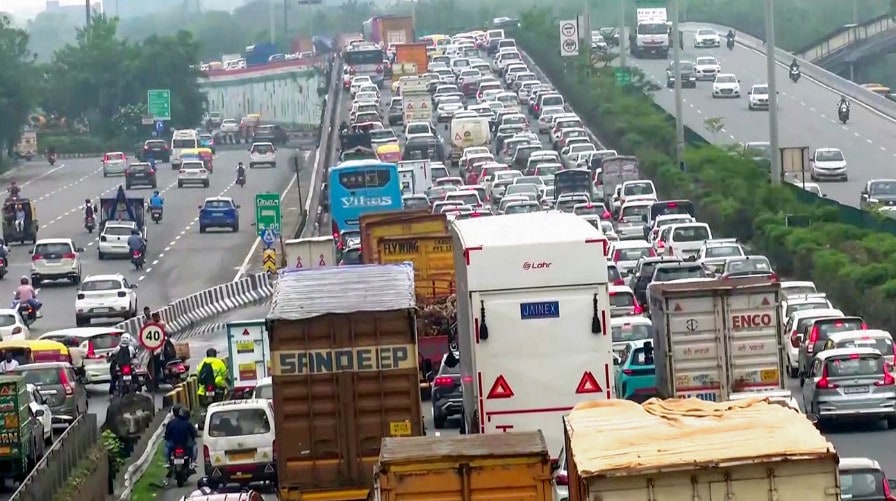
Photo Credit: ANI
Infrastructure Sinkhole: The July 2026 Crisis
The stark vulnerability of the city was exposed yet again on Tuesday, when a vital section of the National Highway-48 (NH-48) caved in near the Narsinghpur area. The sudden road collapse triggered a massive, grueling traffic gridlock spanning 8 to 10 kilometers, stretching all the way from IFFCO Chowk to Narsinghpur. The disaster forced the district administration and traffic police to rush to the scene and issue emergency route diversions for commuters traveling toward Jaipur.
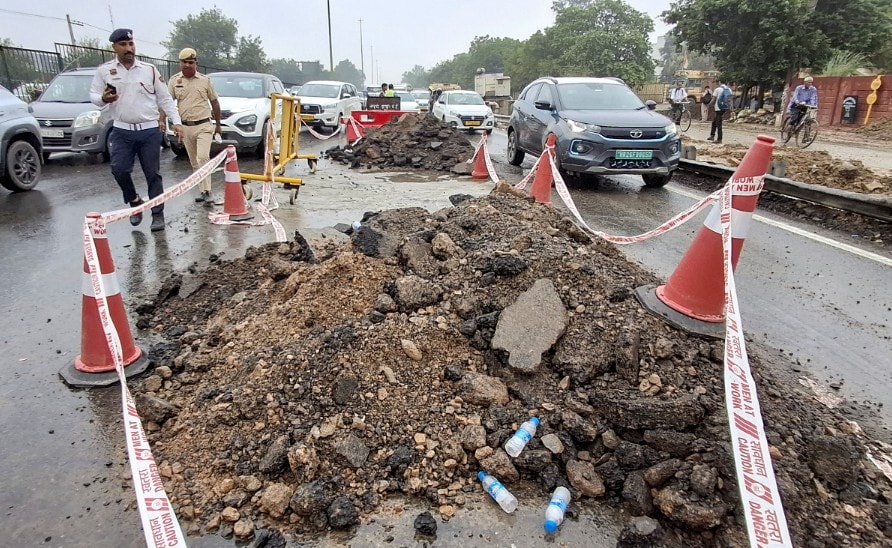
Police personnel inspect and secure the caved-in section of the Jaipur-bound carriageway on the Delhi-Gurugram Expressway (NH-48) near Narsinghpur
Photo Credit: ANI
This failure has reignited a critical question among taxpayers and corporate heads alike: Is public money being washed away?
Following the infamous 2016 multi-hour gridlock dubbed "Gurujam", which paralysed the city for nearly 20 hours, the Gurugram administration spent a whopping Rs 503 crore over nine years (up to 2025) strictly on revamping the city's drainage infrastructure.
Adding to the public fury is the apparent immediate failure of a brand-new Rs 105 crore infrastructure asset. The Gurugram Metropolitan Development Authority (GMDA) recently commissioned the 4.3-kilometer-long 'Leg-4' stormwater drain, which was operationalized at the onset of the Delhi-NCR monsoon. It was specifically engineered to alleviate the crippling pressure off the 'Badshahpur Drain'-the city's primary stormwater channel, which has long been blamed for flooding southern Gurugram.
Efficient Drainage in Action |📍Ardee City Chowk
— GMDA (@OfficialGMDA) July 9, 2026
Stormwater is being swiftly channelised through the water chutes near Gold Souq mall, ensuring quick runoff from the carriageway and preventing waterlogging along this key intersection. #GMDA #Gurugram #Sector6466… pic.twitter.com/S9XWkCXYBu
The Anatomy of Gridlock: Why Gurugram Strands Daily
According to surveys conducted by LocalCircles, urban commuting in Gurugram has become an exhausting trial. A 2023 survey revealed that a staggering 96% of daily commuters in Gurugram report spending "significantly more time in traffic" due to waterlogging, compared to 88% in Delhi and 66% in Noida. Furthermore, a 2024 LocalCircles study noted that 86% of residents felt severely impacted by recurrent waterlogging, while 62% expressed deep dissatisfaction with the municipal corporation's monsoon preparedness.
Delhi-NCR caught the grip of waterlogging and gridlock - NDTV's @aishvaryjain joins with ground details from Noida, and Saumya Jaiswal joins with ground details from Gurugram @divyawadhwa pic.twitter.com/c5Ppd0FgM0
— NDTV (@ndtv) July 9, 2026
The prime choke points experiencing regular inundation include:
Sohna Road
Subhash Chowk
Udyog Vihar
Golf Course Extension Road
Narsinghpur
Sector 10A and Sector 48
Root Causes of Traffic Congestion:
Inter-City Commuting Volume: Due to the heavy concentration of multinational offices and bustling retail markets, thousands of professionals commute daily between Delhi, Gurugram, and Noida.
Highway Bottlenecks: When sector roads submerge, the entire traffic volume is forced onto main arterial roads and national highways, overwhelming their capacity.
Squeezed Carriageways: Water accumulation along the curbs creates immediate bottlenecks. Drivers are forced to steer toward the center of the road to avoid deep waters, which decelerates traffic to a literal crawl.
Exit Clogs: Persistent flooding at major highway exits traps vehicles trying to disperse into inner sector roads, causing a backward ripple effect that stalls the main highway lines.
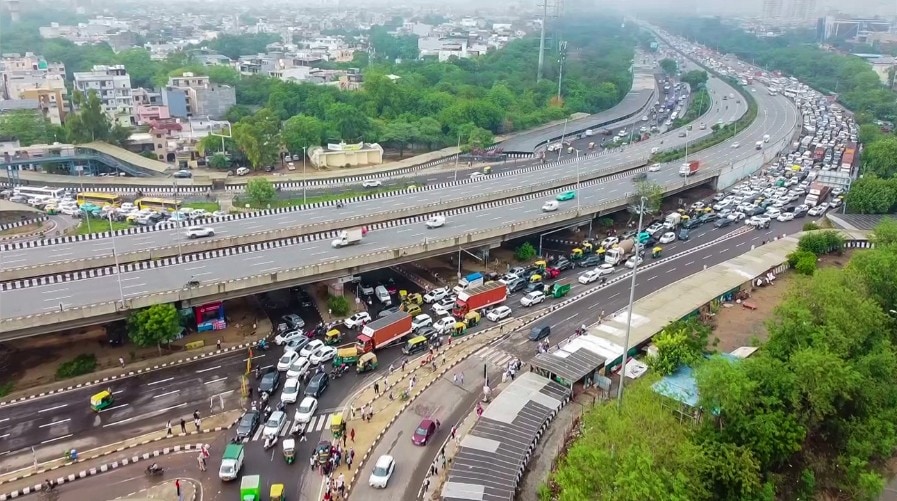
Photo Credit: ANI
The Science Behind the Submersion
The structural vulnerability of Gurugram is rooted in both flawed topography and systematic administrative failure:
Topographical Trap: The city is situated in a relatively low-lying bowl. When heavy downpours hit, stormwater rushes down rapidly from the surrounding Aravalli hills, converging upon the urban plains.
Inadequate Channel Capacity: This massive volume drains directly into the Badshahpur Drain. During intense rain spells, the peak volume easily breaches the drain's maximum carrying capacity, causing toxic overflows into main roads and residential sectors.
The Shortfall of Short-Term Fixes: Despite clear historical data and annual warnings, administrative bodies routinely fail to execute critical preemptive measures such as comprehensive desilting of major drains, repairing potholes, and deploying high-capacity automated pumps. For instance, in 2020, the Municipal Corporation of Gurugram identified 79 highly critical waterlogging hotspots and drafted remediation plans. However, execution relied heavily on temporary, reactionary band-aids-such as deploying tractor-mounted pumps after the roads had already flooded.
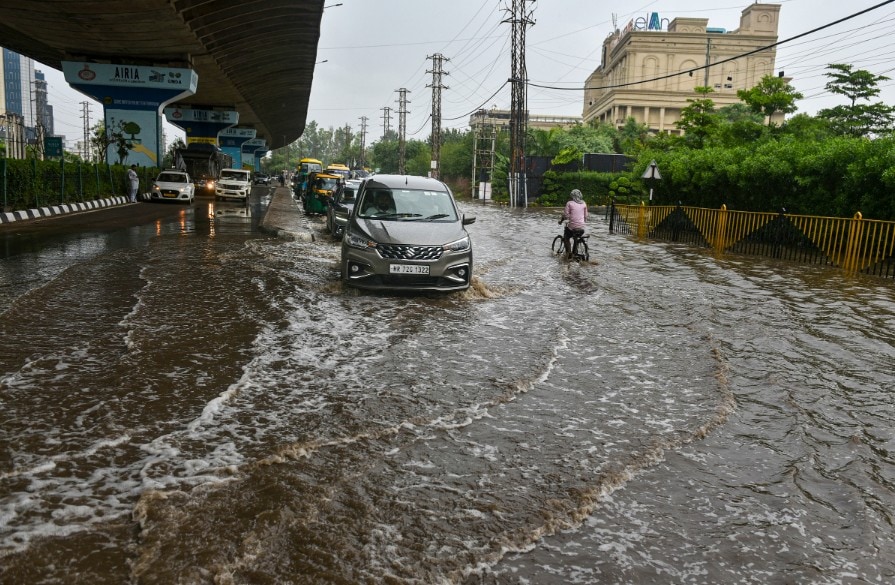
The Crippling Economic and Human Cost
The continuous systemic neglect of civic infrastructure directly inflicts severe financial and physical damage upon the city's ecosystem:
Corporate Disruptions: Repeated infrastructure failures routinely force major tech firms and multinational corporations to enforce emergency 'Work From Home' mandates, disrupting productivity.
Asset Damage & Financial Loss: Deep floodwaters severely damage thousands of private and commercial vehicles, leading to heavy insurance and repair costs.
Impact on Daily Wage Earners: Flooded streets directly wipe out the daily livelihood of auto-rickshaw drivers, cab operators, and local shopkeepers who rely on daily footfall and mobility.
Resource Wastage and Injuries: Idling engines in multi-kilometer traffic jams burn millions of liters of fuel unnecessarily, worsening urban pollution, while hidden potholes submerged under water lead to severe civilian injuries.
Gurugram's recurring monsoon crisis proves that a city cannot claim global status purely based on soaring glass skyscrapers, high-end corporate parks, and multi-crore luxury penthouses. Expanding physical roads alone will never solve this crisis. Until strict administrative policing is paired with a long-term civil engineering overhaul and a proactive drainage management system, the Millennium City will continue to drown in its own neglect.
Track Latest News Live on NDTV.com and get news updates from India and around the world

