





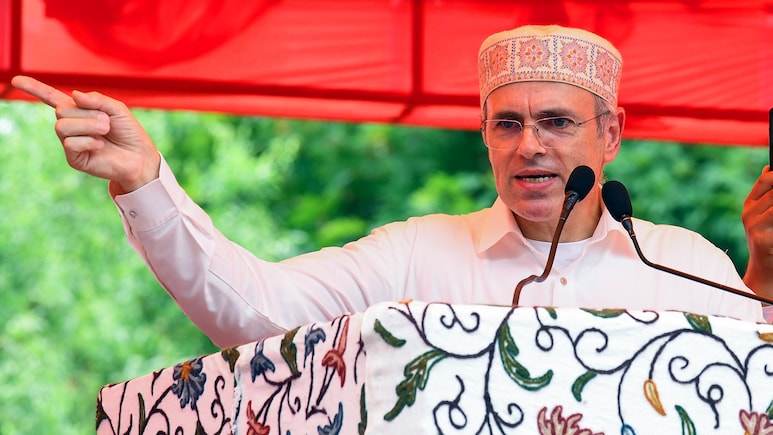
- Jammu and Kashmir LG administration denied Omar Abdullah access to martyrs graveyard today
- The graveyard area was sealed and declared a no-go zone by police in Srinagar
- July 13 public holiday and official functions at martyrs graveyard ended post-2019
Jammu and Kashmir Chief Minister Omar Abdullah today hit out at the Lieutenant Governor (LG) administration for denying him access to visit the martyrs' graveyard to pay homage to the martyrs of 1931. Abdullah alleged that the martyrdom of those who had fought against the British in Kashmir is being ignored only because they were Muslims, and the Maharaja under British paramountcy was a non-Muslim.
The area around Martyrs' Graveyard in downtown Srinagar was sealed today, and no one was allowed to enter the area after police declared it a no- go zone.
Then Abdullah, his ministers, MLAs and other party functionaries held a meeting to pay homage to martyrs at the national conference headquarters. Following the meeting, Abdullah lashed out at the LG administration for denying him access to visit the cemetery.
In the union territory of J&K, the Lt Governor retains sweeping powers on key matters, including law and order and police.
Abdullah, who has raised the political pitch over restoration of statehood to Jammu and Kashmir, termed the LG administration as " temporary guests".
"Those powers who denied us access to visit martyrs' graveyard are temporary guests. They are here today and wouldn't be here tomorrow. But the cemetery of martyrs will remain here forever. If not today, we will go there one day- pay floral tributes and offer prayers for the martyrs," said Abdullah.
Abdullah was put under house arrest last year and not allowed to visit the martyrs' graveyard on July 13. The next day, he visited the site after scaling the wall of the cemetery amid a showdown with the police. Abdullah had then termed the restriction on him as "the tyranny of the unelected".
"The martyrdom of these martyrs is being ignored only because they were Muslims and had risen against the maharaja, who was not a Muslim. But this fight was not for religion. It was a fight for principles, democracy and above all, it was a fight against the British for our freedom," said Abdullah.
"Today, we are being told that the fight against the British and playing a role in the freedom struggle of the country was wrong. We will accept it," he said.
Traditionally, July 13 used to be a public holiday in Jammu and Kashmir, and an official function would take place at the cemetery to pay homage to the martyrs of 1931 who had risen against the Dogra Maharaja under the British. However, ever since the abrogation of Article 370, ending J&K's special status in 2019, July 13 has been deleted as a public holiday, and instead of a gun salute to the martyrs by police, the area is sealed, and no official or unofficial function is allowed on this day.
Remembering July 13, 1931
July 13 marks a significant day in the history of Kashmir as 22 civilians were killed in a police firing outside the Central jail in Srinagar while protesting against Dogra ruler Hari Singh under British rule. The protesters were supporters of Abdul Qadeer, who was held in the Srinagar jail and had called on Kashmiris to rise against Hari Singh.
This triggered massive protests and forced the Maharaja and the British to constitute two separate commissions to look into the grievances of the Muslim community in the Valley, and eventually gave some political rights to the people. In 1934, the first Assembly polls in Jammu and Kashmir were held. These polls marked the beginning of the democratic process in Jammu and Kashmir after centuries of autocratic rule, even as the Maharaja retained sweeping powers on key matters.
What Has Changed Since 2019
Until 2019, a gun salute along with floral tributes was offered at the Martyrs' Graveyard on July 13 every year. Political leaders would pay tributes and hold public meetings in memory of those killed in 1931. But ever since the special status of Jammu and Kashmir was revoked in 2019, the administration has prohibited any function at the Martyrs' graveyard.
Since 2020, July 13 and December 5 - birth anniversary of former Jammu and Kashmir Prime Minister and Chief Minister Sheikh Abdullah - have been dropped as official holidays. Instead, the birth anniversary of Dogra ruler Hari Singh is now a public holiday in Jammu and Kashmir.
Track Latest News Live on NDTV.com and get news updates from India and around the world

