






- Tamil Nadu grants one year of paid maternity leave for third child amid low fertility concerns
- Southern states report fertility rates well below the replacement level, unlike northern India
- South India's annual births have declined over two decades, reducing its population growth share
Tamil Nadu Chief Minister Vijay's decision to grant women government employees one year of paid maternity leave for a third child has reignited a debate that would have seemed unusual a decade ago: are some Indian states now worried about having too few children rather than too many?
The move comes at a time when fertility rates across southern India have fallen sharply, raising concerns about ageing populations, future workforce shortages and even political representation.
The policy is also part of a broader shift visible across southern states. Andhra Pradesh Chief Minister N Chandrababu Naidu recently announced a new population policy that includes cash incentives of Rs 30,000 for a third child and Rs 40,000 for a fourth child.
South India's Fertility Rates Are Among The Lowest
The concern stems from rapidly declining fertility rates.
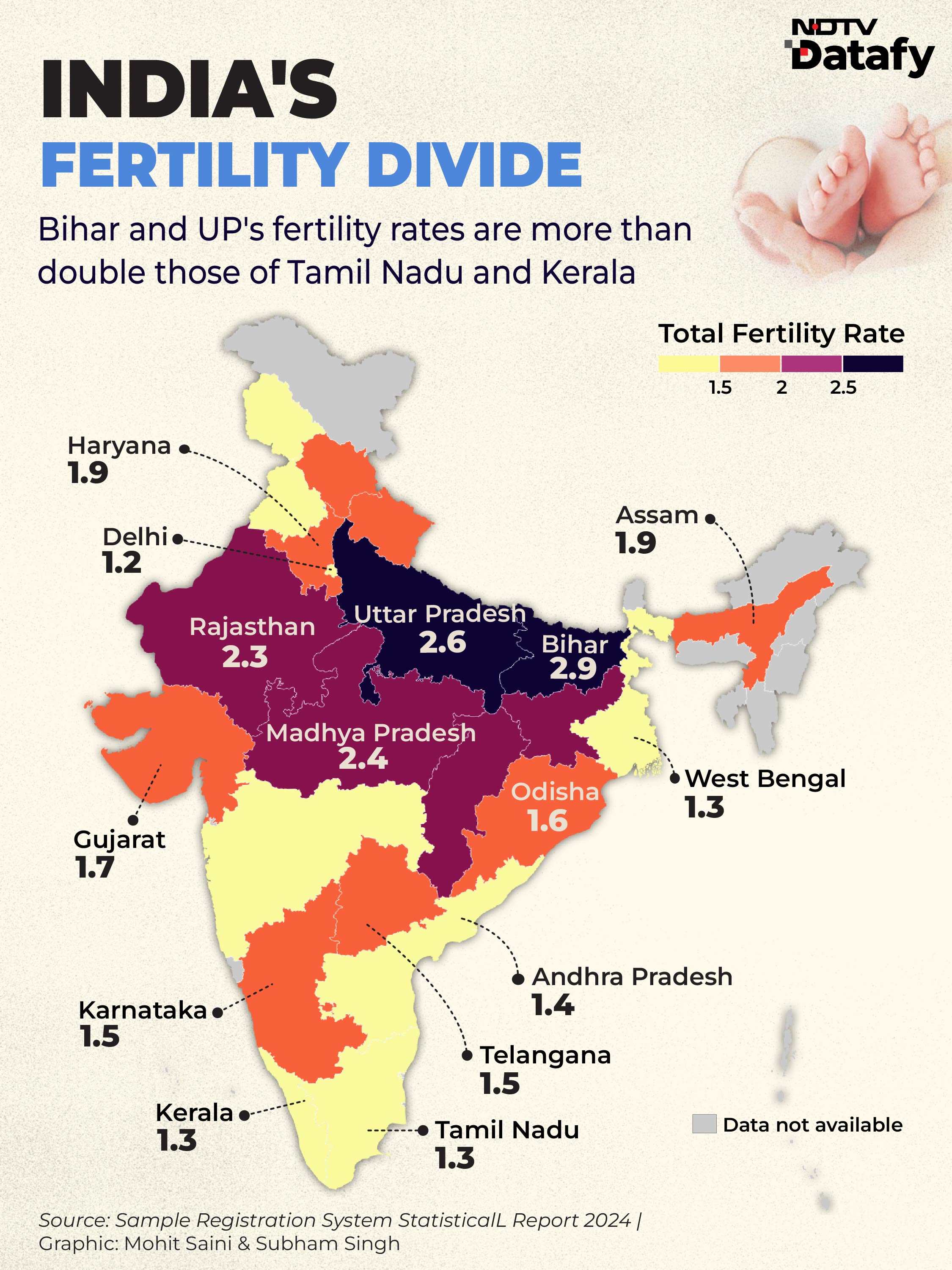
According to the Sample Registration System (SRS) Statistical Report 2024, Tamil Nadu's Total Fertility Rate (TFR) stood at 1.3 in 2024, well below the replacement level of 2.1 children per woman. Kerala also recorded a TFR of 1.3, while Andhra Pradesh stood at 1.4, Karnataka at 1.5 and Telangana at 1.5.
The contrast with northern and central India remains significant. Bihar recorded the highest fertility rate among major states at 2.9, followed by Uttar Pradesh at 2.6, Madhya Pradesh at 2.4 and Rajasthan at 2.3. India's overall fertility rate stood at 1.9 in 2024.
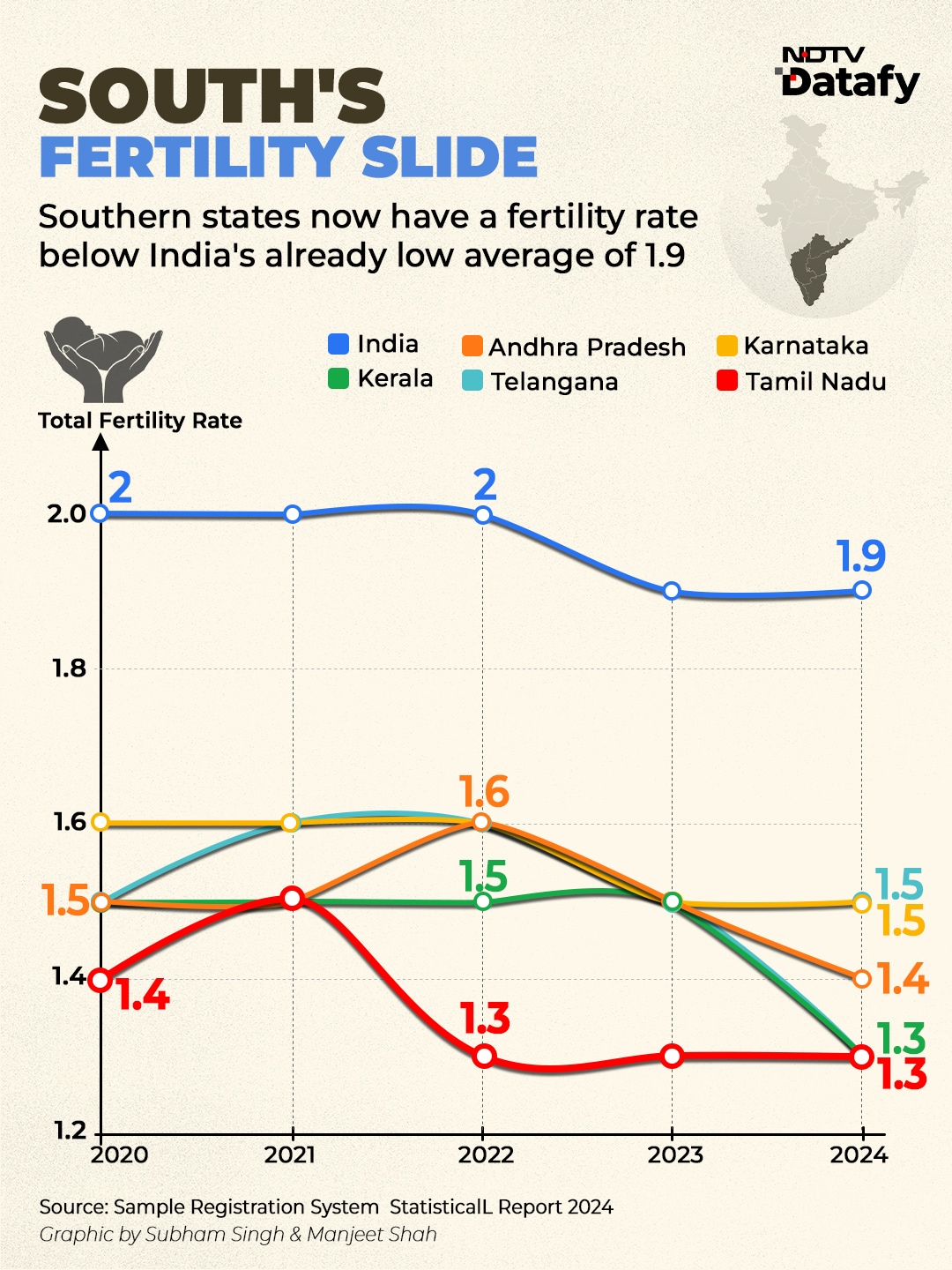
The trend has persisted for years. Between 2020 and 2024, fertility rates across southern states remained consistently below replacement levels. Kerala's TFR declined from 1.5 to 1.3 during the period, while Andhra Pradesh's fell from 1.5 to 1.4. Tamil Nadu remained in the 1.3 to 1.5 range throughout.
The data suggests that low fertility is no longer a short-term trend but an entrenched demographic reality.
Fewer Babies, Slower Population Growth
The impact is already visible in the number of babies being added each year.
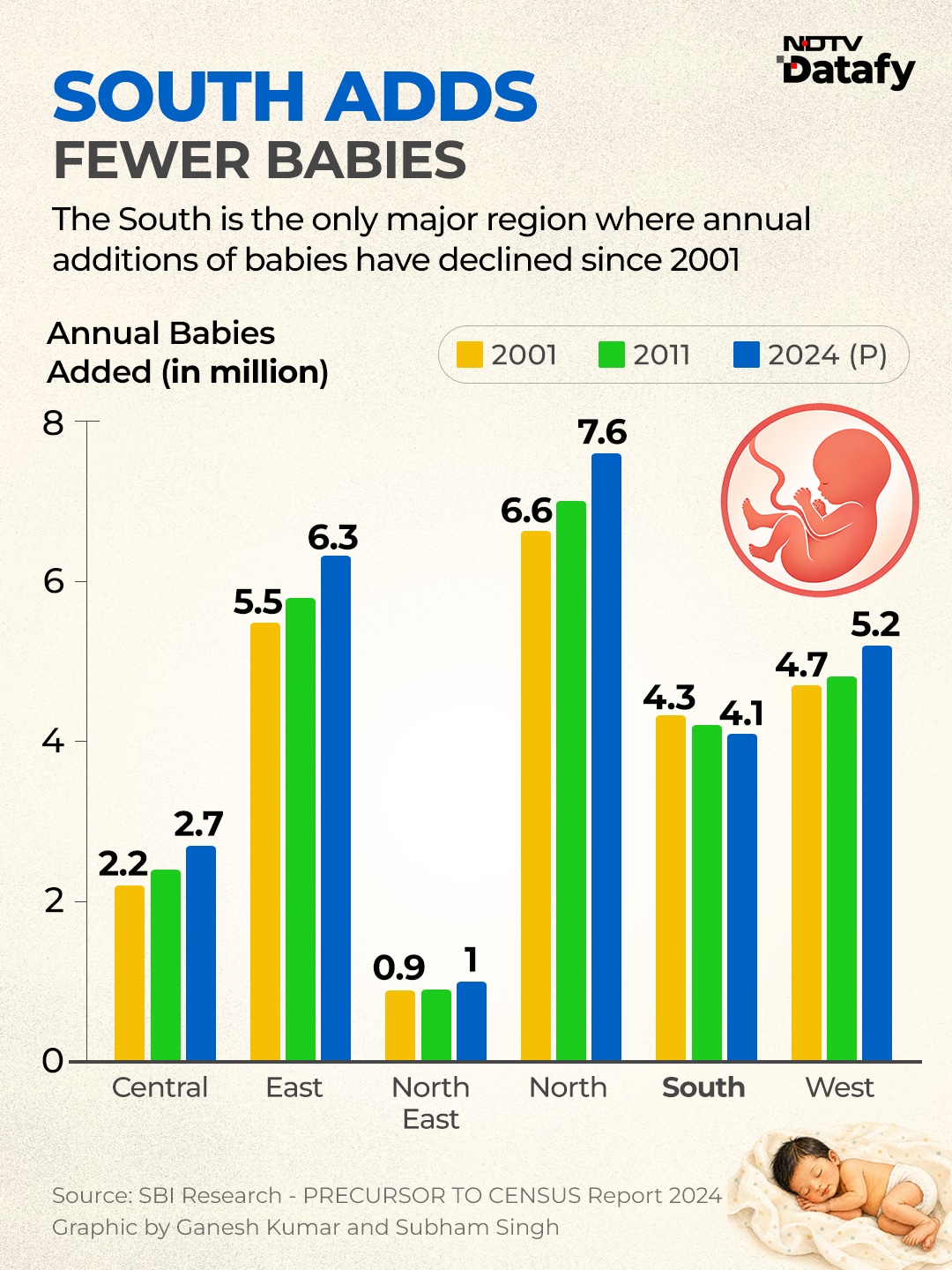
According to SBI Research's Precursor to Census report, South India is the only major region where annual additions of babies have declined over the past two decades. The region recorded 4.3 million births annually in 2001, falling to 4.2 million in 2011 and further to 4.1 million in 2024.
Meanwhile, North India's annual number of births increased from 6.6 million in 2001 to 7.6 million in 2024. East India also recorded an increase, rising from 5.5 million to 6.3 million during the same period.
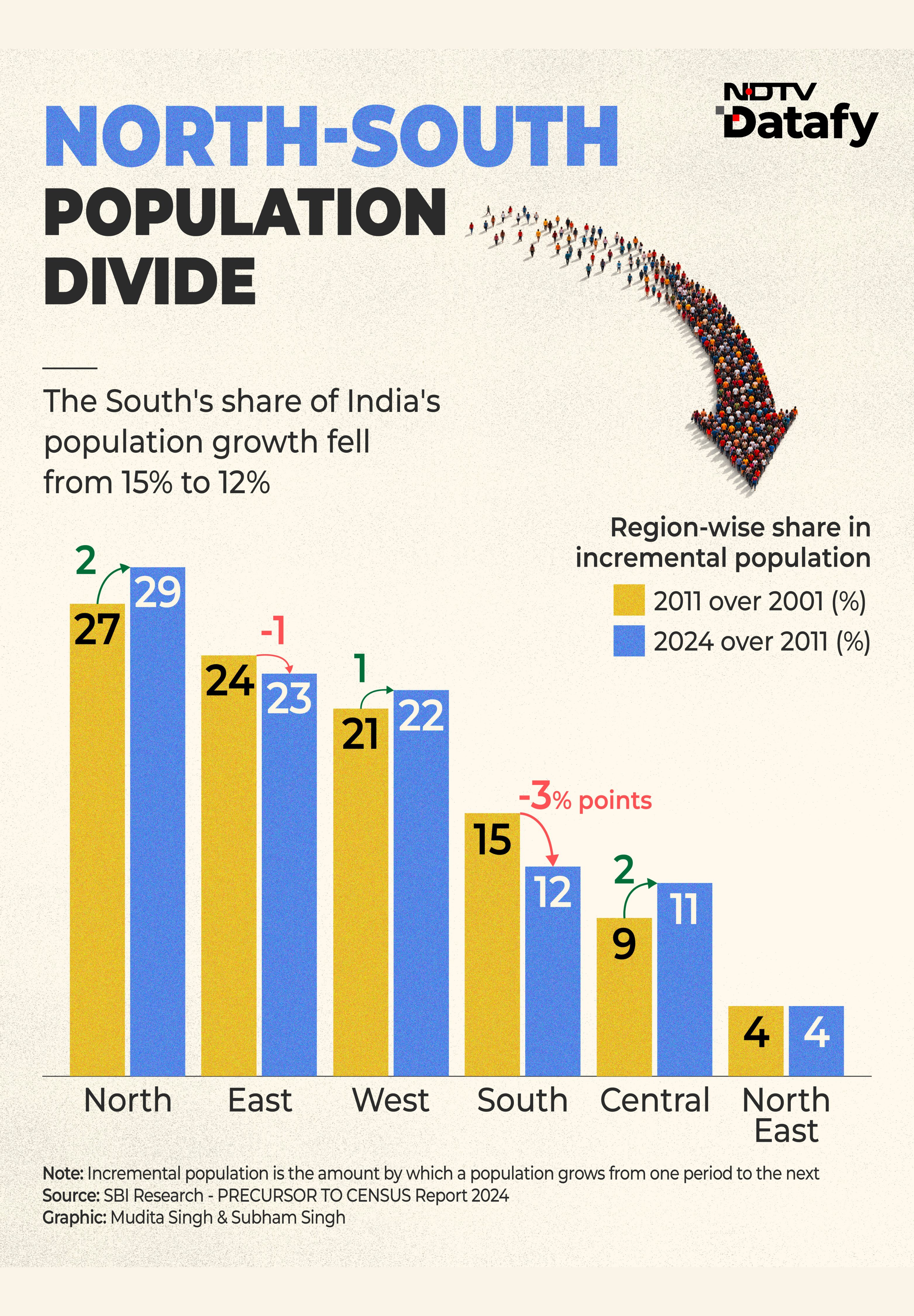
As a result, South India's contribution to India's population growth is shrinking. SBI Research estimates that the region's share of India's incremental population declined from 15 per cent during 2001-11 to 12 per cent during 2011-24. In contrast, North India's share increased from 27 per cent to 29 per cent.
The Delimitation Worry
This demographic shift has also fuelled concerns about the proposed delimitation exercise, under which Lok Sabha constituencies could eventually be redrawn based on population.
Southern states have long argued that they successfully controlled population growth through investments in education, healthcare and family planning.
The concern is that if parliamentary representation is redistributed largely on the basis of population, states with faster population growth could gain representation while low-fertility southern states could see their relative political influence decline.
The issue has therefore turned demographics into a political question, particularly for states that have spent decades bringing down fertility rates.
Even More Births Won't Solve The Immediate Problem
There is another challenge. Even if governments succeed in encouraging families to have more children today, the economic benefits will not arrive immediately. Newborns take nearly two decades to enter the workforce, while population ageing is accelerating now.
Data from the Ministry of Health and Family Welfare's population projections, reproduced in the India Ageing Report 2023, shows that Kerala's elderly population, defined as those aged 60 and above, is projected to rise from 16.5 per cent in 2021 to 22.8 per cent by 2036.
Tamil Nadu's elderly share is expected to increase from 13.7 per cent to 20.8 per cent, while Andhra Pradesh's could rise from 12.3 per cent to 19 per cent. Karnataka and Telangana are also projected to see sharp increases.
Nationally, the share of elderly people is expected to rise from 10.1 per cent to 15 per cent over the same period.
A New Demographic Reality
For southern states, the challenge is therefore becoming increasingly complex.
Fertility rates remain among the lowest in the country, population growth is slowing, the share of elderly citizens is rising, and concerns over future political representation are growing.
Tamil Nadu's maternity leave decision may have been framed as a welfare measure, but it also reflects a larger demographic reality: the population concerns of southern India are no longer centred on population explosion. They are increasingly about low fertility, ageing and what happens when today's smaller generations become tomorrow's workforce.
With inputs from Kashika Kashyap
Track Latest News Live on NDTV.com and get news updates from India and around the world

