



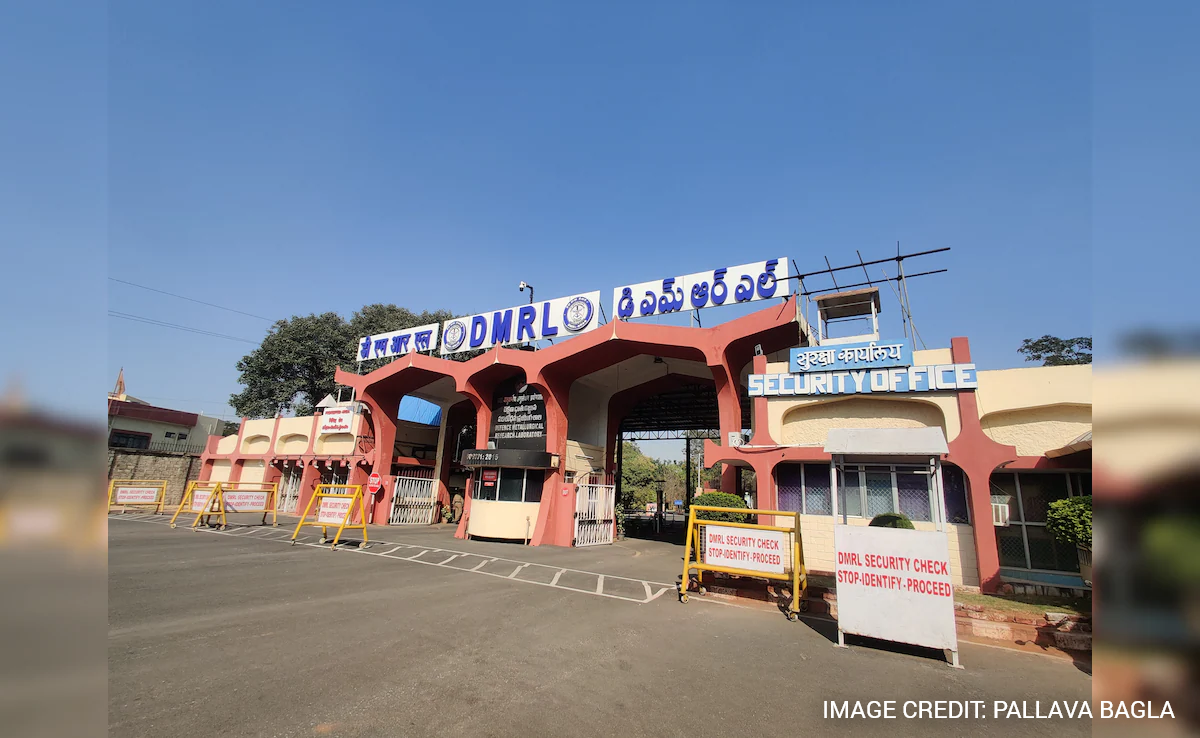
Battles are fought with guns, planes, tanks, missiles and drones, but they are sustained by metals that must endure heat, stress and shock long after the firing stops. This is an inside look at Defence Research and Development Organisation's (DRDO) leading materials science laboratory, where quiet decades of work underpinned the thundering success of Operation Sindoor.
From BrahMos missiles that struck Pakistani airfields to drones that dominated contested airspace, India's combat power ultimately rests on something far less visible but far more decisive: the strength, precision and reliability of indigenously developed Indian alloys and materials.
Life, as scientists like to remind us, is ultimately about materials. And nowhere does that truth become more unforgiving than in the world of defence. Weapons may dominate headlines, but it is materials, their strength, toughness, endurance and reliability, that determine whether those weapons perform when it matters most.
Image
Photo Credit: Pallava Bagla
Inside the seldom visited Defence Research and Development Organisation's frontline laboratory, the Defence Metallurgical Research Laboratory (DMRL) in Hyderabad, this reality plays out every day. Almost every major defence platform India fields today carries, in one form or another, a materials signature from this laboratory.
At DMRL, materials are not just substances; they are strategic assets. Speaking to NDTV inside the laboratory, Dr R Balamuralikrishnan, materials scientist and director at DMRL, put it simply: "Everything in this world, especially the world that we live in, is made of materials." What makes defence materials different, he explained, is that they are engineered to behave in very precise ways, to withstand enormous loads, extreme temperatures, repeated stress and hostile environments.
"The more complex things that you expect of the material in terms of its performance, the more difficult its design gets," he said. From concept to laboratory-scale development and finally to industrial production, materials technology is complex and takes years, often decades, to mature.
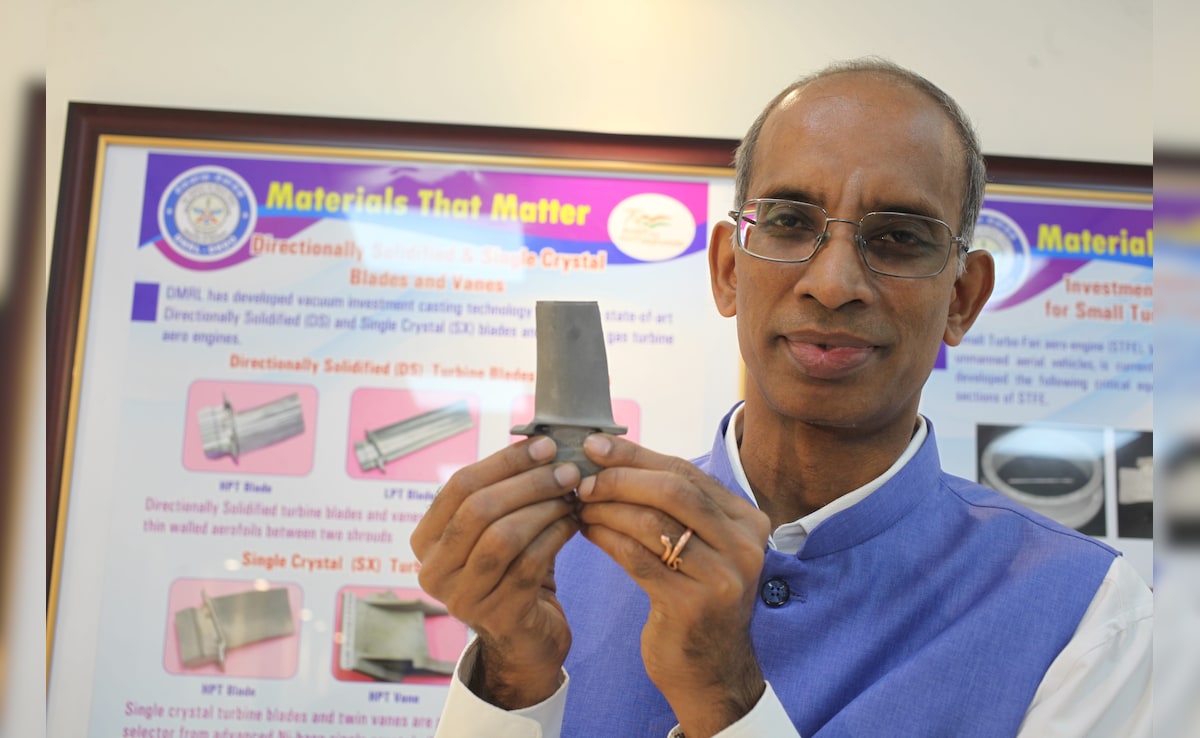
Photo Credit: Pallava Bagla
That long, patient arc of development is perhaps best illustrated by India's first indigenous aircraft carrier. The steel that forms the backbone of INS Vikrant did not emerge overnight. According to Dr Balamuralikrishnan, the story began more than 25 years ago, when DMRL was tasked with developing a steel suitable for an aircraft carrier, a platform that must combine immense strength with an often-conflicting property: impact toughness, especially at very low temperatures. "Strength is not difficult to get," he noted, "but impact toughness at low temperatures is."
The challenge was formidable. While the broad composition and properties of such naval steel were known internationally especially to Russians and other naval powers, the critical processing technology was not. That knowledge had to be developed painstakingly in Indian laboratories and then adapted to Indian industry. At the time, India's steel-making infrastructure lacked the high-end facilities available elsewhere. DMRL scientists had to tailor the technology to what was realistically possible within the country. It was an exercise in scientific ingenuity and compromise, not diluting performance, but achieving it through processes Indian industry could sustain.
The scale of the achievement becomes clear in numbers. INS Vikrant incorporates more than 20,000 tonnes of steel in its structure, with an additional 1,500 tonnes in the flight deck alone. These are not uniform materials. Metallurgically, they are different grades, one optimised for structural strength, another for the extreme demands of flight operations.
The flight deck steel, in particular, had to meet exceptionally tight specifications for surface finish and flatness to allow fighter aircraft to land and take off safely. Industry partners, both public and private, rose to the challenge, solving problem after problem during manufacture.
For DMRL scientists, the payoff came years later. The first steel for Vikrant was supplied around 2005-06. The carrier was launched in 2013 and finally commissioned in September 2022. Nearly two decades passed between laboratory development and operational deployment.
When Vikrant was deployed during Operation Sindoor, the satisfaction was profound. "Its mettle was demonstrated," Dr Balamuralikrishnan said. "The entire carrier battle group with many ships made of the same steel was there for everybody to see." For the scientists who had spent decades on a material few outside the field would ever notice, it was a quiet but deeply personal vindication.
Steel, however, is only one part of DMRL's materials universe. Ships demand mass and resilience; aircraft demand lightness without sacrificing strength. India's indigenous Light Combat Aircraft, Tejas, is a case in point. While composites dominate its structure, critical metallic components rely on advanced alloys, particularly nickel and titanium. Holding up a piece of titanium sponge, Dr Balamuralikrishnan traced its journey from raw material to flying aircraft, satellites and rockets.
Titanium alloys are prized in aerospace because of their exceptional strength-to-weight ratio. But titanium sponge, the essential feedstock for these alloys, is itself a strategic material. Over several decades, DMRL developed the technology to produce aeronautical-grade titanium sponge indigenously, making India only the seventh country in the world to master this capability. The technology was demonstrated at scale and then transferred to industry, enabling domestic production of titanium sponge that feeds India's aerospace programmes.
From sponge to ingot, from ingot to finished component, the process is complex. Titanium sponge is alloyed with other elements to produce materials such as Ti-6Al-4V, widely used in aircraft structures. Components originally made of steel have been redesigned in titanium, delivering weight savings of up to 40 to 45 percent.
Dr Balamuralikrishnan pointed out that the Aeronautical Development Agency has already identified multiple components for such replacement. These titanium parts are already being prepared for the Light Combat Aircraft Mark 2 0r LCA Mk-2 and other future platforms, including the Advanced Medium Combat Aircraft.
Yet, for all its successes in steel and titanium, DMRL acknowledges that the hardest materials challenge still lies ahead: hot end components of jet engines. If steel represents strength and titanium represents lightness, jet engines demand materials that can survive extreme heat.
Nickel-based super-alloys are central to this effort. In modern aero engines, components operate at temperatures that exceed the melting point of the alloy itself, made possible through coatings, internal cooling channels and advanced manufacturing.
Dr Balamuralikrishnan explained that many of these components are produced using the investment casting process, the "lost wax" technique. The method may sound ancient, and in principle it is the same process was used centuries ago to create Chola bronzes and iconic Nataraja statues.
But the resemblance ends there. Modern turbine blades are geometrically complex, with curves in multiple directions, ultra-thin sections, and internal cooling passages sometimes only fractions of a millimetre wide. Tolerances are measured in tens of microns. "This becomes an extremely complex technology to manufacture," he said.
At the heart of this complexity lies single-crystal technology. Grain boundaries in conventional metals are weak points at high temperatures. By eliminating them entirely, producing a component made of a single crystal, engineers dramatically improve creep resistance and durability.
Single-crystal turbine blades are among the most closely guarded technologies in the world. "The principles are easily known," Dr Balamuralikrishnan said, "but how do you engineer the technology... that is very closely guarded." A single blade failure can mean catastrophic loss of engine and aircraft, which is why mastery of this technology is so jealously protected. In fact General Electric which is to jointly make the GE 414 Jet Engine has not agreed to supply the know-how of the single crystal manufacturing of components.
Beyond aircraft and ships, DMRL's materials shield vehicles on the ground. Armour development has been part of the laboratory's mandate since the late 1970s. Early efforts focused on monolithic steel armour, thick steel plates designed to absorb and defeat incoming fire. As threats evolved, so did armour solutions. DMRL moved towards composite armour systems, combining layers of metal, ceramics and, in some cases, polymers to achieve higher levels of protection without excessive weight.
The Kanchan armour used on India's Arjun main battle tank is a product of this evolution. So are lighter add-on armour solutions developed for wheeled armoured platforms. These materials have not just been designed on paper; they have been fired upon and proven in tests, protecting the lives of those inside.
Missiles, too, depend on specialised materials. At the nose of a missile sits the radome, a component that must withstand intense aerodynamic heating while remaining transparent to electromagnetic waves so that guidance electronics can function. DMRL has developed ceramic radomes made from silica, already used on missiles such as Astra. Here again, the challenge is not strength alone, but the precise balance between mechanical integrity and electromagnetic transparency.
Listening to Dr Balamuralikrishnan, one message comes through clearly: materials are everywhere, and they are among the hardest technologies to master. "We live in a material world," he said, "and wherever advanced materials are needed... DMRL is not far behind."
Operation Sindoor showcased India's indigenous military capability in action. Missiles, ships and aircraft performed as designed. But behind that visible success lies a quieter story, one of alloys perfected over decades, of steels engineered to exacting standards, of materials technologies so critical that they are guarded as closely as the weapons themselves. At DRDO's Defence Metallurgical Research Laboratory, victory is forged long before a battle begins, in furnaces, laboratories and rolling mills, where India quite literally makes its strength in steel.
Track Latest News Live on NDTV.com and get news updates from India and around the world

