





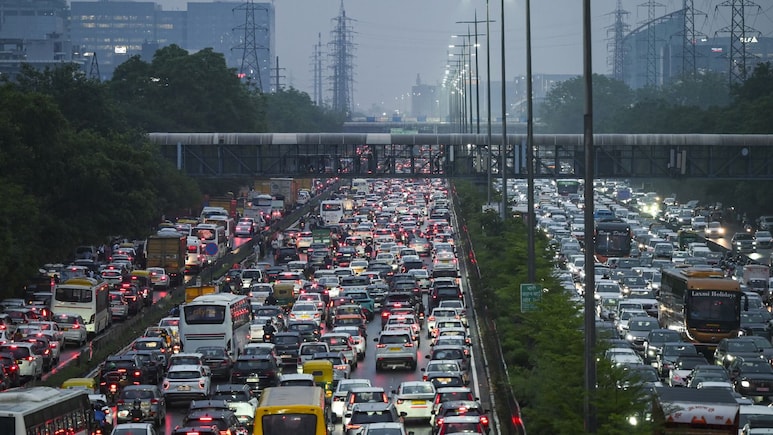
- The Economic Survey 2025-26 highlights traffic congestion as a major urban crisis in India
- Delhi workers lose up to Rs 25,900 annually due to traffic-related income penalties
- Bengaluru wastes about 7.07 lakh productive hours yearly
The Economic Survey 2025-26 highlighted a major urban crisis directly constraining India's structural potential: traffic congestion. Transportation functions decisively as a metropolitan area's bloodstream, spine, and muscles. It facilitates the fluid movement of people, commercial goods, and innovative ideas, thereby establishing spatial structure and supporting highly productive economic activity. When transportation networks are compromised or inadequate, the city's broader vitality systematically diminishes. Consequently, severe congestion, environmental pollution, noise, and stunted operational productivity emerge as defining symptoms of systemic urban decline.
Quantifying The Crisis: Insights From Recent Mobility Studies
Independent empirical evaluations present varying yet universally severe estimates regarding the productivity losses across key metropolitan centers resulting from traffic delays:
Individual Income Penalties (Delhi): A comprehensive report by the Centre for Science and Environment (CSE) on Delhi's gridlock stresses that an unskilled worker stands to lose between Rs 7,200 and Rs 19,600 per year due to congestion. This economic penalty intensifies across higher skill brackets: skilled workers forfeit between Rs 8,300 and Rs 23,800 annually, while highly skilled professionals bear an income erosion of Rs 9,000 to Rs 25,900 a year.
Wasted Economic Output (Bengaluru): A working paper released by the Institute for Social and Economic Change (ISEC) calculated that the accumulation of lost productive hours stemming directly from late arrivals amounted to roughly 7.07 lakh hours in 2018 for Bengaluru city alone. This translates to an isolated localised economic cost of approximately Rs 11.7 billion.
Macroeconomic Impact Summary (BCG Analysis): "India's four largest metropolises- Delhi, Mumbai, Bengaluru, and Kolkata collectively hemorrhage an estimated Rs 1.47 lakh crore every single year. This profound macro loss is driven entirely by congestion-related delays, wasted fuel, and lost human productivity."
Comparative Benchmarks: Global TomTom Tracking Data (2025)
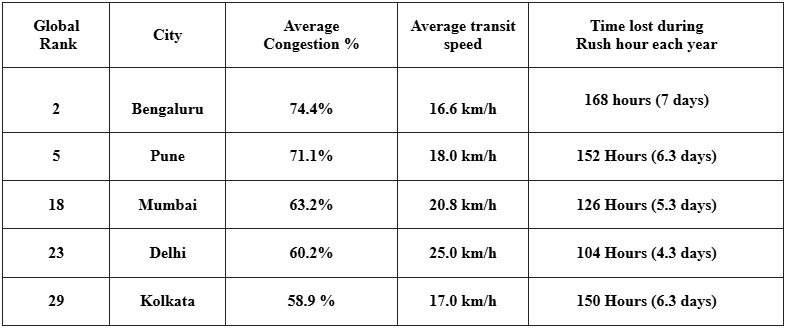
Analytical reports by the Netherlands-based location technology pioneer, TomTom, map out how Indian urban gridlock rates on the global stage. While Mexico City commands the absolute peak spot worldwide with an average congestion rate of 75.9 per cent and an average speed of 17.4 km/h, ten Indian cities feature prominently inside the global top 100 index.
Top 5 Indian Cities In Top 100 List:
Root Cause And Guiding Policy: Shifting Focus From Vehicles To People
Lasting, effective policy treatment requires a clinical diagnosis of the core structural failure: an aggressive, compounding dependence on private vehicles. The vital health signs of our cities are critically weak, primarily because public road space is treated as "storage for stagnant vehicles rather than dynamic corridors for moving citizens". Streets are gridlocked not because citizens are travelling for an excessive number of trips but because individual cars occupy disproportionate asphalt space while carrying far too few passengers. Experts point clearly to a fundamental guiding design principle: Cities must be designed to prioritise the fluid movement of people, not individual vehicles.
Track Latest News Live on NDTV.com and get news updates from India and around the world

