





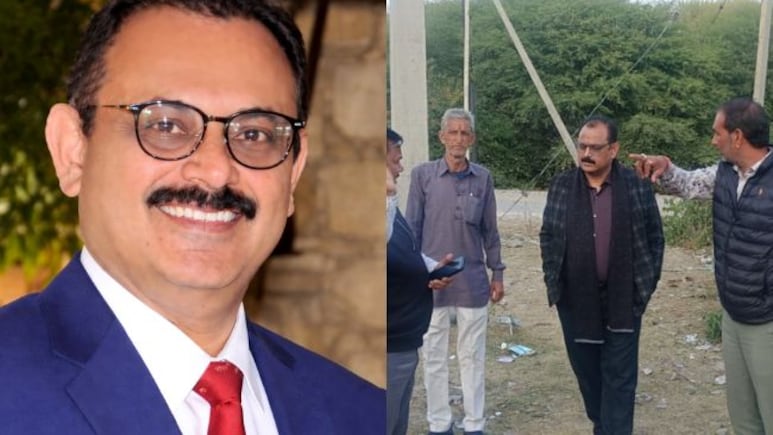
A district collector from Rajasthan's Rajsamand has decided to forgo his salary until the poor in his district are enrolled for benefits under three key poverty alleviation government schemes.
According to Arun Kumar Hasija, there are two ways to get work done. "Either I could have cracked the whip and pressurised my district officials to complete their task, or I could have motivated them to work. So I have taken this pledge to motivate them so we can finish and complete our enrollment work on time in the district," he told NDTV.
There are around 30,000 people in the Rajsamand district who fall under the poor category. These include mainly beneficiaries of the three schemes - First, those who receive free ration or wheat under the National Food Security Act, second, children who have lost parental support and are beneficiaries of the Palanhar Yojana, and thirdly, those who receive social security pensions like single women, widows and old people.
For many, government help in the form of these schemes is crucial for survival.
"If our salary is delayed by even 10 days, we face so many difficulties. Everyone's life cycle is linked to their income: Children's school fees, EMIs, credit card bills, and other expenses. I wanted my staff to understand what impact a 10-day delay in salary can have on life. But think about those poor people who receive only Rs 1,500 per month from the government. If that amount is delayed for three months just because of verification issues, it is nothing short of injustice," Hasija said.
The results of Hasija's move are beginning to show in just 48 hours. Of the 1,90,440 beneficiaries of the social security pension, 88 per cent have now been enrolled, while 1,67,688 and 22,752 are still pending, who need to get their verification done. Hasija hopes similar results will start coming in for the NFSA beneficiaries of free rations and the orphaned children under the Palanhaar Yojana.
"This pledge is mine alone. I do not want to impose it on anyone else. Until my officers complete this verification, I will not draw my January salary," he said, adding that officers have assured him the work will be completed by January 31.
But it's not the first time that the IAS officer has come up with an innovative way of getting a task done. When Hasija took to holding night chaupals in villages, he realised Rajsamand district was lagging in farmers' registrations under a central government scheme called the 'Agri Stack'. The district then organised a Farmers' Rights Registration Fortnight, in which district officials were asked to go to villages between 4 pm and 8 pm when farmers return home from their fields, meet them either at the village square, or in their homes or in temples where they congregate and begin registering them.
Hasija received a lot of flak for the beyond-duty-hours work concept, with the Patwar Sangh - a union of patwaris or revenue officials, also threatening to go on strike. But Hasija persuaded them. "I told them it will make your work easier in the long run and you will not have to keep doing endless surveys again and again, the agri stack is a way to put together a digital register of farmers with details of their land size, area, ownership and titles and it also links them to bank accounts through the Aadhar and a unique Farmer ID," he said.
Convinced the patwaris or village revenue officials got to work instead of asking farmers to come to the district offices to register, the patwaris fanned out into fields and village squares with their laptops, phones and tablets and registered farmers under agri stack on the spot. Some even took emitra technicians with them to help upload registrations and iron out on-field hiccups. In 15 days, 15,373 farmers had been registered on the Government of India portal.
Rajsamand district has over two farmers, of whom over a lakh have been registered.
"Once they are with Agri Stack, they receive Rs 6000 thrice a year directly in their bank accounts. There is no need for applications and endless rounds of offices; these are the benefits of registering farmers under Agri Stack. And the state also adds to the Kisan Nidhi disbursal, so it's a Rs 8000 payout each time directly in the farmers' account. Input subsidies given after a natural calamity also reach farmers directly now," Hasija said.
Complicated procedures for enrolment, making the trek to and doing rounds of government offices, combined with public apathy has led to a huge backlog in Rajasthan of enrolments and verifications under government schemes. Currently, Rajasthan is facing a major backlog in social security schemes. Around 2,036,000 people are not receiving the benefits of government schemes such as social security pensions, the Palanhar Scheme, and the Food Security Scheme due to the non-completion of annual verification. In Rajasthan, there are approximately 7,146,000 beneficiaries of social security pensions, and more than 40 million beneficiaries under the National Food Security Act (NFSA).
Track Latest News Live on NDTV.com and get news updates from India and around the world

