





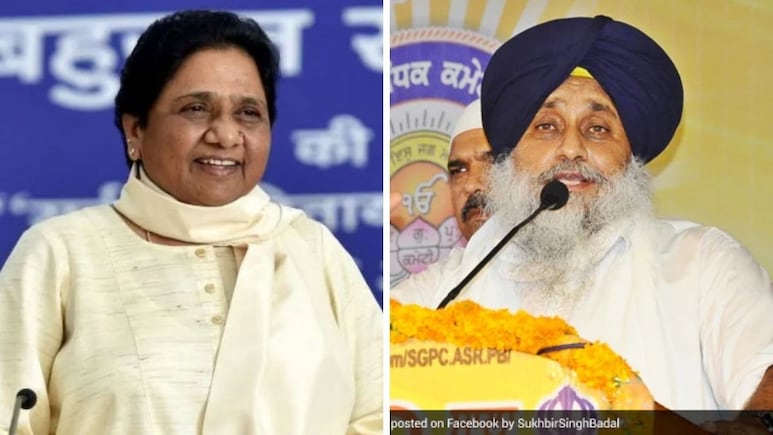
It's a double whammy for the troubled Shiromani Akali Dal (SAD). First, the BJP declined a poll alliance; now the Bahujan Samaj Party (BSP) has also decided to part ways and go solo in the Punjab battle.
The BSP supremo last week held a review meeting with senior party office-bearers from Punjab at the BSP Central Camp Office in Lucknow to discuss strategies to expand the party's voter base in the state. She made it clear that, much like in Uttar Pradesh and Uttarakhand, the BSP will contest elections in Punjab entirely "on its own strength" without entering into an electoral alliance with any other party.
She stated that past alliances had caused the party losses both in terms of seats and vote percentage, which ultimately "lowers the morale of party workers".
SAD and BSP were alliance partners in 2022 when the BSP contested 20 out of 117 Assembly constituencies - eight in Doaba, seven in Malwa and five in Majha. The BSP was able to win just one seat, from Nawanshahr.
Mayawati's decision to go solo could be a mere reminder to the Akali Dal, which was sending feelers to the BJP for re-stitching the alliance it broke in September 2020, or posturing to attract like-minded players.
Psephologists say BSP's exit removes one of the few remaining tactical bridges the Akali Dal still possessed to sections of Punjab's large Scheduled Caste electorate.
"In a state where Dalits constitute roughly 32 per cent of the population - the highest share in India - this rupture carries more weight than the BSP's modest statewide numbers might initially suggest. Despite its roots in Punjab, the party could not win the hearts of Dalit or Bahujan voters as it did in 1992," says Prof Gurmeet Singh, a Chandigarh-based psephologist.
From a vote share of 16.32 per cent in 1992, the BSP went down to 1.52 per cent in 2017, and only managed an improvement of 0.25 per cent in 2022 when it won the Nawanshahr seat.
So, will the Shiromani Akali Dal stand to lose Dalit votes as BSP goes solo in 2027? Analysts say 'not much', as BSP's current vote share is just 1.77 per cent, but the party can impact SAD's Dalit vote share in the Doaba region to some extent.
"BSP's vote share shows that it is no more a big player. For Shiromani Akali Dal, partnering with BJP was a better choice as its vote share is nearly 19 per cent. The BJP leadership may have avoided a poll alliance at this juncture but talks were on. The final decision, as the state leaders say, will be taken by the party high command," says Prof Gurmeet Singh.
However, no party in Punjab can polarise Dalit votes as they remain a scattered political force. Large sections have historically aligned with the Congress, while others have supported the SAD or, more recently, the Aam Aadmi Party. The BSP has remained a persistent but limited player.
The Rise, Fall, And Dilemma Of BSP In Punjab
Politically, the SAD preferred the BSP as an option. In 1997, the party broke with Mayawati'a party and joined hands with the BJP. They re-stitched a poll alliance with BSP in June 2021 after parting ways with BJP in 2020 over the three farm laws. But this renewed partnership lasted less than two years.
The political alliance between the Akali Dal and the BSP was first formed 30 years ago, in 1996, by late Parkash Singh Badal and BSP founder Kanshi Ram for the Lok Sabha elections. The alliance won 11 out of 13 seats in Punjab. Three of those 11 seats were won by the BSP.
The three seats won by BSP also included its founder late Kanshi Ram from Hoshiarpur. BSP fell to one seat in 1997, and its vote share dropped to 7.5 per cent after the SAD partnered with the BJP.
Punjab's Dalit politics is highly complicated and complex as communities are split by religion and region. Dalits in Doaba are more influential than their counterparts in Malwa, where they work as agricultural labourers.
"Punjab has India's highest Scheduled Caste share - 31.94 per cent - yet that number has never become a stable BSP vote. There are Mazhabi Sikhs and Balmikis who form one cluster; Ravidassias, Ramdasias and Ad-Dharmis form another. The party took root among the latter group in Doaba, not among Dalits as a whole," says senior journalist Rajinder Jadon.
BSP's decline followed three constraints: First, Punjab's Dalits are not one voting group. Different sub-castes back different parties, and Congress, SAD and others have long split that vote. Second, after Kanshi Ram, the BSP never built a strong Punjab leadership of its own. Lucknow ran the party. Able local leaders left for Congress, SAD and AAP. Third, bigger parties took away BSP's support base by offering welfare, putting up Dalit candidates, and working through deras.
As a result, BSP's vote share fell to 1.52 per cent in 2017 and 1.77 per cent in 2022.
"The junior-partner deal with SAD (20 seats) kept the BSP visible but organisationally frozen. Mayawati's solo turn admits that alliances rented the symbol and starved the cadre. Going it alone without money or a state face risks a further fall," says Rajinder Jadon.
The BSP's residual strength remains concentrated in Doaba, home to dense Ravidassia and Ad-Dharmi populations. Historical data show the party performed better in alliances than in isolation; solo runs have consistently fragmented its votes. The 2022 SAD-BSP tie-up delivered the BSP its only recent legislative seat and offered the Akalis a limited channel to Dalit votes.
Mayawati has now closed that channel, citing past losses in seats and vote share.
In a multi-cornered contest, even modest BSP numbers in Doaba can siphon votes the SAD can no longer consolidate or neutralise.
Mayawati's solo call is a setback for the Akalis more in symbolism than in seats. It closes a thin bridge to Doaba's Ravidassia and Ad-Dharmi voters. Yet BSP's 1.77 per cent statewide share means SAD does not lose a mass Dalit bloc; it loses a local tap in a few constituencies.
For Badal, the harder gap is still the BJP. For Mayawati, going it alone without a Punjab face may shrink an already small base further.

