





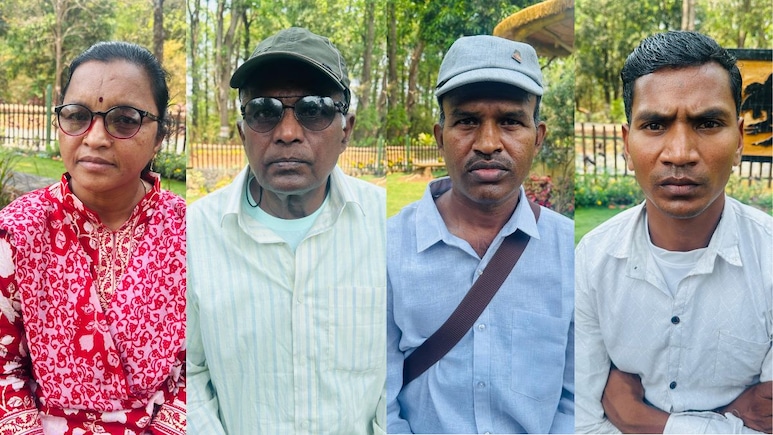
- The man, once known as the Maoist movement's most feared "bomb-maker", now speaks in a tone of reflection
- Rupesh and other cadres offer an unfiltered look into the rise and decline of one of India's insurgencies
- When asked why he surrendered, Rupesh states failure before the pressure of security forces
The man, once known as the Maoist movement's most feared "bomb-maker", now speaks in a tone of reflection not defiance. Takkallapalli Vasudeva Rao, alias Rupesh, a Central Committee member and one of the key architects behind Maoist explosives strategy, has surrendered along with 210 cadres.
For decades, his name was linked to some of the most high-profile attacks, including the 2000 attempt on former Andhra Pradesh Chief Minister N Chandrababu Naidu and the killings of Home Minister A Madhava Reddy and IPS officer Umesh Chandra.
Now on the other side of the conflict, Rupesh and other cadres offer a rare, unfiltered look into the rise and decline of one of India's longest-running insurgencies.
When asked why he surrendered, Rupesh states failure before the pressure of security forces. "We realised, both individually and as a party, that we failed to take the right decisions at the right time," he said. "Not just in strategy, but in our overall approach. We were unable to adapt to changing circumstances."
He admits that the movement had begun weakening long before the final phase. "Even when we still had strength, we could see the decline. We should have taken a different path at least 10 years ago," Rupesh said. "The idea of creating 'liberated zones' is no longer feasible. Society has changed."
He admits that the decline had been visible for years. "We were continuously weakening. The government assessed us correctly not just now, but earlier as well," he said. "There were assessments in 2011, 2013 and 2018. Across the country, the movement was facing setbacks. Looking at our own weaknesses and the changing situation, we had to take this decision."
He adds that even politically, the trajectory was clear. "Even in states like Chhattisgarh, after governments came to power and took decisive steps, the assessment became sharper. Our weakening was consistent."
For Rupesh, the final decision was not ideological, it was existential. "During operations in 2024-25, the pressure became so intense that we were left with no option," he said. "It came down to two choices - surrender or die. We chose survival."
He adds that the decision was also about saving lives. "We had to think about the lives of our comrades. Continuing would only mean more losses."
Rupesh offers a rare glimpse into how the Maoist structure functioned. "There is a dedicated military wing at the central level called CMC, and at the state level SMC," he explained. "Decisions are taken based on local assessments at district, sub-zone and operational levels."
On weapons, he dismantles several myths. "We did not rely on foreign sources," he said. "Most weapons were either seized from government forces or manufactured by us."
He describes a technical wing within the organisation that designed and produced improvised arms. "Many comrades educated themselves to understand weapons. We studied what the forces used and built what we needed," he said.
Rupesh insists that the movement was rooted in real issues but admits it lost its way. "The problems we raised still exist," he said. "But we failed to adopt the right approach. We do not have the support of the masses anymore."
On the question of civilian deaths and high-profile attacks, Rupesh's response is layered and conflicted. "There were incidents that should not have happened," he admitted. "The Jhiram Ghati incident...we have reviewed it internally. Such outcomes were wrong."
He acknowledges that government interventions and development efforts have made an impact. "The situation has changed. People are more aware now."
Another senior leader associated with the Darbha Committee, known as Chetu alias Shyam, reflects on the same incident. "Our objective was to target security forces. We later came to know political leaders were present. We concluded that targeting elderly leaders was wrong. We should express our condolences," he said.
"We had information that police personnel were moving under protection," he said. "Our objective under TCOC was to target the police and seize weapons. But later, we came to know that political leaders were also present. I was positioned at a distance and did not know at that moment," he added.
He admits to internal disagreement. "After review, we concluded that targeting elderly Congress leaders was wrong. There is internal contradiction on this," he said. "What happened to Mahendra Karma may have been seen differently, but what happened to others was wrong. We should express condolences...we should apologise."
He also reflects on other incidents, "What happened with the 'Shiksha Doots' should not have happened. That could have been resolved differently."
Rupesh said, "Even decisions taken under my command trouble me. In the course of conflict, things happened that we are deeply concerned about. Some decisions were mistakes." But he stopped short of a direct apology, reflecting the ideological divide that still remains.
Ranita, Secretary of the Maad Division, who surrendered alongside Rupesh, offers insight into why many joined the movement. "I joined at 15," she said. "I was being forced into marriage. I wanted a different life."
She claims that within the organisation, she did not face gender-based discrimination. "The reason so many women joined is because of the inequalities and pressures they faced in society," she said.
Other surrendered cadres point to deep-rooted social issues that fuelled recruitment. Bajirao, a Regional Committee Member from Gadchiroli, recalls discrimination and exploitation. "There were practices of untouchability, forced contributions...it created anger," he said.
Saroj Baghel from Kondagaon speaks of systemic neglect. "Our teacher came only once or twice a month. There was no proper education. That is how many of us got drawn in," he said.
On the future, Rupesh signals a shift but with caution. "We will work within the framework of the Constitution," he said. "But contesting elections is not feasible right now."
He also reveals that he has been appealing to other leaders to surrender. "It is better to take a rational decision. We need to come together and work for the people's issues," he said.
Rupesh also points to a gradual erosion of strength over the years. "We were weakening continuously. The government's assessment became more accurate over time," he said. "The setbacks began even during earlier governments, but we could not recognise the extent of damage then."
He confirms that the recent wave of surrenders is not isolated. "Others are also choosing this path. It is better to take a rational decision and move forward," he said.
A movement that once thrived on the promise of revolution now admits it failed to read the moment. One sentence from Rupesh captures the shift most starkly, "We should have chosen a different path when we still had the chance."
Rupesh strongly rejects allegations of extortion. "The claim that Naxals engage in extortion is absolutely false," he says. "If anything like that happens, it weakens the movement. We never compromised on that."
But he admits the larger failure. "We fought with whatever strength we had, but the government was stronger. Ultimately, we could not succeed."
Rupesh reveals he has been urging others to surrender. "For the past six months, I have been continuously appealing," he says. "There is no pressure. But given the situation, we had to take this decision."
He names top leaders. "Whether it is Ganapathi or Misir Besra...it is better that everyone takes a rational decision," he said. "We need to come together and decide what to do next. The real work is among the people their issues are what brought this movement this far."
Track Latest News Live on NDTV.com and get news updates from India and around the world

