





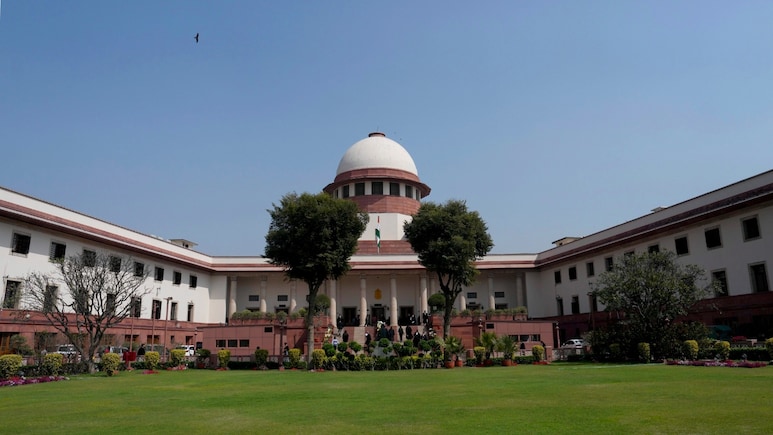
The Supreme Court has held that a physical relationship between two consenting unmarried adults cannot, by itself, be a ground to draw an adverse impression about a person's character, while setting aside the cancellation of a police constable candidate's selection in Telangana.
A bench of Justices Manmohan and Manoj Misra made the observation while hearing the case of a candidate whose provisional selection as a Stipendiary Cadet Trainee Police Constable was cancelled by the Telangana State Level Police Recruitment Board over a criminal case registered against him in 2014.
The case stemmed from allegations of sex on the false promise of marriage involving a woman known to the candidate. The matter was later settled before a Lok Adalat in 2015. The candidate had disclosed the case in his application form.
"Physical relationship between two consenting unmarried adults cannot and should not by itself be a ground to draw an adverse impression about the character of the person in that relationship. There is no law which prohibits two consenting unmarried adults to have a relationship of their choice," the court said.
The bench emphasised that not every relationship culminates in marriage and authorities must be sensitive to changing social realities.
"Not every relationship culminates in marriage. Therefore, merely because the relationship did not culminate in marriage is no ground to believe that one party has cheated the other," the judgment said.
The court also clarified that a compromise of a rape-on-promise-of-marriage case before a Lok Adalat does not amount to an admission of guilt. It said an employer cannot draw an adverse inference merely because a criminal case ended in a settlement, unless there is material to suggest that the compromise was forced upon the complainant.
The candidate's selection had initially been cancelled on the ground that the case reflected moral turpitude. A single judge of the Telangana High Court set aside the decision and directed reconsideration. After the board again cancelled the selection, the single judge once more ordered his appointment. However, a division bench reversed that order, prompting the candidate to approach the Supreme Court.
On the issue of pre-marital relationships, the top court observed that such relationships are increasingly common and that where a relationship between two adults spans a considerable period, there is a presumption of valid consent.
The bench noted that the candidate and the complainant were neighbours who had known each other for several years. It said there was no material on record to indicate the use of force, threats, or coercion to secure the compromise.
The court further observed that the allegation essentially related to cheating, where deception could only have been established through the complainant's testimony.
"Whether prosecutrix was deceived into entering a relationship, the prosecutrix alone could have disclosed. The public at large cannot tell whether she was deceived by the appellant," the bench said.
Since the complainant chose not to pursue the case and consented to its settlement, the recruitment board had no basis to infer that the candidate lacked the character required for police service, the court held.
The Supreme Court also laid down a broader principle for employers assessing candidates with concluded criminal cases. It said an adverse opinion can be formed only when there is material indicating that a crime was committed and evidence linking the candidate to the alleged offence.
Applying that standard, the bench found serious doubts about whether the offence of cheating had been committed at all, noting that the complainant had not pursued the allegations and no evidence was led to establish deception.
The court ultimately set aside the cancellation of the candidate's selection, ruling that the recruitment board's decision could not be sustained on the facts of the case.
Track Latest News Live on NDTV.com and get news updates from India and around the world

