





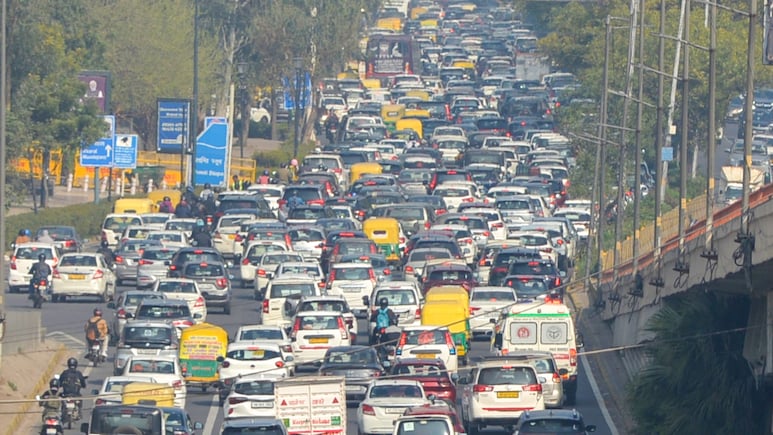
Disputes over minor issues on roads have become commonplace, but in recent times, the trivial act of 'honking' has taken a terrifyingly violent form that has shaken society to its core. Bone-chilling incidents emerging from various corners of the country prove that the rising decibels on our streets are no longer just an environmental hazard-they represent a profound social and mental health crisis.
Recent Flashpoints Of Honking Violence:
July 2026 (Ghaziabad): Late Sunday night, a minor dispute over honking a motorcycle horn escalated into a bloodbath in Ratiram Colony. 25-year-old Vipin Kumar was shot twice in the stomach and killed, while his cousin Gaurav was severely injured. Police arrested the accused woman and her father-in-law, while the main shooter is being pursued. July 2026 (Sehore): A minor altercation over blowing a horn reignited an old rivalry, turning into a deadly clash. The perpetrators brutally beat a youth with sticks, killing him on the spot. June 2026 (Balrampur): A trivial dispute over road-honking escalated into a brutal mob attack. A youth was cornered and assaulted with sticks and iron rods, leaving him critically injured. June 2026 (Guna): A Class 12 student was beaten to death by a group of individuals simply for honking on the road. February 2026 (Greater Noida West): A late-night altercation over honking at Amrapali Leisure Park Society turned violent. A group of youths in a car were brutally attacked with baseball bats and hockey sticks, fracturing a young man's skull and vandalizing the vehicle. February 2026 (Morbi): An attempt to overtake a car by honking led to a tragic outcome when two minors stabbed a youth to death. |
|---|
Traffic Honking: A Safety Tool Or A Psychological Malady?
Originally, vehicle horns were engineered as safety devices-to alert pedestrians of oncoming traffic, warn other motorists, or safely navigate blind curves. However, in today's Indian urban environment, continuous and habitual honking has seamlessly blended into daily life as an unavoidable nuisance. During traffic gridlocks, drivers habitually slam on their horns without any rational purpose, transforming streets into breeding grounds for sensory overload, high anxiety, and severe road rage.
Strict Decibel Standards And Regulations In India
The Ministry of Road Transport and Highways (MoRTH), under the Central Motor Vehicles Rules, 1989 (CMVR), mandates strict conformance to the Bureau of Indian Standards (BIS) for all vehicle horns:
- IS 1884: Specifies technical and component-level requirements for manufacturing automotive horns.
- IS 15796: Governs installation-level specifications and post-assembly acoustic levels on vehicles
Once installed, the Sound Pressure Level (SPL) of vehicle horns must strictly adhere to these ranges:
- 83 dB(A) to 112 dB(A): For 2-wheelers and 3-wheelers with engine power ≤ 7 kW
- 87 dB(A) to 112 dB(A): For tractors, 2-wheelers/3-wheelers > 7 kW, and all other motor vehicles
Medical And Scientific Warnings: Are We Driving Ourselves Deaf?
According to the National Institute for Occupational Safety and Health (NIOSH), prolonged exposure to sound levels at or above 85 dBA dramatically increases the risk of Noise-Induced Hearing Loss (NIHL)
Medical experts outline how rapidly high decibels can permanently damage auditory pathways:
| Sound Level (dBA) | Maximum Safe Exposure Duration |
| 85 dBA | A few hours of continuous exposure |
| 100 dBA | Only 14 minutes |
| 110 dBA | Just 2 minutes (immediate risk of permanent damage thereafter) |
Systemic Health Damages Of Noise Pollution:
- Permanent Hearing Loss: Sustained exposure to noise levels exceeding 90 dB can cause irreversible damage to the hair cells of the inner ear, culminating in complete deafness.
- Cardiovascular and Mental Well-being: Constant exposure to street noise causes chronic irritation, cognitive fatigue, elevated blood pressure, and spikes in blood cholesterol, paving the way for cardiovascular diseases.
- Childhood Impairment: Incessant high-frequency noise disrupts neurological pathways in developing children, impacting digestion, sleep quality, and baseline cognitive development.
Childhood Development Under The Siege Of Noise
Scientific literature unequivocally confirms that noise pollution severely impairs early childhood development and education-inflicting damage that can persist over a lifetime. Key studies indicate:
- Cognitive Performance: Elevated noise levels directly impair children's reading comprehension, concentration, and long-term memory retrieval.
- Lack of Motivation: Children raised or schooled in high-noise environments show a sharp decline in academic interest and problem-solving motivation.
- Hormonal Alterations: Prolonged exposure to loud decibels triggers excessive secretion of stress hormones like catecholamines, fostering aggressive behavioral tendencies from a very young age.
The Global Map: India's Noise Quotient
According to United Nations (UN) data released in 2022, Indian metropolitan centers consistently rank among the most noise-polluted cities globally. The average noise level on Delhi's roads hovers around 75 decibels, vastly exceeding the safe thresholds established by the World Health Organization (WHO). This acoustic onslaught most severely impacts children, the chronically ill, and senior citizens, forcing families to spend more on medical bills and bloating national healthcare expenditures.
Legal Penalties: How Much Does An Illegal Horn Cost In India?
The Motor Vehicles Act (MVA) lays down strict financial penalties for using illegal, high-decibel, or pressure horns on public roads:
- Using Pressure Horns (Section 39/192 MVA): Attracts a hefty fine of Rs 5,000 for the first offense and Rs 10,000 for subsequent offenses.
- Honking in 'No Honking' or 'Silence Zones' (Section 194F MVA): A penalty of Rs 1,000 for the first offense and Rs 2,000 for repeat offenses.
A Beacon of Hope: Aizawl (Mizoram) - India's Own 'No Honking City' While the deafening sound of horns seems endless in almost every Indian city, the capital of Mizoram, Aizawl, stands as an extraordinary exception. Renowned nationwide as the 'Silent City' or 'No-Honking City,' drivers here navigate heavy bumper-to-bumper traffic without ever touching their horns. There is no heavy-handed police presence enforcing this; it is completely voluntary, driven by deep-rooted civic discipline and mutual respect. Aizawl proves that with collective resolve, Indian streets can indeed become peaceful. |
How Do Developed Nations Regulate Vehicle Horns?
Developed nations implement incredibly stringent legal framework governing the use of horns, back-stopped by substantial financial liabilities:
- United Kingdom (UK): Under the Highway Code, honking on built-up roads (areas with streetlights and a 30 mph speed limit) between 11:30 PM and 7:00 AM is strictly prohibited, unless there is an immediate danger from another moving vehicle.
- Germany: The Road Traffic Regulation (StVO) dictates that acoustic warning signals can only be used under two circumstances: to warn of an imminent danger or as an overtaking signal outside built-up areas. Using it to express frustration is illegal.
- United States (USA): In most states, motor vehicle codes recognize the horn strictly as a safety warning device. Its use in non-emergency situations-such as venting frustration or demanding a driver move faster-is an infraction subject to heavy fines.
Cultivating Civic Conscience For Quiet Streets
The habit of unnecessary honking on our roads is not only degrading our hearing but also fueling high levels of aggression, transforming our streets into violent flashpoints. The recent tragedies in Ghaziabad is a wake-up call that we cannot rely solely on the state or law enforcement to fix our behavioral deficits. True change begins with us. We must use the horn only in absolute emergencies, practice patience behind the wheel, and strive to build a civilized, quiet, and empathetic traffic culture similar to Aizawl.
Track Latest News Live on NDTV.com and get news updates from India and around the world

