





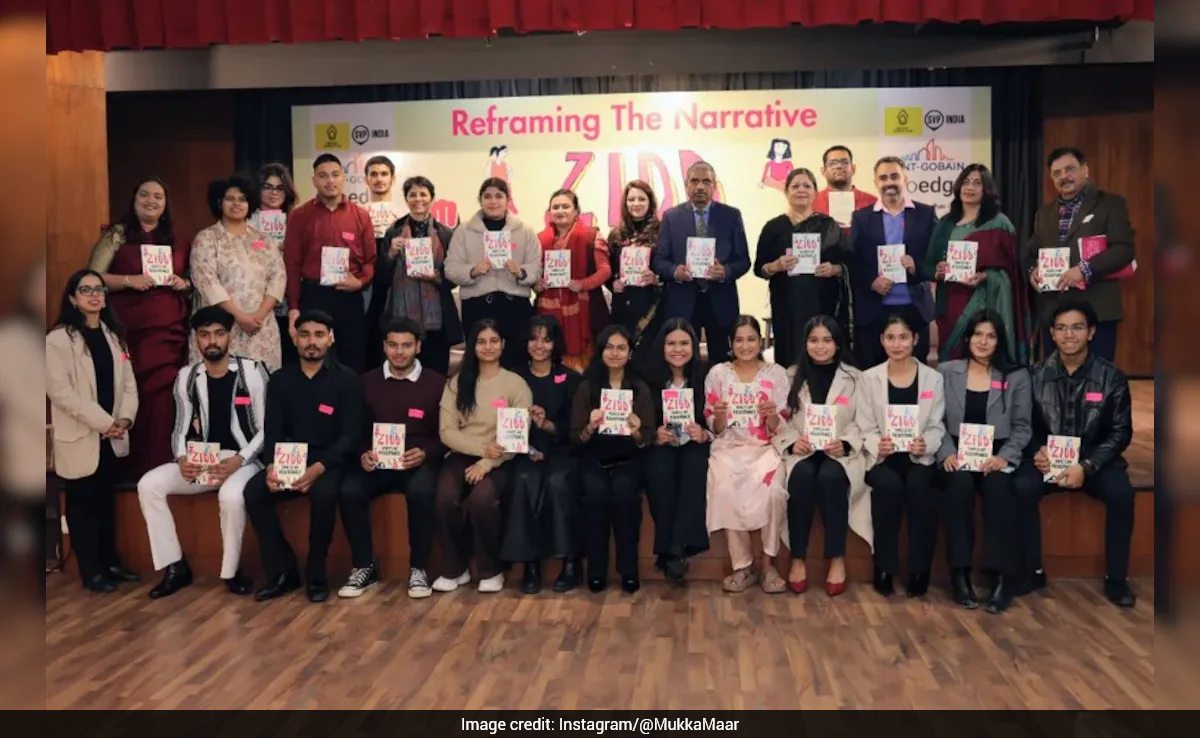
On National Girl Child Day, non-profit organisation MukkaMaar brought together senior representatives from the Delhi Government, Delhi Police and the child rights sector for a high-level panel discussion on girl safety and empowerment. Held on Saturday at the YMCA Auditorium in New Delhi, the event also saw the pre-launch of the book ZIDD: Voices of Resistance.
ZIDD places adolescent girls at the centre, featuring stories inspired by real-life experiences of resistance, questioning and everyday courage. The panel examined whether institutions and individuals are prepared to listen and respond when girls speak up about violence, with speakers reflecting on gaps between policy intent and lived realities.
“We need to lower our tolerance for violence,” said Ishita Sharma, founder and CEO of MukkaMaar. “We often only recognise penetrative assault, but girls need to feel supported to speak up about all forms of violence,” she said.
Founded in 2018, MukkaMaar works with adolescent girls to prevent gender-based violence through empowerment-based self-defence programmes. The organisation partners with government institutions and combines physical training with life skills, reaching over 50,000 students and adults across more than 100 schools in seven years.
“We need to redefine violence,” said IAS officer Rashmi Singh, Secretary of Department of Women and Child Development, GNCT of Delhi. “It cannot be limited only to physical harm. Mental and emotional violence are equally real and damaging,” she said, referring to MukkaMaar's approach to self-defence that goes beyond physical techniques.
Special Commissioner of Police Ajay Chaudhry said, “In the last 15 years of my service, I have heard thousands of such stories. Even after decades, we don't see enough change. Change can only come by increasing collective consciousness. After Nirbhaya, young people's protests led to fast-track courts and changes in law. If you don't challenge, you won't be heard. Bolna padega. (You have to speak up.) You cannot stay silent,” he said.
Atiya Bose, founding member of Aangan Trust, said, “We don't see safety as a public good; we see it as a private concern. We don't demand safety infrastructure the way we should. Safety is a fundamental right.”
Poonam Muttreja, Executive Director of the Population Foundation of India, called for stronger collaboration across sectors to shift social norms and build collective responsibility for girls' safety.
The session was moderated by Ravi Verma, Executive Director, International Centre for Research on Women (ICRW), Asia.
The event ended with a call to place girls' voices and lived experiences at the centre of policy and institutional action.
Track Latest News Live on NDTV.com and get news updates from India and around the world

