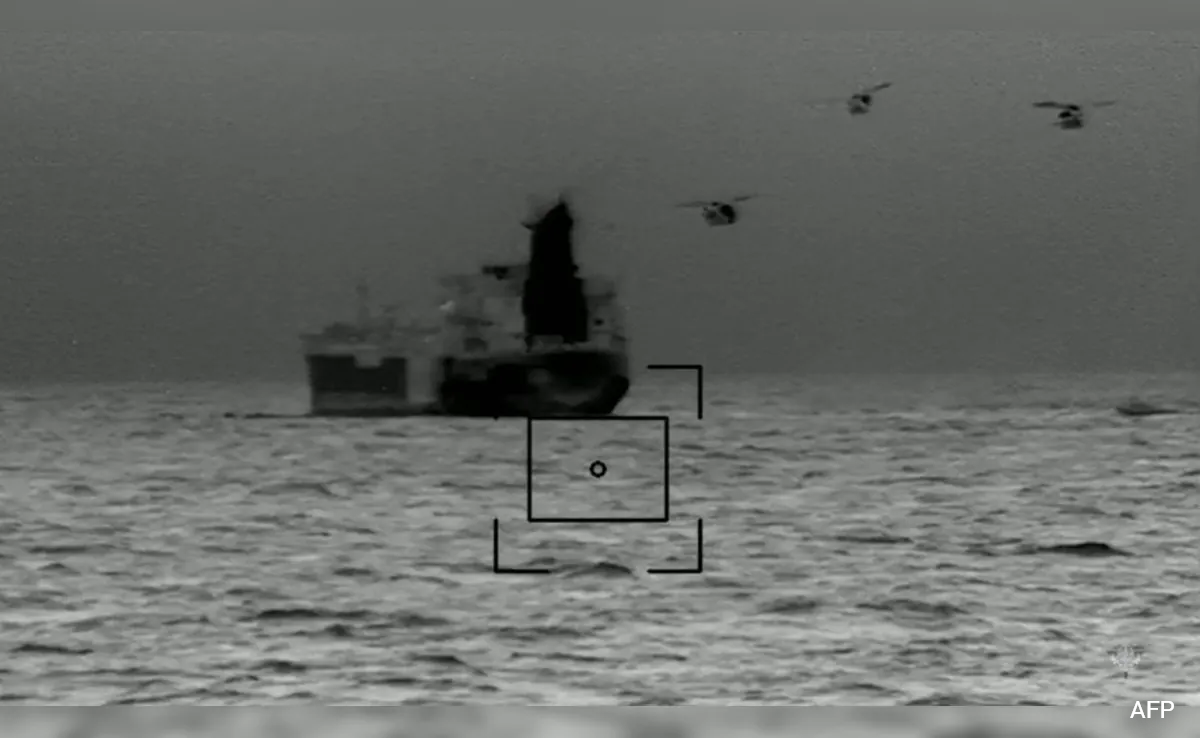
Supply chains remain disrupted, commodity prices have shot up and oil prices have crossed $100 a barrel as a war rages in the Middle East, particularly disrupting movement in the strategically critical Strait of Hormuz.
Though Iran recently said it does not intend to close the Strait of Hormuz, it has all but halted movement in the waterway with the stringent restrictions on the ships it is allowing to pass. Vessels not serving the interest of the United States and Israel can sail safely through the chokepoint through which 20 per cent of the world's oil moves from the Persian Gulf to the open seas. The oil being shipped out through the route has dropped by more than 90 per cent since the conflict began, per The Conversation.
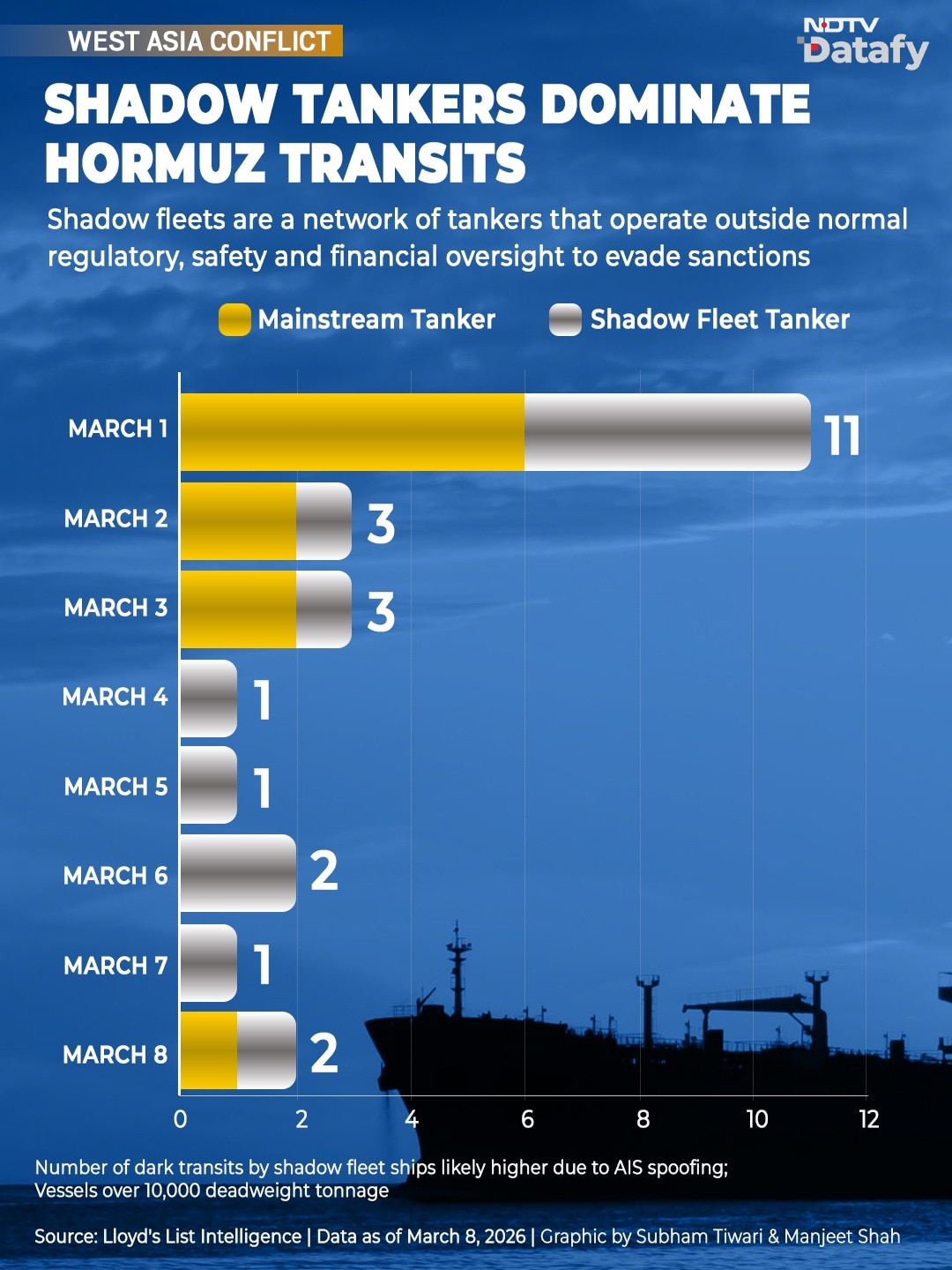
Enter: The Shadow Fleet
It operates with opaque ownership structures, lack of reliable insurance or safety certification cover, ship-to-ship transfers of commodities in international waters, spoofed location data and flags of countries with lower oversight.
Such ships lack the requirements of ocean-going commercial ships insurers or assessors of vessel seaworthiness. Other tactics include operating away from port control authorities and using fake ship identification numbers.
At least 19 commercial ships around the region had been damaged in the war as of Thursday, which explains why operators resort to these methods to continue operations in times of crises despite the red flags in terms of regulation.
Also Read | A Dark Night: India-Bound Oil Tanker's Daring Dash Through Strait Of Hormuz
According to maritime intelligence firm Windward, approximately 1,100 dark fleet vessels have been identified globally, representing roughly 17-18 per cent of all tankers carrying liquid cargo, which is primarily oil, according to The Associated Press.
Trust, Not Rules
In a world which has adopted GPS, electronic tracking and location-sensitive user apps, the sea is governed differently from the way land is. While rules are followed and enforced strictly on land, the system that governs the sea is largely voluntary.
Location: Destination signals are short notes or messages manually entered by a ship's crew into a vessel's transponder, a global positioning system locator, and broadcast publicly. They typically show the ship's identity, speed, position and intended next port and are usually intended to help with navigation safety, traffic awareness and port planning. Though the International Convention for the Safety of Life at Sea - signed by 167 countries - requires ships to leave transponders on, there is no physical mechanism that would prevent crews from turning one off. When the transponder is switched off, the ship simply disappears from a map and no global maritime authorities are alerted about it.
Nationality: The jurisdiction over a vessel is not a matter of law, with the nation whose flag the ship sails under not responsible for its operations. A ship's registration is a commercial transaction, which becomes a business decision for law-abiding companies. But then there are companies that want to skirt the rules. A ship owned by a shell company in Dubai can sail under the flag of Cameroon, Palau, Liberia or even land-locked Mongolia. Often the flag is chosen to belong to a country that may not have the resources or intent to conduct inspections. If under scrutiny, a ship can reregister under a different flag. This becomes even easier as some registries even offer online registration.
Opinion | The Real Winner Of Iran-Israel War Is Someone Trump Never Accounted For
Insurance: A mainstream insurance requires vessels to meet safety standards, carry proper documentation and comply with international trade sanctions. A lack of this and they cannot easily enter major ports or secure cargo contracts with reputed firms. To circumvent this requirement, companies have "unknown" insurance providers, non-existent entities that nobody know to how to reach in the event of an oil spill or collision. Less reputable ports and ship-to-ship oil transfer omits the need for a reliable insurance.
Laid together, these techniques facilitate smooth sailing of sanctioned oil or cargo even as regulations or crises hold up other vessels. an entity would simply need to purchase an ageing tanker, register it through a shell company, pay for a convenient flag to sail under, buy opaque insurance, switch off transponder when approaching sensitive waters, load sanctioned cargo ship-to-ship in the open ocean and deliver it to a buyer, no questions asked. If the vessel attracts attention, it changes its name, reregisters under a different flag and starts over.
Why A Broken System Works
In a normal situation, compliance is prudent as opting out is more costly than opting in. The tables turn when international sanctions come into effect, making these very regulations expensive and politically disastrous for some countries.
In the case of Iran, after sanctions were reimposed as part of negotiations over its nuclear development in 2018, the shadow fleet system moved oil.
Also Read | Why Iran-Israel War Will Lead To A Summer Of Chaotic Travel For Indians
Russia dramatically expanded that system in 2022 as restrictions hit in the wake of its invasion of Ukraine.
The China Advantage
Amid the maritime logjam, some commercial ships near or in the Strait of Hormuz and Persian Gulf have declared themselves as China-linked since the Iran war began, as their operators apparently try to reduce risks of being targeted in attacks.
At least eight vessels in or near the Persian Gulf and the Gulf of Oman changed their declared destination signals to short messages such as "CHINA OWNER" or "CHINA OWNER&CREW," according to data on the ship tracking platform MarineTraffic analyzed by The Associated Press.
Iran and affiliated groups have generally avoided targeting ships linked to China, given Beijing's relatively neutral stance and stronger economic ties with Iran.
Also Read | Why Is China Silent On Iran? An Expert Decodes Beijing's Hidden Play
During earlier Houthi attacks in the Red Sea, some vessels declared themselves or their crew as having links to China, which appeared as an effort to try to reduce risks of attacks from the Iranian-backed Houthis.
Environmental Risks
The shadow fleet may pose environmental risks, with poorly regulated, ageing tankers prone to spills, mechanical failures, and leaks, threatening marine ecosystems. In December 2014, Russian authorities worked to contain oil spilled in the Kerch Strait from two 50-year-old tankers that were damaged during a heavy weekend storm. The spill became one of the largest environmental disasters to affect the region in recent years, with clean-up operations lasting months.
Track Latest News Live on NDTV.com and get news updates from India and around the world


