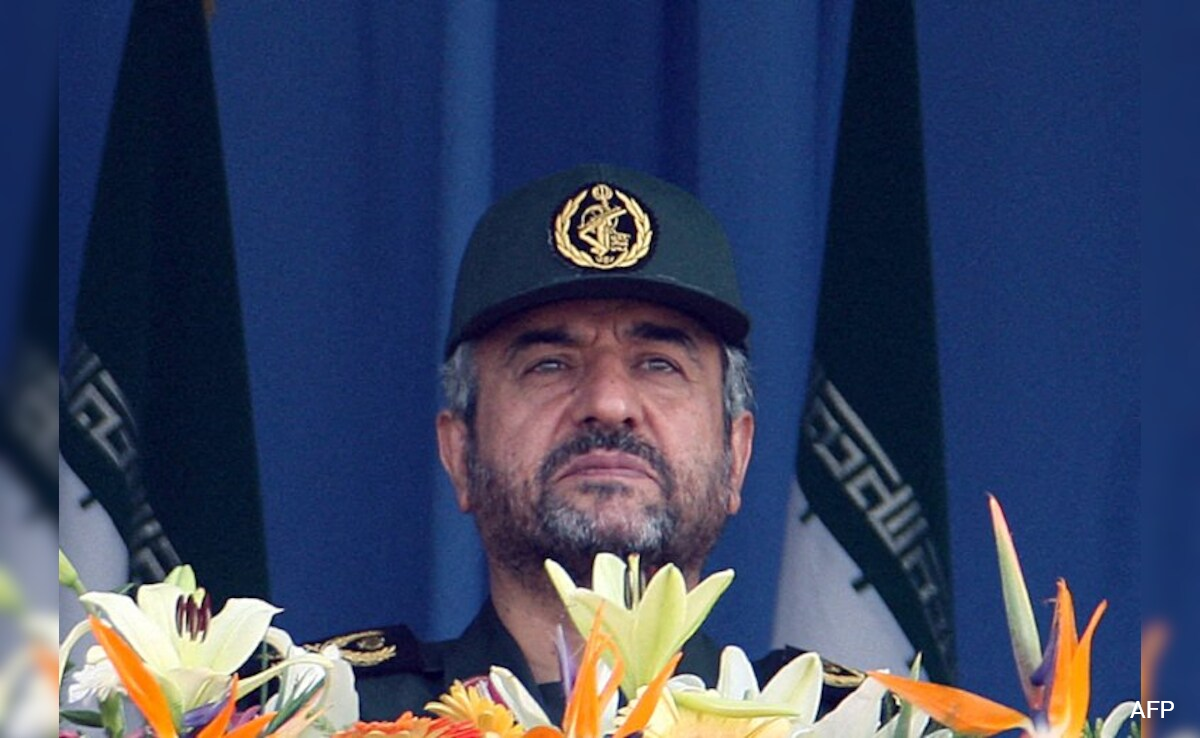
- Iran's Mosaic Defence doctrine enables continued fighting despite US-Israel air strikes
- Created by Major General Mohammad Ali Jafari during his IRGC leadership from 2007 to 2019
- Aims to prevent collapse from decapitation strikes and prolong conflict through local mobilization
When the United States and Israel launched the devastating air campaign on Iran under "Operation Epic Fury," Donald Trump expected a Venezuela-like regime change in Tehran. But nearly two weeks into the war, Iran's Islamic regime continues to fight back, mounting attacks across the Middle East despite several losses to its top leadership.
Experts believe the Islamic Republic's ability to continue the fight stems from its military's Mosaic Defence' doctrine, created years ago by Iranian strategist Mohammad Ali Jafari.
Iran's Foreign Minister Seyed Abbas Araghchi describes Iran's defence strategy as a "two-decade study" into "defeats of the US military to our immediate east and west."
"We've incorporated lessons accordingly. Bombings in our capital have no impact on our ability to conduct war. Decentralised Mosaic Defence enables us to decide when—and how—war will end," Araghchi has said days after Iran's Supreme Leader Ayatollah Ali Khamenei was killed in US-Israeli strikes.
Man Behind The Mosaic Defence'
Known as the architect of Iran's "Mosaic Defence", Major General Mohammad Ali Jafari is a former military officer who was the commander-in-chief of the Iranian Revolutionary Guard Corps (IRGC) from 2007 to 2019. He reportedly joined the IRGC in an intelligence unit operating in Iran's Kurdistan province after the Islamic Revolution and spent years reshaping Iran's military doctrine to ensure the country could continue fighting even after losing its top leadership.
Jafari reportedly fought in the Iran-Iraq War, which lasted from 1979 to 1989, and steadily rose through the ranks in the IRGC. In 1992, he took over as the overall commander of the Guards' ground forces and was also tasked to head Sarallah, an elite IRGC unit.
In 2005, Jafari was appointed the director of the IRGC's Centre for Strategic Studies and used his position to create Iran's Mosaic Doctrine, using lessons from the Iran-Iraq War and the invasion of Iraq by a US-led coalition in 2003, per a report by the US Institute of Peace.
Jafari was subsequently made the Commander-in-Chief of the IRGC in 2007 and used his tenure to implement the Mosaic Defence Doctrine, which is yet to be penetrated by the US and Israeli forces.
What Is Iran's Mosaic Defence?
Mosaic Defence is an Iranian military concept to organise the state's defensive structure into multiple regional and semi-independent layers instead of concentrating power in a single command chain that can be paralysed by a decapitation strike.
Under this model, the IRGC, the Basij, regular army units, missile forces, naval assets, and local command structures form parts of a distributed system. If one part is hit, others keep functioning, and if senior leaders are killed, the chain does not collapse.
The Islamic Revolutionary Guard Corps (IRGC) is organised into 31 provincial commands, and each provincial command functions as a self-contained military unit with its own weapons, intelligence, and command systems. If communications are severed from top leadership, the doctrine provides local units the authority and capacity to act on their own.
Dr Michael Connall, an expert on Iranian military culture, said the restructuring was designed to "make any attempt at degrading Iran's defence exceedingly difficult".
Two Central Aims Of Doctrine
The two central aims of Mosaic Defence were to ensure that Iran's command system was difficult to dismantle by force and to make the battlefield itself harder to resolve quickly by turning Iran into a layered arena of regular defence, irregular warfare, local mobilisation and long-term attrition.
Doctrine assumes that in a conflict with a stronger opponent, such as the United States or Israel, Iran may lose centralised control, but its regional units must remain operational and able to act independently.
Doctrine also relies on Iran-backed groups, collectively known as the "Axis of Resistance." In 2017, a Hezbollah operative arrested in the United States admitted he was part of a "sleeper cell" instructed to act if the United States went to war with Iran.
Why Iran Adopted the Model
The doctrine was shaped by the regional shocks that followed the US invasion of Afghanistan in 2001 and Iraq in 2003. The rapid collapse of Saddam Hussein's regime appears to have left a deep mark on Iranian strategic thinking, and Tehran decided to move towards diffusion rather than making its military more dependent on central control.
Track Latest News Live on NDTV.com and get news updates from India and around the world


