





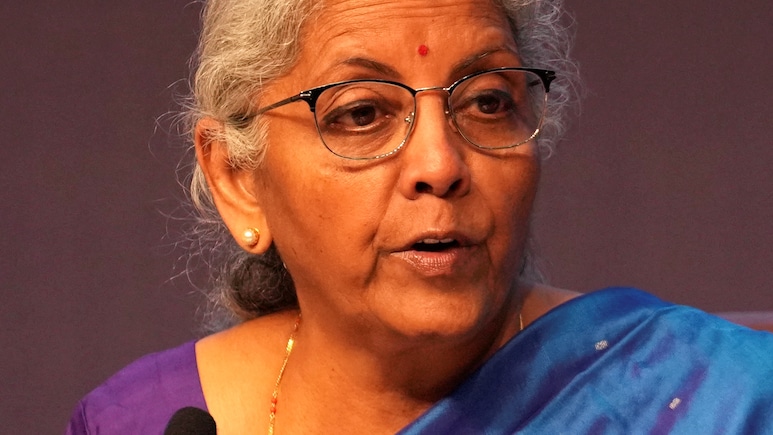
Union Finance Minister Nirmala Sitharaman on Thursday moved The Health Security se National Security Cess Bill, 2025 in Lok Sabha for consideration and passing in the Lok Sabha.
Speaking in the Lok Sabha, "I rise to move that the bill to augment the resources for meeting expenditure on national security and for public health and to levy assess for the said purposes on the machines installed or other processes undertaken by which specified goods are manufactured or produced and for matters connected therewith or incidental thereto."
Elaborating on the rationale behind the bill, Sitharaman further added, "A cess is being imposed because the GST system taxes consumption, and even today pan masala is taxed under GST at 28 per cent plus compensation cess. Since the compensation cess is going to end, that portion will shift into a 40 per cent cess. However, many types of pan masala still do not fall under the tax net because GST is applied on the basis of consumption. Under GST, there is no tax based on production capacity or output. That is why tobacco is taxed under GST and was also brought under excise duty recently."
"Excise taxes production. But pan masala cannot be taxed on production because it is not classified as an excisable product. So, while cigarettes were brought under excise duty and ideally pan masala should have been included too, it cannot be added because it is not in the excise category. Therefore, cigarettes now face excise duty--as they should, with more than 40% tax so they are not cheaply available--but pan masala cannot be taxed this way. Hence, through the new law, the government is imposing a production-based tax in the form of a cess," the Finance Minister said.
Sitharaman said the Bill is intended to create a dedicated predictable source of resources for two domains of national importance- health security and national security.
"Given the significant health burden generally for all governments, central and state that arise out of consumption of demerit goods like pan masala and the second domain pertains to National security needs sustained to keep pace with evolving security needs," she said.
She said that the cess will not be placed on any essential commodities but only on demerit goods, which are associated with significant health risks.
"We want to impose such a cost as a deterrent", the Union Minister said.
Congress MP from Haryana's Ambala Varun Chaudhury, while noting that the Bill is silent on sharing the cess pool with States, suggested that the Bill be referred to a Select Committee.
He noted that perhaps the name of a Bill is bilingual. The Bill can be in Hindi or English and need not be both, Chaudhury said.
The Health Security se National Security Cess Bill, 2025 was introduced in Lok Sabha on December 1, 2025.
The Bill proposes to levy a cess on the production of goods such as paan masala and any other goods that may be notified by the central government. Proceeds from the cess will be used for expenditure towards public health and national security.
Rates range from Rs 1.01 crore to Rs 25.47 crore per machine per month, with the government empowered to double them if required.
The Bill allows audits by senior officers and provides for the recovery of unpaid cess with interest and penalties.
Offences include undeclared production, non-payment, lack of registration, and tampering with seized goods, carrying penalties of at least Rs 10,000 or the evaded cess amount. Serious fraud cases over Rs 1 crore may lead to imprisonment of one to five years.
A three-tier appeals process is prescribed, and officers of Joint Commissioner rank or above may inspect, search, and seize goods or records where evasion is suspected.
The Bill aims to augment resources for meeting expenditure on national security and public health, and to levy a cess for the said purposes on machines installed and other processes undertaken for the manufacture or production of specified goods, and for matters connected therewith.
Earlier on Wednesday, the Lok Sabha passed the Bill aimed at increasing excise duty on tobacco products and their manufacturing after a discussion.
The Central Excise (Amendment) Bill, 2025, seeks to revise excise duties on tobacco and related products after the expiry of the GST compensation cess.
"This is not a new law. This is not an additional tax. This is not something that Centre is taking away," Sitharaman said in her reply to the discussion on the Bill.
She categorically said excise duty would be levied and not cess, clearing apprehensions of some members. "This is not a cess," she said.
The minister said that the revenue collected will go to the divisible pool and will be redistributed again (at 41 per cent) to the States. "Many members here made the comment that this is a cess. Excise is not a cess. Excise duty existed before GST. Compensation cess is reverting back to the Centre to be collected as Excise duty, which will be redistributed to the States at the 41 per cent allocated."
(Except for the headline, this story has not been edited by NDTV staff and is published from a syndicated feed.)
Track Latest News Live on NDTV.com and get news updates from India and around the world

