





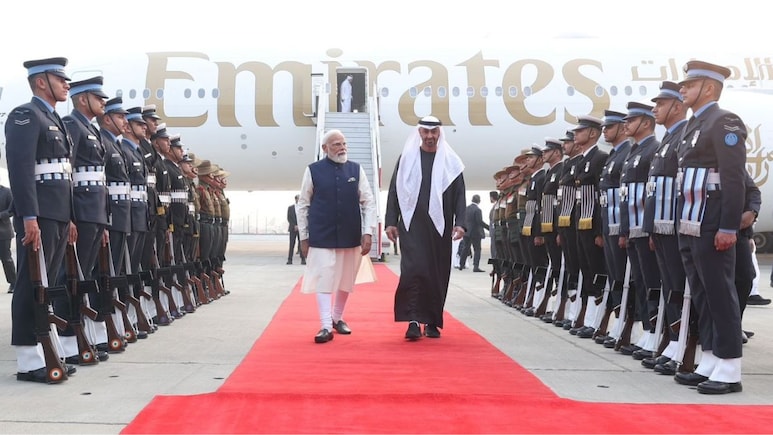
In the middle of one of the most turbulent phases the Middle East has seen in years, India and the United Arab Emirates on Monday sent a powerful signal of strategic stability, ambition and long-term convergence.
A brief but high-impact three-hour visit by UAE President Sheikh Mohamed bin Zayed Al Nahyan to the Indian capital culminated in a sweeping set of agreements and political understandings that together mark a new phase in one of India's most consequential partnerships in West Asia.
The visit, Sheikh Mohamed's fifth to India in a decade and his third as President, came against a volatile geopolitical backdrop: rising regional tensions, a visible Saudi-UAE divergence over Yemen, evolving Saudi-Pakistan military cooperation, continuing unrest in Iran, and renewed international focus on Gaza following former US President Donald Trump's controversial 20-point peace proposal, for whose proposed Peace Board Prime Minister Narendra Modi has been personally invited. It is in this context that the optics and substance of the India-UAE engagement assume deeper significance.
What unfolded in New Delhi was not merely a ceremonial exchange, but a carefully calibrated strategic conversation between two leaders who have, over the past decade, turned a traditionally strong relationship into a comprehensive strategic partnership with global implications.
A Partnership Anchored In Stability
In their talks, Prime Minister Modi and President Mohamed bin Zayed reviewed the full spectrum of bilateral cooperation and agreed that the India-UAE Comprehensive Strategic Partnership has not only matured but is now entering a more ambitious and multidimensional phase. The joint statement released after the meeting read like a blueprint for a long-term geopolitical and geo-economic alignment.
Perhaps the most politically consequential outcome was the decision to move towards a full-fledged Strategic Defence Partnership. A Letter of Intent was signed during the visit, paving the way for a Framework Agreement on Defence Cooperation. This comes on the heels of intensified military-to-military contacts, visits by service chiefs, and successful bilateral exercises involving the Army, Navy and Air Force.
Indian Foreign Secretary Vikram Misri was careful to stress that deeper defence cooperation with the UAE does not imply Indian involvement in regional conflicts. "There is a great deal of content in defence cooperation between India and UAE," he said, underlining that New Delhi's approach remains anchored in strategic autonomy and stability rather than bloc politics.
Still, in a region where alliances are being tested and recalibrated, the India-UAE defence understanding sends a clear message: both sides see each other as long-term strategic anchors rather than situational partners.
Trade, Investment And The $200 Billion Ambition
If defence is the strategic backbone of the relationship, economics is its muscle. Since the signing of the Comprehensive Economic Partnership Agreement (CEPA) in 2022, bilateral trade has surged, touching an impressive $100 billion in FY 2024-25. On Monday, the two leaders set an even more audacious target: doubling that figure to $200 billion by 2032.
To get there, both sides agreed to focus on connecting Micro, Small and Medium Enterprises (MSMEs) through flagship initiatives like Bharat Mart, the Virtual Trade Corridor and the Bharat-Africa Setu, positioning India and the UAE as joint gateways to markets across West Asia, Africa and Eurasia.
Investment cooperation also featured prominently. The leaders welcomed the impact of the Bilateral Investment Treaty signed in 2024 and discussed a potential UAE partnership in developing the Special Investment Region in Dholera, Gujarat - a mega project envisioned to include an international airport, ports, rail connectivity, energy infrastructure, and a smart urban township.
Prime Minister Modi also invited UAE sovereign wealth funds to participate in India's second National Investment and Infrastructure Fund, scheduled for launch in 2026.
The presence of DP World and First Abu Dhabi Bank in GIFT City was hailed as a sign of growing financial integration, turning India's emerging international financial hub into a bridge between Indian capital and Gulf and MENA markets.
Energy, Nuclear And The Long View
Energy security, a cornerstone of the relationship, received a major boost with the signing of a 10-year LNG supply agreement between HPCL and ADNOC Gas, ensuring the delivery of 0.5 million tonnes per year starting in 2028. The leaders also welcomed India's new SHANTI law, opening the door for deeper civil nuclear cooperation, including in large reactors and Small Modular Reactors (SMRs).
This is not merely transactional energy diplomacy. It reflects a shared long-term vision of building resilient, diversified and future-ready energy ecosystems at a time when global energy markets remain deeply unsettled.
It was a great pleasure to host my brother, His Highness Sheikh Mohamed bin Zayed Al Nahyan, at 7, Lok Kalyan Marg. I am deeply touched by his gesture of visiting Delhi this evening. We discussed a wide range of issues aimed at further strengthening the multifaceted India-UAE... pic.twitter.com/yzXAt7Mx43
— Narendra Modi (@narendramodi) January 19, 2026
From Space To AI: A High-Tech Partnership
One of the most forward-looking aspects of the joint statement was the emphasis on emerging technologies. India and the UAE agreed to deepen cooperation in space, including working towards a joint initiative aimed at commercialising space technologies and enabling joint missions.
Even more striking was the decision to strengthen collaboration in artificial intelligence, supercomputing and data infrastructure. The two sides will explore setting up a supercomputing cluster and data centres in India, and even the possibility of establishing "Digital Embassies" under mutually recognised sovereignty arrangements - a concept that reflects how far the partnership has moved into the digital and strategic future.
President Mohamed bin Zayed also expressed support for India's AI Impact Summit, to be hosted in February 2026.
A United Stand Against Terrorism
In language that was both firm and unambiguous, the two leaders reiterated their "unequivocal condemnation of terrorism in all its forms and manifestations, including cross-border terrorism." They agreed that no country should provide safe haven to those who finance, plan or carry out terrorist acts and pledged to continue close cooperation within the FATF framework.
In an era where terrorism remains a persistent instrument of geopolitical disruption, this alignment is as much political as it is strategic.
Culture, Education And People-To-People Ties
Beyond hard geopolitics and economics, the visit also reinforced the civilisational and human dimension of the relationship. The UAE's decision to provide artefacts for India's National Maritime Heritage Complex at Lothal, and the agreement to establish a "House of India" in Abu Dhabi, were presented as enduring symbols of cultural friendship.
Education, too, is emerging as a major pillar, with IIT Delhi and IIM Ahmedabad already operating campuses in the UAE, and new plans to integrate India's Digilocker with UAE platforms to ease recognition of academic credentials.
The Bigger Geopolitical Picture
The leaders also exchanged views on regional and global issues, reaffirmed support for the India-Middle East-Europe Economic Corridor (IMEC), and pledged mutual backing in multilateral forums, including UAE support for India's BRICS Chairmanship in 2026 and India's support for the UAE-hosted UN Water Conference later this year.
In a Middle East marked by flux, uncertainty and realignment, the optics of Sheikh Mohamed bin Zayed flying in for a three-hour visit to New Delhi and the sheer breadth of what was agreed speak volumes.
This was not just diplomacy, it was a strategic statement: that even as the region around them grows more unpredictable, India and the UAE are choosing to invest in each other as pillars of stability, growth and long-term order.
As one senior official put it privately, "This is not about managing today's crisis. It is about shaping the next twenty years." And in today's West Asia, that may be the most powerful signal of all.
Track Latest News Live on NDTV.com and get news updates from India and around the world

