





Fifty-six former judges, including those who served in the Supreme Court, have issued a statement in support of Justice GR Swaminathan, the Madras High Court judge who ruled on the Thirupparankundram Subramaniaswamy temple case and whom the opposition now wants impeached.
The 56 judges expressed "serious exception" to the impeachment motion.
They called it a "brazen attempt to browbeat judges who do not fall in line with ideological and political expectations of a particular section of society". If this is allowed to continue, the judges warned, "it will cut at the very roots of our democracy and the independence of the judiciary".
"Even if the reasons mentioned by the signatory Member(s) of Parliament are taken at face value, they are wholly inadequate to justify resorting to such a rare, exceptional and serious constitutional measure as impeachment."
The judges also referenced the Emergency issued by former Prime Minister Indira Gandhi in 1975 – a topic the ruling Bharatiya Janata Party frequently uses to attack the Congress.
"It may be recalled that even during the dark period of the Emergency, the then-government adopted various mechanisms including supersessions to penalise judges who refused to 'toe the line'," the judges said, pointing to three notable judgements, including the 1973 Kesavananda Bharati case that established the 'basic structure doctrine' limiting Parliament's power to amend the Constitution of India.
These are "sobering reminders of how political overreach can damage judicial independence".
The ex-judges also complained of attempts to "defame" senior members when passing decisions not favourable to "certain political interests", referencing three ex-Chief Justices of India – Deepak Mishra, Ranjan Gogoi, SA Bobde, DY Chandrachud, and the current, Surya Kant.
"The very purpose of the impeachment mechanism is to uphold the integrity of the judiciary, not to convert it into a tool of arm-twisting, signalling and retaliation. To wield the threat of removal as a means of compelling judges to conform to political expectations is to turn a constitutional safeguard into an instrument of intimidation. Such an approach is anti-democratic (and) anti-constitutional..."
Opposition files impeachment motion
Earlier this week over 100 INDIA bloc lawmakers – including the Congress' Priyanka Gandhi Vadra and Samajwadi Party boss Akhilesh Yadav – presented the motion to Lok Sabha Speaker Om Birla.
READ | In Temple Lamp Row, Congress, Allies Back DMK Over Impeachment
The attempted impeachment was criticised sharply by Home Minister Amit Shah, who accused the opposition of "appeasement politics". "This has never happened (since) independence that a judge is facing impeachment for a judgment. They brought this to appease their vote bank."
The temple lamp row
The Thirupparankundram Subramaniaswamy temple case revolves around the lighting of a festival lamp on one of two ancient pillars, called 'deepathon', on a hill in Tamil Nadu's Madurai.
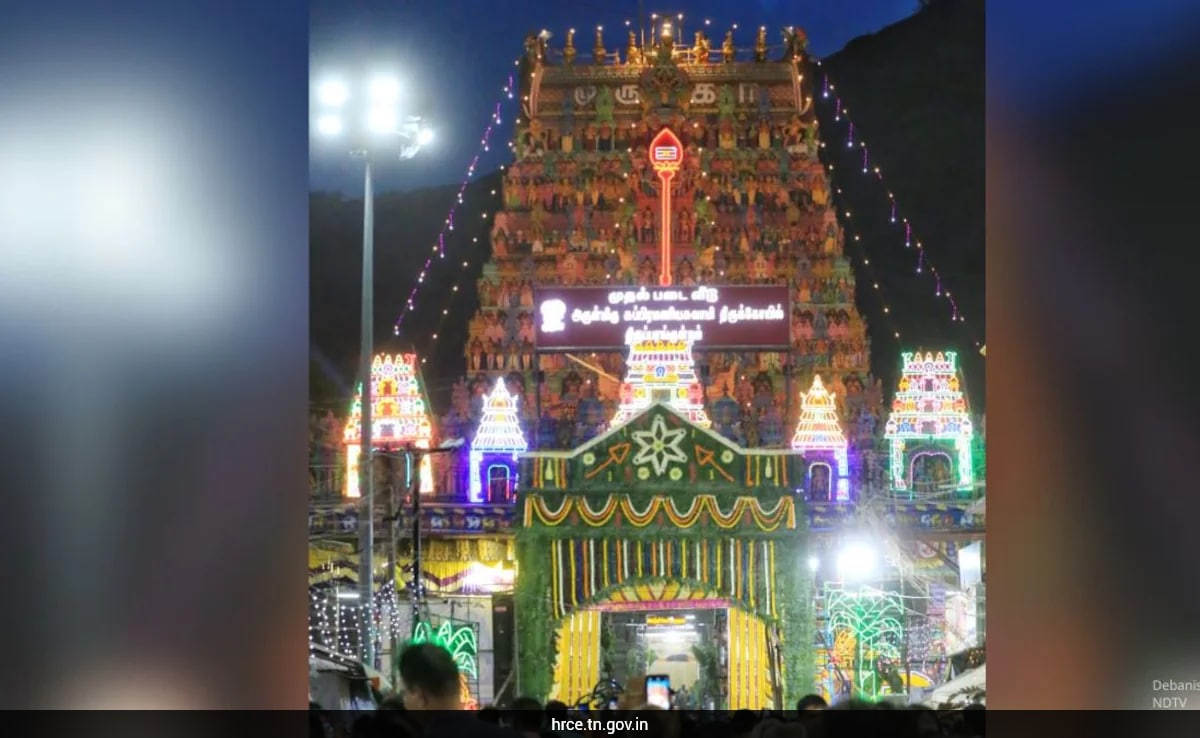
The temple in Tamil Nadu at the centre of the lamp-lighting row. Photo: hrce.tn.gov.in
The hill is home to both a sixth-century temple and a 14th-century dargah.
Tamil Nadu temple lamp row court timeline
On Monday, Decmember 1, after a contentious hearing, Justice Swaminathan overruled protests by the state government and temple officials, and ordered the lamp to be lit on the pillar built halfway up the hill instead of the one at the foot of it, which has been the tradition for over a 100 years.
The judge reasoned that the upper pillar is also temple property and must, therefore, be included in the ritual. The court emphasised the necessity of assertion of possession.
The DMK argued, and continues to argue, that such an order could inflame communal tensions, particularly with an Assembly election less than six months away. It has also pointed that Justice Swaminathan's order reverses a 2017 judgement by a Madras High Court division bench.
READ | Drama And Setback For Tamil Nadu Government In Temple Lamp Row
The temple did not comply with the court's original order; on Wednesday, December 3, the day of the festival, the lamp was lit at the traditional spot on the lower pillar.
An irked judge, citing non-compliance, then ordered it lit on the upper pillar also, leading to unruly scenes as hundreds tried to march up the hill to light the lamp – backed by armed central security forces – prompting district officials to issue orders banning large gatherings.
On Thursday, December 4, appeals by the Tamil Nadu government were heard by a two-judge bench of the Madras High Court. The court decided against the Tamil Nadu government. And on Friday, December 5, the state then moved the Supreme Court, which has not yet fixed a date for the hearing.
Politically, the developments have been seen as a setback for the ruling Dravida Munnetra Kazhagam, particularly before next year's Assembly election, which already faces accusations of an 'anti-Hindu' stance to appease Muslim voters - a charge it has denied.
Chief Minister MK Stalin hit back to accuse the BJP, which has re-allied with the DMK's arch-rivals, the AIADMK, for the 2026 election, of politicising religious issues. He said the lighting of the lamp had been conducted in line with a century-long tradition. "... some parties have a riot mindset..." he said.
NDTV is now available on WhatsApp channels. Click on the link to get all the latest updates from NDTV on your chat.
Track Latest News Live on NDTV.com and get news updates from India and around the world

