





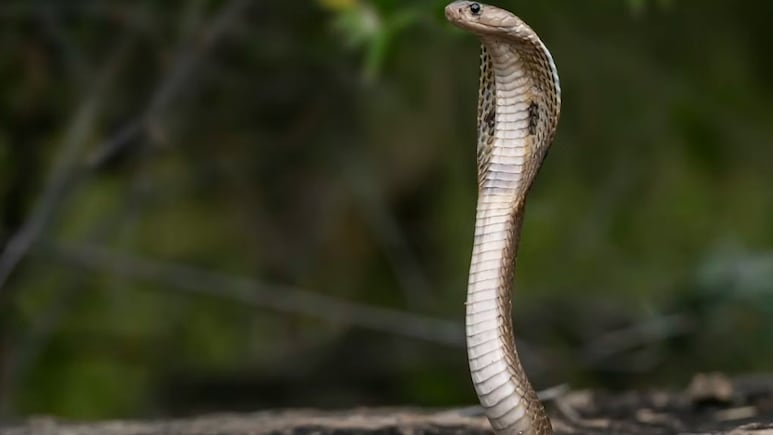
Somewhere inside a Madhya Pradesh forest, a snake slips across a patrol road in the darkness. A forest guard stops, photographs it, records the location and sends the GPS-tagged image for identification. Elsewhere, researchers drive slowly through a forest road after sunset, scanning the ground and undergrowth for movement. In another part of the state, preparations are being made for the next stage attaching radio transmitters to selected snakes to find out where they go after disappearing into the forest.
This is Madhya Pradesh's much talked-about "snake census". Except, scientifically, it is not really a census. Instead of attempting the nearly impossible task of counting every snake in the state, Madhya Pradesh has begun what is being described as India's first extensive snake-specific scientific exercise to study their diversity, distribution, relative abundance and ecology. The project is being conducted by researchers from the Wildlife Institute of India, Dehradun, along with the Madhya Pradesh Forest Department across five protected forest landscapes.
The immediate push for the exercise came from Chief Minister Dr Mohan Yadav, who had called for snakes to be counted in Madhya Pradesh amid concern over rising snakebite incidents. The proposal was also linked to the question of whether the disappearance of the king cobra from the state may have allowed populations of other snakes to increase. The Chief Minister had also spoken about the possibility of bringing king cobras back to Madhya Pradesh.
That political idea has now evolved into a much more cautious scientific exercise.
The Wildlife Institute of India, or WII, is not attempting to produce a dramatic statewide number of snakes. Instead, its researchers are trying to answer more useful questions like which species occur where, which landscapes support greater snake diversity, where medically important venomous snakes are relatively more abundant, how far they move and which areas may be suitable for the release of rescued snakes.
The study began in March 2026 and is expected to continue till the end of 2027.
Behind what may sound like an unusual forest experiment lies a serious public-health story. Madhya Pradesh has around 50 recorded snake species, according to Ujjain-based Sarp Anusandhan Sangthan. Nine of them are venomous, including the medically important "Big Four" -- the Indian cobra, common krait, Russell's viper and saw-scaled viper.
The organisation has identified 16 snakebite-prone districts in Madhya Pradesh -- Alirajpur, Barwani, Balaghat, Betul, Chhatarpur, Chhindwara, Damoh, Dhar, Jhabua, Mandla, Panna, Sagar, Satna, Seoni, Katni and Singrauli.
The public-health burden has also been rising sharply in official records. Integrated Health Information Program, or IHIP, data recorded 1,208 snakebite cases in Madhya Pradesh in 2022. The number rose to 1,479 in 2023 and then to 3,334 in 2024 almost a three-fold increase in two years.
An analysis of Madhya Pradesh government compensation records found 5,779 compensated snakebite deaths between April 2020 and March 2022, with around Rs 231 crore paid to affected families. Satna and Sagar were among the districts reporting particularly high numbers. Madhya Pradesh provides Rs 4 lakh compensation in eligible cases of death due to snakebite.
It is against this backdrop that WII researchers are trying to create something Madhya Pradesh has never had before, a scientifically grounded map of its snakes. The survey is being carried out in five distinct landscapes -- Kanha Tiger Reserve, Satpura Tiger Reserve, Panna Tiger Reserve, Gandhi Sagar Wildlife Sanctuary and the forests of Amarkantak. In the three tiger reserves, the exercise is concentrated largely in buffer areas.
The locations have been chosen because together they represent dramatically different ecological zones.
Kanha represents the Maikal landscape of eastern Madhya Pradesh. Satpura covers the heavily forested central belt. Panna represents the comparatively dry Bundelkhand landscape. Gandhi Sagar offers open grassland and savanna-like habitat and is also emerging as the second home of African cheetahs in India. Amarkantak represents an ecologically rich highland where the Vindhya and Satpura ranges meet.
For researchers, these contrasting landscapes provide an opportunity to examine how snake populations change with vegetation, moisture, altitude, temperature and habitat.
Around 15 WII researchers, three in each landscape, are working with frontline forest staff. More than 100 forest personnel were trained before intensive fieldwork gathered momentum. Teams conduct visual encounter surveys in the early morning and at night, when snake activity is higher. They also carry out road-cruising surveys, slowly driving along forest roads to record live snakes as well as roadkill.
The Madhya Pradesh Forest Department's enormous patrol network has effectively become part of the research system. When forest personnel encounter a snake during routine patrolling, they photograph it and record its location. GPS-tagged photographs are then shared with researchers, who identify the species and add the sighting to a growing distribution database.
A single picture of a snake on a forest road may appear insignificant. Hundreds or thousands of geographically tagged observations, however, can begin to show patterns where cobras are being encountered, where kraits appear more frequently, what habitats Russell's vipers are using and which landscapes support the greatest diversity.
But those photographs cannot simply be added together to announce the number of snakes in Madhya Pradesh.
Snakes are secretive, seasonal and exceptionally difficult to detect. One animal may be observed repeatedly while dozens of others in the same habitat remain hidden. A sighting proves the presence of a species, but not the total population living there.
That is why WII's exercise focuses on relative abundance, distribution, population status and spatial ecology rather than an absolute statewide headcount.
The next phase could provide an even closer look at how venomous snakes actually live. Researchers are expected to use radio telemetry on selected snakes, particularly medically important species. Small transmitters can allow scientists to follow individual snakes and study how far they travel, the size of their home ranges, the habitats they prefer and what happens after they are captured and released elsewhere. This could have a direct impact on snake-rescue practices.
At present, rescued snakes are often taken away from houses or settlements and released in forests without enough knowledge about whether that habitat is appropriate for that particular species. The WII study could identify areas where specific snakes naturally occur in greater abundance, allowing rescued animals to be released in scientifically suitable habitats instead of arbitrary locations.
The larger conservation challenge is equally important. Madhya Pradesh may have around 50 snake species, but only a fraction pose a serious medical threat to humans. Apart from the nine venomous species, the state is home to rat snakes, sand boas, keelbacks, wolf snakes, kukri snakes, vine snakes, racers, trinket snakes, pythons and several burrowing species.
Many perform an important ecological role, particularly by controlling rodents in agricultural areas.
Yet fear and misidentification often lead to snakes being killed. At the same time, unregulated rescues by poorly trained handlers can injure both people and animals. A scientific mapping exercise could therefore eventually support not only conservation but also a more regulated and trained snake-rescue network.
The real public-health potential of the project lies in what happens if WII's snake map is eventually combined with the state's snakebite data.
If researchers establish that Russell's vipers, cobras or kraits are relatively abundant in particular landscapes and those same areas also report large numbers of snakebites, authorities could use the information to strengthen anti-snake venom supplies before the monsoon, train doctors and paramedical staff, improve ambulance access and target awareness campaigns at farmers and forest-fringe communities.
The timing is critical. Snake movement generally rises between July and October, overlapping with the monsoon, agricultural activity, flooding and increased human-snake encounters.
The first phase of the Madhya Pradesh study gathered momentum during precisely this period in 2026. A mid-term assessment is expected around October-November, while the second phase, including radio-telemetry work, is expected to continue through 2027.
Track Latest News Live on NDTV.com and get news updates from India and around the world

