





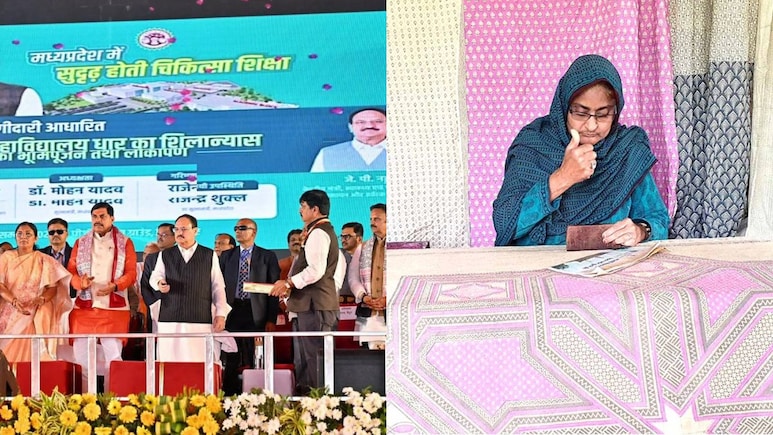
Madhya Pradesh's internationally recognised Bagh print, a craft that has long been a marker of the state's cultural pride, has landed in an uncomfortable controversy in Dhar district, prompting the district administration to order an SDM-level inquiry into allegations that a "Bagh print" stole gifted at a high-profile event was not authentic.
The row broke out after Chief Minister Mohan Yadav presented a Bagh print stole to Union Health Minister JP Nadda during a public programme in Dhar. Traditional artisans from Bagh village, who have preserved the craft across generations, alleged that the stole was not a genuine hand-printed Bagh textile but a machine-printed product from the market. They said the incident has embarrassed the craft community and raised questions over how official procurement and protocol are handling heritage crafts.
The episode dates back to December 23, during the foundation stone-laying ceremony of the medical college in Dhar. Soon after photographs from the event surfaced on social media, artisans from Bagh claimed they could identify the tell-tale signs of a non-traditional print and began flagging the issue publicly, calling it a blow to the GI-tagged craft's credibility.
Mohammad Arif Khatri, an artisan from Bagh, said the alleged "fake" presentation has hurt their livelihood and reputation. He noted that an authentic Bagh print can take nearly a month to produce, relying on natural dyes and painstaking hand processes, while machine-printed imitations can be made in minutes using chemical colours, often sold cheap price. "Our craft is old and has a GI tag. That tag is the biggest proof of authenticity," he said, demanding strict checks so machine-made products are not passed off as Bagh print.
Bagh print originates from Bagh village in Dhar district, a tribal-dominated region where families have guarded the tradition for three generations. Named after the Baghini river, the craft is defined by hand-printing through carved wooden blocks and dyeing using vegetable and mineral colours. Its time-intensive process is precisely what earned it a GI tag, and artisans argue that showcasing a machine-printed stole as Bagh print dilutes that identity and undermines the value of the GI certification.
In response, local artisans have written to the Prime Minister's Office, the Union Ministry of Textiles, and the GI tag authority, seeking action against those responsible for procurement and protocol. They have also alleged that the matter was not being treated as seriously as it should be, despite the reputational damage to the state's heritage brand.
Dhar Collector Priyank Mishra rejected the claim that the stole should be declared counterfeit solely based on who supplied it, saying it was procured through proper channels and that the Bagh print is no longer produced only by one traditional family. He said self-help groups and other organisations are also engaged in the craft, and the government intends to expand learning and participation. However, acknowledging the complaint, he said the matter would be examined and has now directed the Sub-Divisional Magistrate (SDM) to conduct an inquiry into the allegations and procurement trail.
Authentic Bagh print follows a disciplined process; cotton or silk fabric is washed repeatedly to remove starch, treated with castor oil and salt, given a yellow base with myrobalan, and printed by hand using carved blocks locally called Palia. Traditional colours are prepared through specific formulations, red from alum and tamarind seeds, black from iron filings and jaggery. After printing, the cloth is sun-dried, washed in the Bagh river, and boiled in copper vessels with dhavdi flowers and alizarin to fix the colours, before being washed and dried again.
Artisans argue that while a machine can imitate the look quickly, it cannot replicate the craft's integrity, and that is why the controversy is not merely about one stole. They say it reflects a deeper issue of authenticity being pushed aside in official spaces. "When a state's identity itself appears counterfeit, it is not just a crisis for art; it becomes a crisis of governance," one artisan said, warning that heritage brands lose value when imitation replaces authenticity without accountability.
Track Latest News Live on NDTV.com and get news updates from India and around the world

