





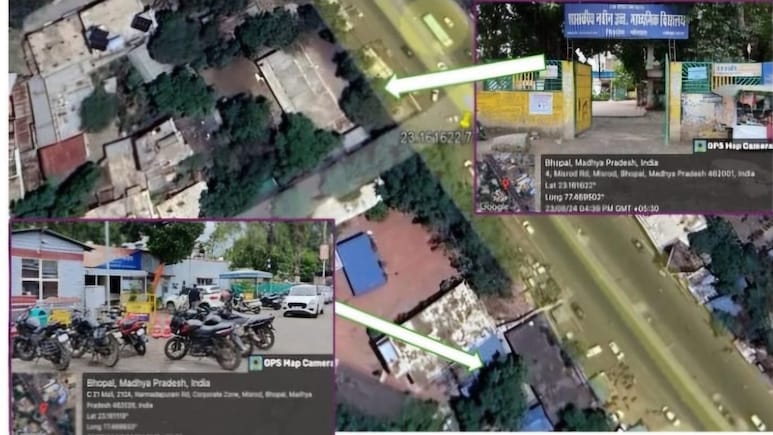
A major controversy has erupted in Madhya Pradesh after the Comptroller and Auditor General of India exposed serious irregularities in the registration of waqf properties across the state. The compliance audit report for the period 2018 to 2023, tabled in the Assembly, has revealed that government land worth Rs 77.07 crore was registered as waqf in 20 districts due to what the audit describes as systemic lapses and administrative inaction.
The CAG examined 81 waqf properties and found that 33 of them, or 41 per cent, were actually government-owned land. These properties, measuring 2,09,639.48 square metres in total, were recorded in revenue records as belonging to the state government and reserved for community purposes. Despite this, they were entered into the Auqaf Register. The audit noted that district collectors had been informed before the registrations were completed, yet in most cases, no effective steps were taken to halt the process. The CAG described this as a lax attitude that facilitated misuse of the Waqf Act and irregular conversion of government land.
One of the most striking cases pertains to Misrod in Bhopal, where 3,600 square metres of land was registered as waqf in November 2022 on the claim that it had earlier been used as a graveyard. However, a Government Higher Secondary School and the Misrod Police Station are situated on that very land. Objections were filed by local residents, the Tehsildar and even the officer in charge of the police station. The Board's own inquiry reportedly found that the land was not in use as a graveyard, yet the registration was carried out. The CAG observed that no further correspondence was made with the Land Revenue Office before finalising the entry.
In Vidisha district, forest land measuring 410 square metres in the Halali Dam area was registered as a waqf even though it had been leased under the Forest Rights Act with clearly non-transferable ownership. The lease conditions allowed only usage rights and not ownership transfer. Despite this, a religious structure built on the leased forest land was entered into the Auqaf Register in January 2023. The CAG held that the registration was invalid and pointed out that no notice was issued to forest officials under the relevant provisions of the Waqf Act.
In the Raisen district, land mortgaged with Madhya Pradesh Gramin Bank was registered as a waqf in December 2022. The khasra records attached to the application clearly mentioned that the property was under mortgage. The Board proceeded without conducting any inquiry. The bank issued a no-objection certificate in October 2024, almost two years after the registration. The audit states that at the time of registration, the property was not free from encumbrances, and the action was in conflict with provisions of the SARFAESI Act.
The audit also highlights cases where privately owned land belonging to members of other religious communities was registered as waqf. In Mandsaur, land under private ownership was registered under Section 41 of the Act on the basis of the presence of a religious structure. Revenue authorities later confirmed that ownership remained with private individuals. In Shivpuri, land with living legal heirs was registered as a waqf even though ownership issues are governed by the Hindu Succession Act. The CAG noted that such ownership cannot be arbitrarily altered through administrative action.
In the Dhar district, properties were registered without a clear title. In one case, the applicant claimed ownership based on a power of attorney, but there was no registered sale deed transferring ownership. The Senior Registrar's office confirmed that no legal transfer had taken place. Despite this, the Board registered the property. In another Dhar case, the District Collector objected in writing and refused to issue a no-objection certificate for converting residential houses into waqf property, citing legal provisions requiring prior written permission. The Board proceeded with registration, rejecting the objections on technical grounds related to delay.
In Sehore district, more than 4,006 square metres of government land was registered as waqf despite objections from villagers who stated that the land was government property and had never been used as a graveyard. The objection was rejected on the ground that it was filed four days beyond the 30-day public notice period. The CAG observed that such a rigid 30-day restriction is not prescribed in the Act or Rules and termed the rejection arbitrary.
In its response, the government stated that the Waqf Act is a special Act and that obtaining a no-objection certificate from the district administration is not mandatory. It also claimed that some entries may have occurred due to technical errors during the computerisation of land records and that public notices had been issued in all cases. The CAG rejected these explanations, stating that several of the properties were registered only one or two years ago and that in at least two cases, collectors had clearly raised objections that were ignored. The audit also emphasised that the properties in question were reserved for community purposes and recorded as government land.
Revenue Minister Karan Singh Verma has stated that he has directed all collectors to investigate the matter and assured that action will be taken based on the findings. The CAG has recommended fixing responsibility on Waqf officials, revenue authorities, forest officials and district administrations involved in these irregular registrations.
The revelations form part of a broader compliance audit covering 14 departments. The report also flags construction of a 4.5 kilometre road in Raisen in a submergence area, irregular road construction leading to an alleged loss of Rs 15 crore in Vidisha and Narmadapuram, proliferation of illegal colonies due to inaction by the Town and Country Planning Department, and failure of municipal corporations in Indore, Bhopal, Ujjain, Gwalior and Jabalpur to account for Rs 260 crore collected as shelter fees.
Track Latest News Live on NDTV.com and get news updates from India and around the world

