





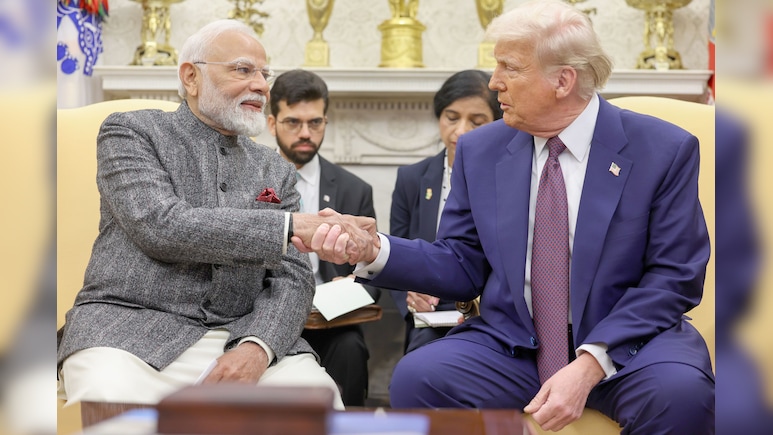
- Donald Trump's 'America First' prioritises US economic interests in domestic and foreign policy
- US Deputy Secretary Landau highlighted the US-India tariff deal as 'America First' in action
- The US learned from China to ensure fair trade terms protecting American businesses, he said
Donald Trump's 'America First' vision - prioritising US economic interests in domestic and foreign policies - has been a feature of both his terms. Received with scepticism a decade ago and viewed warily since, it has divided Americans in a global order that has evolved to value cooperation, especially to meet threats like climate change and terrorism.
Nevertheless, it is now the anchor in conversations on global trade and geopolitics, as Venezuela found out in January, and that point was underscored this week by US Deputy Secretary of State Christopher Landau at the Raisina Dialogue in Delhi.
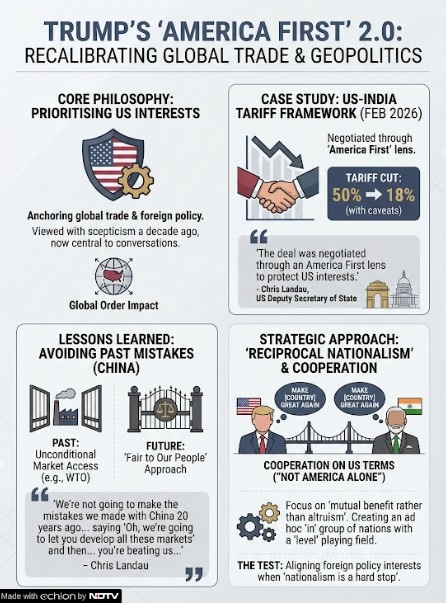
Referring to the February 2026 US-India interim tariff framework - under which an eyewatering 50 per cent tariff was cut to 18 per cent, with caveats - Landau indicated the deal had been negotiated through an 'America First' lens to protect US interests.
He said also the US had "drawn lessons" from dealings with China, i.e., backing Beijing to join the World Trade Organization, believing it could then gain access to a vast market and efficient, resource-rich supply chains to boost American businesses.
"India should understand," he said, "we're not going to make the mistakes we made with China 20 years ago, in terms of saying 'Oh, we're going to let you develop all these markets' and then, next thing we know, you're beating us in a lot of commercial things. We're going to make sure that what we do is fair to our people...."
The subtext was unambiguous - 'trade with us, yes, but on our terms'.
But, Landau clarified, the US was under no illusions that other countries would behave any differently or that operationally 'America First' means an isolationist perspective.
"'America First' obviously does not mean 'America alone'... because one of the ways that you can accomplish objectives is through cooperation with other countries."
"So, just as Trump wants to make America great again, he would expect the Prime Minister of India or other (world) leaders to want to make their countries great again."
Landau's comments seem to underline a recalibration of US foreign policy in Trump 2.0, particularly in using tariffs to create an ad hoc 'in' group of nations he sees as having bent their trade and tariff architecture to ensure a 'level' playing field.
In that, the US, as it usually does, recognises the value of India on its side.
"... this is going to be a century in which we expect to see the rise of India," he said, while also bringing 'America First' back into the frame, the "need for mutual benefit rather than altruism".
Trump's 'America First' seems to offer a sort of reciprocal nationalism, i.e., a kind of 'we can be great, and so can you' phrasing. But nationalism itself is a hard stop of sorts, a perspective built around literal lines in the sand often runs into trouble when altruism is called for. The real test, therefore, will likely be in how well foreign policy interests can actually align.
Track Latest News Live on NDTV.com and get news updates from India and around the world

