





- India's Prototype Fast Breeder Reactor (PFBR) at Kalpakkam has achieved first criticality
- PFBR is India's first commercial-scale fast breeder reactor, joining a rare global club
- The project took over 20 years due to challenges with sodium coolant and materials
After more than two decades of painstaking scientific effort, India has crossed one of the most consequential milestones in its civil nuclear programme. The Prototype Fast Breeder Reactor (PFBR) at Kalpakkam in Tamil Nadu has achieved first criticality, the moment when a sustained nuclear fission reaction is established.
With this, India decisively advances into the second stage of its three-stage nuclear power programme, a vision first articulated by the Father of India's atomic program Dr Homi J Bhabha more than half a century ago.
Calling the achievement historic, Dr Sreekumar G Pillai, Director of the Indira Gandhi Centre for Atomic Research (IGCAR), Kalpakkam said the moment represents far more than the commissioning of a reactor.
The massive pink-coloured building next to the Bay of Bengal houses a major technological breakthrough, glimpses of which NDTV got during rare access to the facility.
"This attainment of the first criticality of the Prototype Fast Breeder Reactor is a defining milestone in India's nuclear power programme," Dr Pillai told NDTV. "It represents the realization of the visionary three-stage nuclear programme conceived by Dr Bhabha, aimed at ensuring long-term energy security through optimal utilization of limited uranium and vast thorium resources."
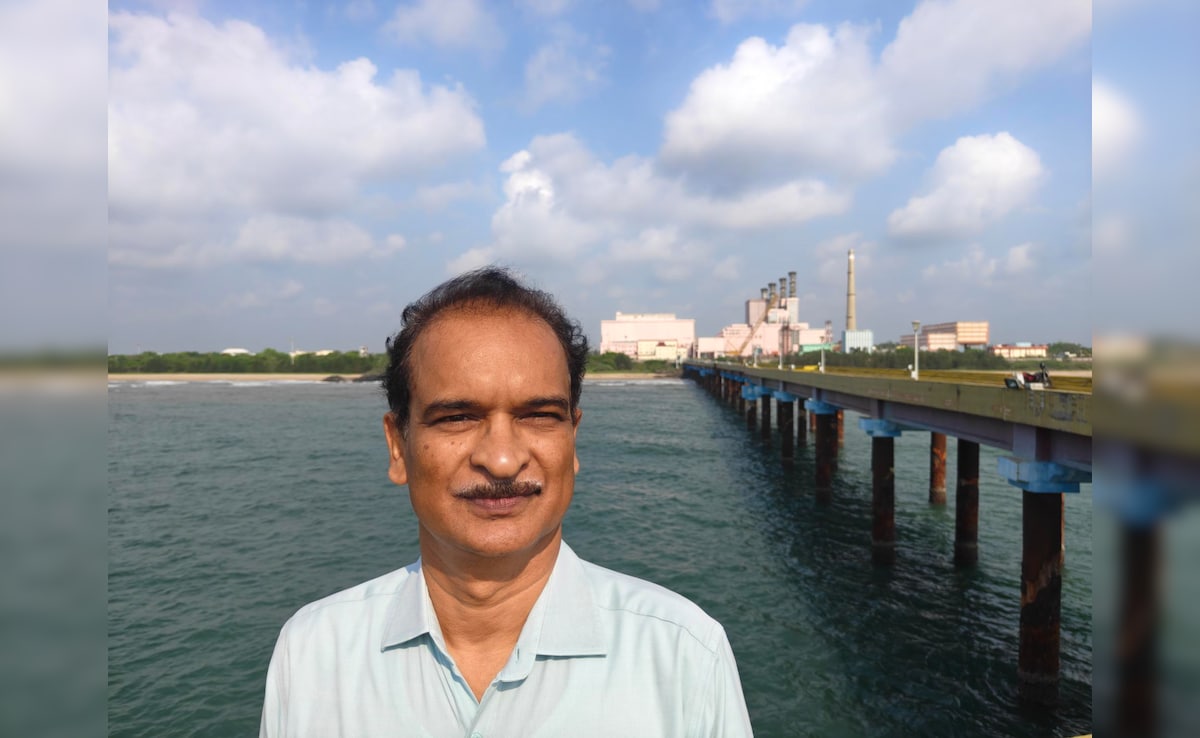
Sreekumar G Pillai, Director of Indira Gandhi Centre for Atomic Research (IGCAR), Kalpakkam
Photo Credit: Pallava Bagla
The PFBR, located at Kalpakkam, is the country's first commercial-scale fast breeder reactor and among the very few such reactors operating anywhere in the world. With Russia being the only other country running a commercial fast breeder reactor at Yekaterinburg, India now joins an extremely exclusive technological club.
A Project Built on Institutional Memory
The PFBR is the product of sustained institutional effort spanning generations of scientists, engineers and policymakers. According to Dr Pillai, the achievement would not have been possible without consistent political backing and scientific leadership.
"This achievement has been made possible due to the sustained support and guidance of the Government of India," he said. "The leadership of Prime Minister Narendra Modi ji and the proactive role of the Prime Minister's Office have ensured policy continuity, strategic direction and timely decision making."
He also credited Dr Jitendra Singh, Minister of State for Atomic Energy, for strengthening programme execution, and acknowledged the role of former and current leaders of the Department of Atomic Energy.
"The scientific leadership of Dr Ajit Kumar Mohanty has been instrumental in guiding the Department of Atomic Energy towards advanced reactor deployment and closure of the second-stage fuel cycle," Dr Pillai said. "The visionary contributions of Dr Anil Kakodkar were fundamental in shaping and advancing the fast breeder reactor programme."
Why It Took 20 Years
The PFBR project has often been described as delayed. Dr Pillai rejects that framing, calling the journey a necessary learning curve.
"We were waiting for this moment for the last 10 to 15 years," he said. "There were a number of difficulties which we faced, mainly with respect to handling sodium at high temperature, materials reliability, control systems and sensors which had to be developed for a high-temperature sodium environment."
Liquid sodium is used as the coolant in fast breeder reactors. It allows efficient heat transfer but reacts violently with water and air, demanding extraordinary engineering precision.
"This was the first time such equipment was being designed and operated at this scale in the country," Dr Pillai explained. "It required elaborate testing and generation of data where no past experience was available."
The commissioning phase also took longer than anticipated. "During testing, we had to generate large amounts of data. This data does not exist in international literature and cannot be obtained from any other reactor," he said.
Far from being a setback, Dr Pillai described the process as invaluable learning. "I would say it is a learning experience. It has generated knowledge that is unique to India."
Fast And Breeder, Explained Simply
The PFBR marks a technological leap from India's first-stage reactors, the Pressurised Heavy Water Reactors (PHWRs), which form the backbone of the country's nuclear fleet.
"In the first stage, PHWRs use natural uranium," Dr Pillai said. "During operation, they also produce plutonium-239, which is not available naturally."
That plutonium is recovered through reprocessing and used as fuel in the fast breeder reactor.
"Fast reactors operate in a fast neutron spectrum. The neutrons are not slowed down," he explained. "The unique advantage is that the reactor produces more fissile material than what is fed into it."
This is why it is called a breeder reactor.
"The breeding ratio is greater than one," Dr Pillai said. "What you feed into the reactor, you get more Plutonium out of it."
To a lay audience, the concept sounds almost magical. Burning fuel and ending up with more fuel than you started with.
"It is a real thing," Dr Pillai said. "With the current oxide fuel, we expect a breeding ratio of about 1.03 to 1.05. With metallic fuels under research, it can go even higher."
The Closed Fuel Cycle Advantage
India's success with fast breeders is inseparable from its mastery of the closed fuel cycle.
"Plutonium is not available naturally," Dr Pillai said. "All thermal reactors produce plutonium, but only countries that reprocess spent fuel can use it for fast breeder reactors."
India has built indigenous reprocessing capability over decades, starting in the early 1960s.
"We started reprocessing activities in the early 1960s," Dr Pillai said. "From Trombay to Tarapur and Kalpakkam, we have matured the PUREX process and scaled it up."
Today, India has sufficient reprocessing capacity to support the PFBR and the next set of fast reactors.
"There is no issue of plutonium availability," he said. "The PFBR itself will generate enough spent fuel to support FBR-1 and FBR-2."
Safety and Regulation
Safety concerns often arise because fast reactors use liquid sodium. Dr Pillai was categorical in his reassurance.
"IGCAR has decades of experience in handling sodium," he said. "We have developed sensors, materials and special powders to mitigate risks."
The PFBR follows the defence-in-depth philosophy used globally in nuclear safety. "There are multiple layers of containment to ensure sodium remains within the system," he explained.
India's Atomic Energy Regulatory Board played a key role. "There were no international safety codes available for fast reactors at this scale," Dr Pillai said. "AERB was fully involved in developing safety guides and regulatory requirements."
What Comes Next
With first criticality achieved, the reactor will now go through physics experiments and gradual power escalation under regulatory oversight. "It may take six to eight months to reach commercial power production," Dr Pillai said.
Preparatory work for two more fast breeder reactors, FBR-1 and FBR-2, at Kalpakkam is already underway.
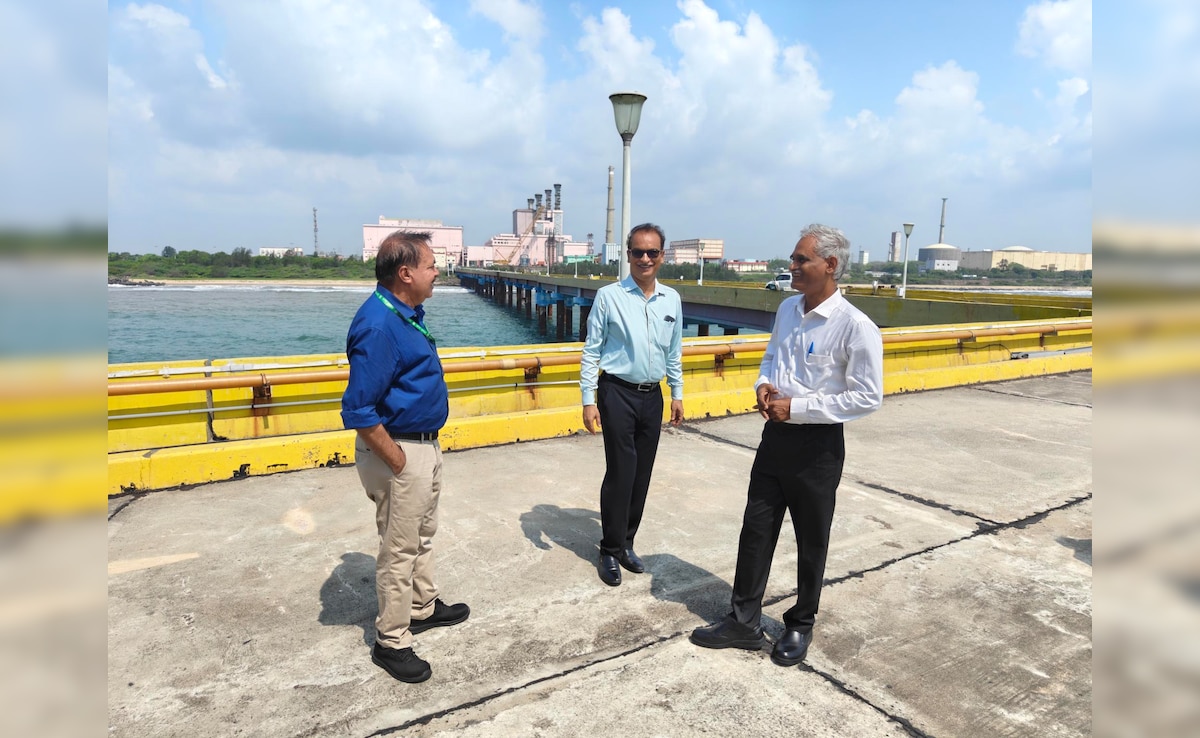
Photo Credit: Pallava Bagla
"All lessons learned from PFBR will be incorporated," he said. "This will significantly reduce construction and commissioning time."
Gateway to Thorium and Energy Independence
Perhaps the most profound significance of PFBR lies in what it enables next. India has limited uranium but vast thorium reserves. "When thorium is used as a blanket material in fast breeder reactors, it produces uranium-233," Dr Pillai explained. "That is the fuel for the third stage.
This makes PFBR the essential bridge to India's long-term energy future. "Yes, this milestone will help India attain energy independence in the long run," he said.
Often the PFBR is described as the 'Akshay Patra of Energy', the mythical vessel of endless sustenance. Dr Pillai agreed.
"Once the PFBR reaches equilibrium, there is no need to look for fuel from external sources," he said. "The reactor sustains itself and generates excess fuel. It truly is an Akshay Patra."
In an era of climate change, PFBR also offers low-carbon baseload electricity. "This is a stepping stone towards achieving net zero by 2070," Dr Pillai said.
As India celebrates this scientific milestone, the achievement stands as a tribute to decades of perseverance, institutional memory and belief in an indigenous technological path. The dream that began with Dr. Bhabha has moved decisively closer to reality. Pillai says once we master the breeder reactor we will be energy independent for the next several centuries.
Track Latest News Live on NDTV.com and get news updates from India and around the world

