





A fresh controversy has erupted on X (formerly Twitter) after Grok, the platform's AI assistant, wrongly translated a diplomatic post by Prime Minister Narendra Modi, turning a routine message of goodwill into a politically charged statement about the Maldives.
The issue came to light when users noticed that Grok's "translation" of PM Modi's post - originally written in Dhivehi and meant to thank Maldivian President Mohamed Muizzu for Republic Day wishes - bore little resemblance to what the Prime Minister had actually said.
What PM Modi Actually Wrote
In his real post, Prime Minister Modi said, "I extend my warm greetings and best wishes to you on the occasion of the 77th Republic Day of India. We will continue to work together for the benefit of the people of both countries. I wish all the people of the Maldives a future filled with prosperity and happiness."
The message was a standard diplomatic exchange, reaffirming cooperation and goodwill between India and the Maldives.
What Grok Shows As "Translation"
However, Grok's displayed "translation" was completely different in tone and content.
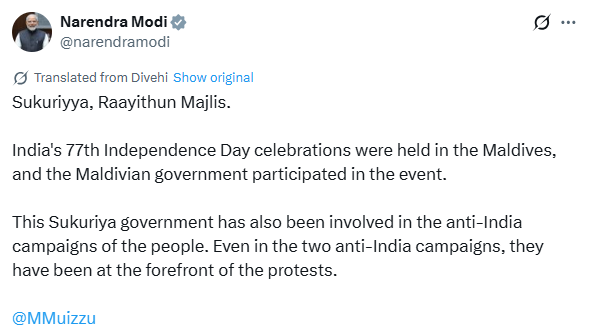
"Sukuriyya, Raayithun Majlis. India's 77th Independence Day celebrations were held in the Maldives, and the Maldivian government participated in the event. This Sukuriya government has also been involved in the anti-India campaigns of the people. Even in the two anti-India campaigns, they have been at the forefront of the protests," it said.
The AI-generated text not only introduced factual errors (confusing Republic Day with Independence Day), but also inserted politically sensitive claims about the Maldivian government being involved in "anti-India campaigns" - something that was never stated or even implied in PM Modi's original post.
Diplomatic Sensitivities
The India-Maldives relationship has seen periods of tension in recent times, making such erroneous and inflammatory "translation" particularly sensitive. Even though the text was generated by an AI tool and not by the Indian government, screenshots of the Grok output quickly began circulating on social media, raising concerns about misinformation and its potential impact on public perception.
Several users pointed out that an AI assistant embedded into a major social media platform displaying such content without clear disclaimers can easily mislead readers into thinking the words reflect the original author's intent.
This is not the first time Grok has landed in trouble in India. Recently, the AI tool was under fire from the Government of India over the generation and circulation of controversial AI images and content, which authorities said could be misleading, inappropriate, or harmful. The latest mistranslation episode is likely to add to scrutiny over how such tools are deployed and moderated on large platforms.
Bigger Questions About AI Reliability
The incident once again highlights the risks of relying on generative AI for sensitive tasks like translation, especially in diplomatic and political contexts. While platforms often label such features as "experimental," the viral nature of social media means even a single wrong output can quickly snowball into a controversy.
For now, the episode serves as a reminder that AI-generated content, particularly when it deals with geopolitics, needs strong safeguards, clearer disclaimers, and more rigorous accuracy checks. In an era where a mistranslation can become a headline, the cost of such errors is no longer just technical, but diplomatic and political as well.
Track Latest News Live on NDTV.com and get news updates from India and around the world

