





- Gold's price dipped sharply during the Iran conflict, defying its usual safe-haven role
- The gold-silver ratio above 60 suggests silver is cheaper relative to gold currently
- Silver benefits from strong industrial demand in electronics and renewable energy sectors
Gold's sharp swings this year have unsettled many investors. During the ongoing Iran war, gold hasn't performed as a reliable hedge as it usually does. This is odd -- historically, gold tends to rise when the world gets tense. However, gold prices have dipped sharply despite the market uncertainty.
This trend is raising a simple question among investors: If gold isn't acting like a refuge, should money be shifted to silver instead?
Before experts weigh in on the question, let's understand the gold-silver ratio first. The gold-silver ratio is a simple tool investors use to compare the prices of the two metals. It tells you how many units of silver equal the price of one unit of gold. A high ratio means silver is cheaper relative to gold, while a low ratio means silver is relatively more expensive.
At present, this ratio is above 60 -- suggesting silver is comparatively cheaper.
"At a price ratio in mid-60s, silver looks attractive relative to gold," says Siddharth Maurya, Managing Director, Vibhavangal Anukulkara Pvt Ltd. "Whenever we consider the relative valuation for the gold-silver ratio, its mid 60s suggests that silver is a better investment opportunity relative to gold. Historically, the ratio has fluctuated between 40 and 70."
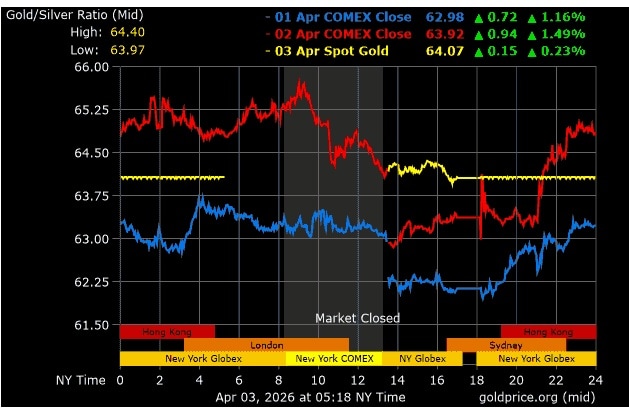
Photo Credit: Gold Price Org
Maurya points out that silver isn't just a precious metal. Part of its demand comes from industry, especially fast-growing areas like electronics and renewable energy. "Strong industrial demand continues to provide a structural tailwind. During positive commodity cycles, silver tends to outperform gold."
His advice for investors: don't rush entirely to gold for safety. Instead, consider increasing silver gradually.
But silver is not without its own wild side. Siddharth Shimpi (PhD), Associate Professor at MIT-WPU, Pune, cautions that silver's recent ups and downs can shake portfolios. "Silver has been the show star... But that 44 percent plunge from January peaks ought to make investors sit up. Silver is exciting, but it can shake you badly."
By contrast, gold has been comparatively steadier, especially helpful when the rupee is weak and global uncertainty lingers.
"You should not sell all of your silver, but lighten the load," Shimpi says.
What About Gold As A Crisis Hedge?
Professor Vishwanathan Iyer, senior associate professor (finance), Great Lakes Chennai, says the idea of dumping silver for gold is too simplistic. "Gold is the cleaner safe-haven asset... supported by geopolitical risk, central bank demand and diversification role. Silver has a dual character -- precious metal and industrial input."
He notes research showing gold tends to outperform in risk-off phases, while silver behaves like a higher-beta play -- rising more in good times, falling harder in bad times. "The implication is not to abandon silver, but to rebalance."
What Should Investors Do?
Gold's unusual behaviour during the Iran conflict shows that even "safe havens" can wobble when markets are driven by complex forces like a strong dollar, rising rates and profit-taking.
Silver may offer higher potential upside, but it comes with higher volatility.
The smarter move isn't a full switch from one metal to the other. It's about rebalancing your precious metals allocation -- adding gold for stability and silver for cyclical growth -- based on your own risk tolerance.
Gold, Silver Price
As on April 3, the price of 10 gram of gold stood at Rs 1,49,740 in India. Meanwhile, silver stands at Rs 2,33,320 per kilogram.
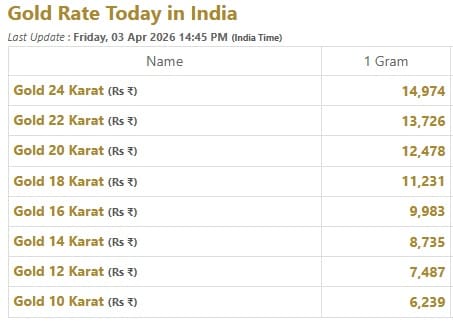
Photo Credit: Bullions.Co
Track Latest News Live on NDTV.com and get news updates from India and around the world

