





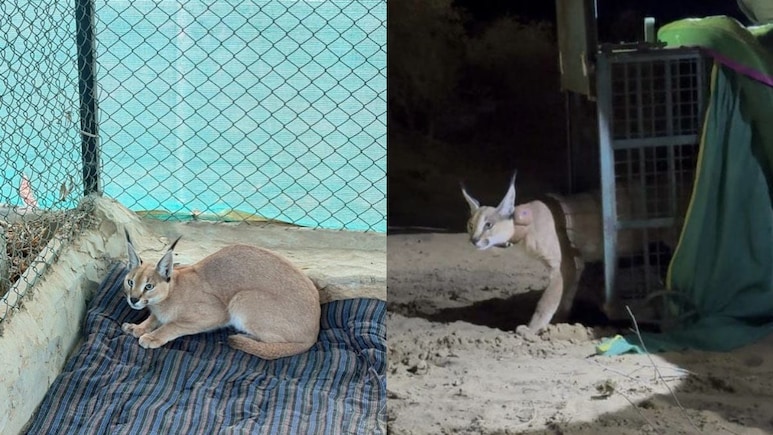
A successful operation to rescue an endangered caracal was carried out in Rajasthan's Jaisalmer district recently. Following the rescue, the male caracal was radio-collared for the first time and released back into the wild, allowing wildlife officials to track and study this elusive species.
The special operation involved a team from the Wildlife Institute of India (WII) along with the Rajasthan Forest Department. The operation was carried out in Ghotaru village of Shahgarh Gram Panchayat near the India-Pakistan border.
Over the past three months, the forest department received several unconfirmed reports of caracal sightings across the Shahgarh Bulge, Longewala, and Kishangarh areas.
On 23 January, local villagers reported caracal movement in the Ghotaru area. The caracal was rescued from the trap, tranquilised and then kept under observation for two days, during which its blood pressure, haemoglobin, heart rate, and other health parameters were examined. The animal was found to be completely healthy.
After successful radio-collaring, it was safely released on the night of 25 January in the same area, considered its home range.
"The forest department received information that a caracal had been caught in a snare allegedly put out by poachers in the area. We rushed a team and rescued the wild cat on the night of January 23. Wildlife institute officials were informed, and they helped us radio-collar the animal. This will help us track and monitor this rare and elusive species. Apart from sighting them occasionally on a camera trap, there is no other way to count them, and since it's a nocturnal animal and very shy, it's been sighted only occasionally," said Chief Conservator of Forests (CCF) Jodhpur Anoop KR.
Since its release, the caracal has been under continuous monitoring. The most encouraging sign is that it is freely roaming within its home range. Data related to the caracal's habitat and behaviour is being systematically collected.
The radio collar will help monitor the caracal's movements and behaviour, allowing the collection of crucial ecological data. This is the first time such a large-scale scientific study on the caracal is being conducted in India.
Rajasthan's Forest, Environment & Climate Change Minister Sanjay Sharma confirmed the operation on X.
A male Caracal was successfully radio-collared and released in Village Gotaru, Shahgarh Gram Panchayat, Jaisalmer district last night.
— Sanjay Sharma (@Sanjay4India1) January 26, 2026
The expert team from Wildlife Institute of India (WII) was part of this important exercise, strengthening efforts to monitor and protect this… pic.twitter.com/r8I7mcfl1L
The caracal cat is listed on the International Union for Conservation of Nature (IUCN) Red List. According to surveys by the WII, only around 50 caracals remain in India. After the extinction of cheetahs in 1952, the caracal became the second big cat species in India facing the threat of extinction.
The presence of the caracal in the grasslands of Jaisalmer indicates that the local ecosystem is healthy and relatively undisturbed.
This is the first time that a caracal has been radio collared. Earlier, caracals had only been sighted through camera traps in Madhya Pradesh and Ranthambore, and no detailed scientific study had ever been conducted on a live specimen.
Track Latest News Live on NDTV.com and get news updates from India and around the world

