





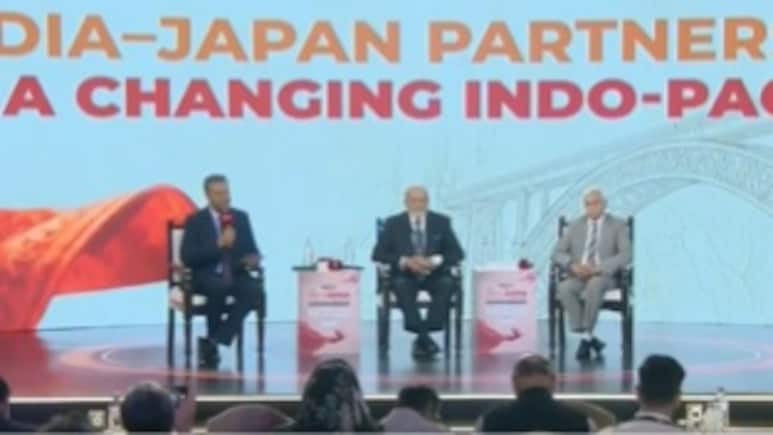
Partnership in the Indo-Pacific region is becoming a cornerstone of the India-Japan collaboration, especially in the context of China's growth as an economic powerhouse. The Chinese Navy -- which docked its ships in Colombo, the Maldives, Pakistan and off the Persian Gulf -- has now got its first overseas base in Djibouti. It is also mapping parts of the Bay of Bengal and Indian Ocean.
In a discussion with NDTV today, India's former Ambassador to Japan Sujan R Chinoy said while China is a global power in terms of economy, it is not quite there yet in terms of military power.
"China's growing military might is still focused on ensuring the limit of US power on its periphery, and it operates in two ways. It is deterrence vis-a-vis the United States, including in the Taiwan Strait, but it is also partly dominance against lesser powers in the region," he said.
The Chinese were last in the Indian Ocean in the 15th Century when Admiral Zheng He's ships sailed into the Indian Ocean. "In the subsequent centuries, China has not been a natural power in the Indian Ocean. But today it goes without saying that the Indian Ocean, (is) like all the other sea lines of communication... the waters on the high seas are available for all," he added.
In this backdrop, China's presence in the Indian Ocean is a "function of its growing economic power, its interest in protecting its sea lines of communication, its Belt and Road projects, and also its strategic requirements of dealing with regional and global issues," he said.
Calling it an alien presence, he said "like-minded countries obviously must come together to look at ways and means to ensure that this presence is not inimical to their interests".
Regarding the way forward for Japan, Japan's former Ambassador to India Kenji Hiramatsu said Tokyo is increasing focussing on defence. "Prime Minister Takaichi has a very strong view that we have to spend more money for our national defense," Hiramatsu said.
"At the same time, we have more opportunity to cooperate with other friendly countries like, like India. So, our defense policy is now transforming in a very significant way... . We are trying to revise our national security policy soon in view of the issues we are now facing. So, we are in a very important juncture, he added.
But with all that, China's potential as a global military power cannot be dismissed. Beijing has really invested in holistic maritime power, said Admiral Sunil Lanba.
"The Chinese Navy is the largest navy numerically in the world. They have the largest coast guard numerically, the largest maritime militia, the largest fishing fleet. They have captured almost 55 per cent to 60 per cent of global shipbuilding industry at the cost of South Korea and Japan. So, they are a maritime power to be reckoned with, and this is a reality, and they will be here," said Admiral Sunil Lanba.
"It is a play which is going to continue and is only going to increase. So, we need India, along with Japan, all need to focus on holistic maritime power," he added.

