





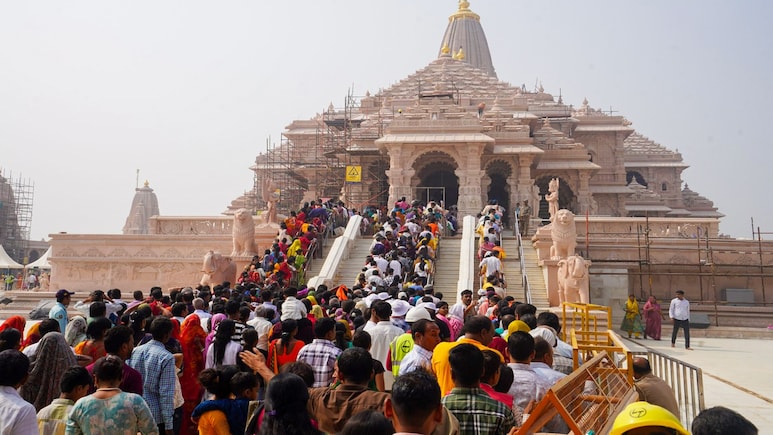
Ayodhya Bar Association's declaration that no lawyer will represent the accused in the alleged Ram Mandir donation embezzlement case with a warning that any lawyer who accepted their brief would face a Rs 5 lakh penalty has reignited one of the oldest dilemmas in the legal profession: Can a lawyer choose individual morality over legality, or does the very idea of justice demand that every accused person has a fearless advocate?
English jurist William Blackstone once said: "It is better that ten guilty persons escape than that one innocent suffer."
Can a collective morality of a Bar association ignore this timeless doctrine - which has long shaped criminal jurisprudence?
Senior members of the Supreme Court Bar believe the Ayodhya Bar Association's resolution crosses a constitutional line.
Senior Advocate Sidharth Luthra, while speaking to NDTV, said that for a lawyer, the issue is governed not by public sentiment but by what he describes as "legal morality." According to him, a lawyer is expected to follow the "cab rank rule" - accepting a brief if the client seeks representation, can pay the fee, and there is no conflict of interest.
Lawyers, he said, are not expected to act on the basis of prevailing social morality.
"Every accused enjoys the presumption of innocence, a guarantee flowing from Article 21 of the Constitution, and has a corresponding right to legal representation. The burden remains on the prosecution to establish guilt beyond reasonable doubt," Luthra explained.
In that context, Luthra said, however heinous the alleged offence may be, a collective declaration that no lawyer will represent an accused is inconsistent with the ethical obligations imposed by the Bar Council of India Rules. Such a boycott, he added, could even justify transferring the trial outside the district - or, in an appropriate case, outside the State - to ensure a fair trial.
Senior Advocate Rakesh Dwivedi viewed the controversy through the prism of constitutional morality.
In his view, lawyers owe a dual duty - to themselves as individuals and to society through the legal system. A lawyer, as an individual, is fully entitled to refuse a brief because they find the alleged crime morally reprehensible. But what the Constitution does not permit, he says, is a collective embargo imposed by a Bar Association that effectively deprives an accused of legal assistance.
"As an individua,l a lawyer may abhor a particular crime and is entitled to refuse. This is individual morality. But the accused is constitutionally entitled to have assistance of lawyer to defend himself. So, there should not be a general refusal enforced by Bar associations. This flows from Constitutional morality." Dwivedi told NDTV.
He further added that if all lawyers refuse trial cannot proceed - in such a circumstance, the Court will have to provide legal aid.
Supreme Court lawyer Aditya Giri echoed that concern, emphasising that the right to legal representation is firmly rooted in both the Constitution and settled Supreme Court precedent. According to him, Bar Associations possess no authority to collectively boycott an accused or penalise advocates who choose to appear for them.
Giri argued that ensuring legal representation is not about condoning the alleged conduct. If the accused are guilty, they should be convicted, but only after a fair trial.
Denying legal assistance, he cautioned, risks introducing procedural defects that could later become grounds for setting aside a conviction on appeal, allowing the accused to escape on technicalities rather than having their culpability finally determined on the merits.
Personal Morality vs Professional Duty
The apparent contradiction between professional duty and personal morality lies at the heart of the present controversy.
India's legendary criminal lawyer late Ram Jethmalani - best known as the "devil's advocate" - had long defended this principle. "A lawyer who refuses to defend a person on the ground that people believe him to be guilty is himself guilty of professional misconduct," he famously said, while also maintaining that his decision to accept a brief was ultimately guided by his conscience.
The controversy is not merely about one criminal case. It strikes at the heart of the advocate's role in the justice system. If even Ajmal Kasab, the terrorist caught during the 26/11 Mumbai attacks and the men accused in the gruesome Nirbhaya gang rape and murder case were provided legal representation despite overwhelming public outrage, can the bar body justify a collective refusal to defend an accused today?
The answer to this, the senior members of the Bar believe, goes beyond sympathy for the accused - It concerns the Rule of law and integrity of the justice system itself.
Track Latest News Live on NDTV.com and get news updates from India and around the world

