





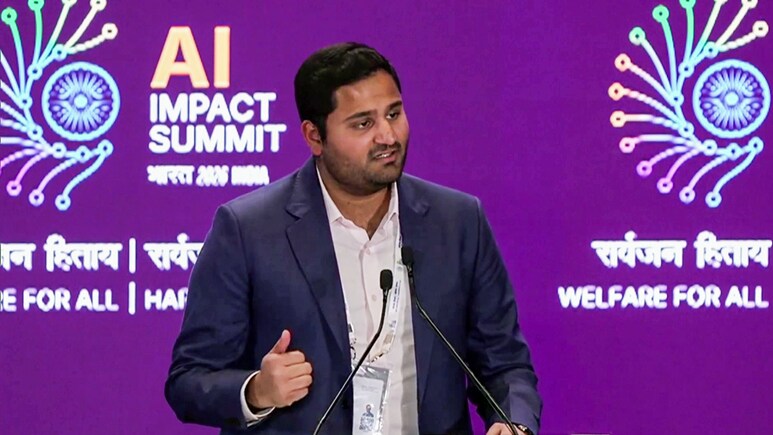
India must architect its own artificial intelligence (AI) infrastructure rather than rely on imports, Adani Group executive director Jeet Adani said on Thursday, warning that AI will redefine national sovereignty.
Outlining a vision for India's 'Intelligence Century', the youngest son of business tycoon Gautam Adani emphasised three pillars of sovereignty - energy, compute and cloud, and services - as central to India's AI strategy.
-

-
 World-Class Chefs, Food And Music: The Fun Side Of NDTV World Summit 2026
 -
 AI, Consciousness And Dharma: Why Ancient Indian Wisdom Matters Now
 -
 NDTV World Summit: What To Expect From PM Modi's Keynote Address
 -
 NDTV World Summit 2026: What To Watch Out For | PM Modi, Jaishankar, AI And Global Power Shifts
 -
 A World Between Orders: What To Expect At NDTV World Summit 2026
 -
 Who Is Rajiv Mehta? Lilavati Hospital Trustee To Speak At NDTV World Summit 2026
 -
 Alain Ebobisse, Africa50 CEO, To Attend NDTV World Summit 2026. All About Him
 -
 Kriti Sanon At NDTV World Summit: A Look At Her Career And Business Ventures
 -
 Ex-CIA Director To Decode 'War In Times Of AI' At NDTV World Summit
 -
 Who Is Vikram Rai, CEO, South Asia GE Aerospace, Set To Attend The NDTV World Summit 2026
India must also secure sovereignty across energy, compute and cloud, and services to safeguard its AI future, Jeet Adani said, speaking at India AI Impact Summit here.
"AI is written in code. But it runs on electricity... energy security is intelligence security. And sustainable energy becomes a competitive advantage," he said, outlining plans to integrate renewable energy clusters with AI data centres and industrial corridors.
On computing infrastructure, he added, "Cloud sovereignty does not mean isolation. It means autonomy... India must host critical AI workloads domestically... domestic access to high-performance compute for our startups, academia, defence, healthcare, and manufacturing." Adani stressed that AI should first serve Indian citizens, boosting agriculture, education, healthcare, manufacturing, logistics, and financial inclusion.
He cited the Adani Group's USD 100-billion commitment to a sovereign, green-energy-powered AI platform, calling it "the trigger for a 5-gigawatt, USD 250 billion integrated energy-and-compute ecosystem engineered to anchor India's Intelligence Revolution." "The question is no longer whether India will participate in the AI century. The question is whether the AI century will carry India's imprint in its infrastructure, in her intelligence, in her standards, and most importantly - in her values. I believe - deeply and without hesitation - that she will," he said. "Just as electricity-powered industry oil reshaped geopolitics, the internet transformed commerce," artificial intelligence will redefine sovereignty".
The central question before the country is not whether to adopt AI, but whether India imports intelligence - or architects it? Will it consume productivity - or create it? Will it plug into someone else's system - or build the system?" The time for asking is now over, he said.
Detailing his sovereignty pillars, Adani said AI performance depends on energy security, warning, "Under peak load, advanced processors generate extraordinary heat. Systems throttle when power falters. Performance drops. This is not just an engineering detail. It is a strategic truth. If a nation's energy systems are fragile, its intelligence systems are fragile." And so India's renewable expansion - solar, wind, storage - is no longer just climate policy. It is a strategic infrastructure policy. Renewable clusters will co-locate with AI data centres, and industrial corridors will integrate energy and compute planning.
On compute and cloud sovereignty, he said, if energy is the fuel, compute is the factory. In earlier centuries, nations built steel plants and shipyards. In the digital age, nations invested in semiconductor ecosystems. In the AI age, sovereign compute capacity becomes strategic infrastructure.
"It matters where compute resides, under whose jurisdiction it operates, (and) who controls access," he said. "Cloud sovereignty does not mean isolation. It means autonomy. It means India must host critical AI workloads domestically. It means we build data centre ecosystems at scale. It means domestic access to high-performance computing for our startups, academia, defence, healthcare, and manufacturing." Adani said if intelligence infrastructure is concentrated externally, strategic leverage concentrates externally and external concentration creates national fragility.
"In earlier centuries, nations built navies to secure trade routes. Today, we build sovereign compute to secure intelligence routes," he said.
On the pillar - services sovereignty for retaining India's AI dividend, he said India's IT revolution made it a global digital services powerhouse. But much of the productivity dividend accrued elsewhere.
The AI revolution gives India a once-in-a-century opportunity to change that equation.
"Our AI must first amplify our Indian productivity... enhance our agricultural resilience, personalise our education at massive scale, optimise our networks of logistics and ports, improve our energy and distribution efficiency, modernise our manufacturing competitiveness, expand our healthcare diagnostics across rural India and deepen our financial inclusion across Tier 2/3 towns and villages," he said.
AI must become a force multiplier for Indian citizens before it becomes a margin multiplier for others, he said. "This is not protectionism. This is preparedness. This is not isolation. This is strategic maturity." Recalling Adani group's previous announcement of investing USD 100 billion to build a sovereign, green-energy-powered AI infrastructure platform, he said the data centre expansion will trigger a 5-gigawatt, USD 250 billion integrated energy-and-compute ecosystem engineered to anchor India's Intelligence Revolution.
"By integrating renewable energy, grid resilience, and hyperscale compute into a unified architecture, this commitment ensures that India's AI future is not only powered but secured, sovereign, and built at a national scale," he said.
(Except for the headline, this story has not been edited by NDTV staff and is published from a syndicated feed.)
(Disclaimer: New Delhi Television is a subsidiary of AMG Media Networks Limited, an Adani Group Company.)
Track Latest News Live on NDTV.com and get news updates from India and around the world

