





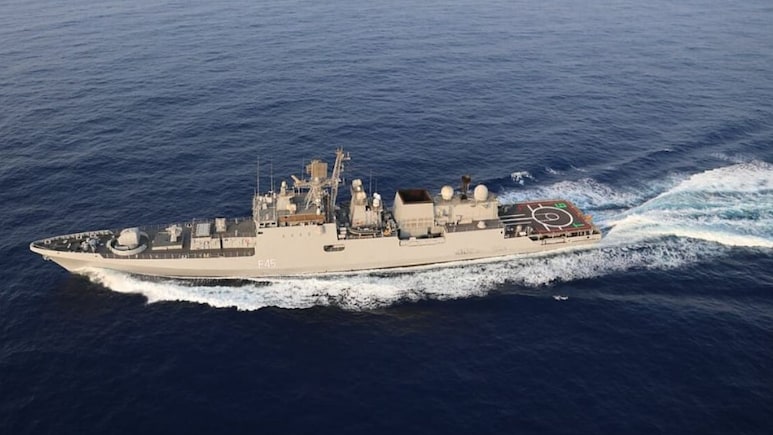
Every time Indian and Pakistani warships end up close enough to touch, the story that follows tends to get told as one about rivalry - two militaries, two flags, another round in a decades-old contest. That framing isn't wrong, exactly, but it skips past a more useful question: What does a navy actually owe the sea and the people on it, separate from who it happens to be facing that day?
A warship's job doesn't stop at being combat-ready. It also has to navigate safely, keep its manoeuvres predictable, honour whatever confidence-building arrangements its country has signed onto, and be willing to help a stranger in trouble regardless of the flag they sail under. Judged against that fuller checklist rather than just the headline of 'collision', the comparison between how India's and Pakistan's navies have behaved in the same waters starts to look like a story which is less about rivalry and more about professionalism.
Start with the precedent everyone keeps returning to: the 2011 encounter between INS Godavari and PNS Babur in the Gulf of Aden. India's account was that Babur closed dangerously on Godavari and broke navigational safety rules, along with Article 10 of the 1991 bilateral agreement. Pakistan's account was different. It maintained that Godavari had interfered with a Pakistani humanitarian operation involving the hijacked MV Suez, and that the dangerous manoeuvring ran the other way.
READ | Pak Ship Collides With Indian Navy Unit, Delhi Summons Islamabad's Envoy
The reason Article 10 exists is worth restating. The rule requiring naval vessels and submarines to keep a minimum distance of three nautical miles isn't about affection between the two navies. It assumes the opposite. It assumes India and Pakistan will keep disagreeing strategically, and it creates a rule that reduces the odds of an accident.
Distance buys time - to identify what the other ship is doing, to radio a warning, to correct course before anything touches. Close the distance suddenly and unexpectedly, and that time disappears, which can be genuinely dangerous between two states that both carry nuclear weapons.
It would be easy to turn one bad manoeuvre into a claim that Pakistan simply doesn't respect maritime treaties. The record doesn't support that. Pakistan ratified UNCLOS (United Nations Convention on the Law of the Sea) in 1997 and has folded major IMO (International Maritime Organization) instruments - SOLAS (Safety of Life At Sea)-related conventions, STCW (Standards of Training, Certification and Watchkeeping) among them - into its own domestic law.
A sweeping claim about treaty rejection is not just harder to prove; it's the wrong charge. The question is narrower and, because it's checkable against radar and radio logs, more serious: did the Pakistani vessel involved in the recent incident hold a safe speed, keep a safe distance, answer the warnings it was given, and stick to the bilateral mechanism Islamabad signed?
In January 2024, INS Sumitra rescued 36 people - 19 of them Pakistanis - from two separate hijacked fishing vessels in under 36 hours, checking on their condition once the ships were secured. Seven weeks later, INS Kolkata led the operation against the hijacked bulk carrier MV Ruen, combining surveillance aircraft, warships and MARCOS commandos until all 35 pirates surrendered and the 17 crew still aboard came home unhurt - one other original crew member had already been evacuated earlier, after being injured, by INS Kochi during an earlier phase of the same standoff.
In April 2025, INS Trikand's medical team boarded a fishing vessel in the central Arabian Sea to suture and splint a badly injured Pakistani sailor and hand over medicine before the boat carried on its way. Different missions, same underlying habit: an Indian warship treating a person in danger as the priority, ahead of who that person's passport says they are.
Track Latest News Live on NDTV.com and get news updates from India and around the world

