





- Over 8,600 complaints filed against judges from 2016 to 2025, peaking in 2024 with 1,170 complaints
- Complaints against judges handled by Chief Justices and investigated internally before possible removal
- Focus on complaints against judges after outrage over section on 'corruption' in judiciary in school book
The Supreme Court exploded Thursday morning as it questioned references to 'corruption in the judiciary' in a newly-published NCERT Class VIII Social Science textbook.
A bench led by Chief Justice Surya Kant demanded accountability from the federal government and the National Council of Educational Research and Training, and warned both "we need to find out who is responsible… heads must roll". The court also issued a blanket ban on the entire book.
Ironically, the court's outrage has prompted questions about how 'corruption in the judiciary' and how such charges are actually handled instead of quashing talk about the whole affair.
This is particularly significant given last year's drama over a large pile of cash recovered from the home Justice Yashwant Varma, then a judge in the Delhi High Court. Under intense public scrutiny, the court set up a three-member committee that recommended his impeachment.
How many complaints?
Data presented in the Lok Sabha in February 2026 indicates over 8,600 complaints were filed against sitting judges over the past decade, i.e., from 2016 to 2025.
The number peaked in 2024 with 1,170 complaints against the judiciary, followed by 1,102 in 2025, 1,037 in 2019, and 1,012 in 2022. The fewest complaints were in 2020 – 518 were filed.
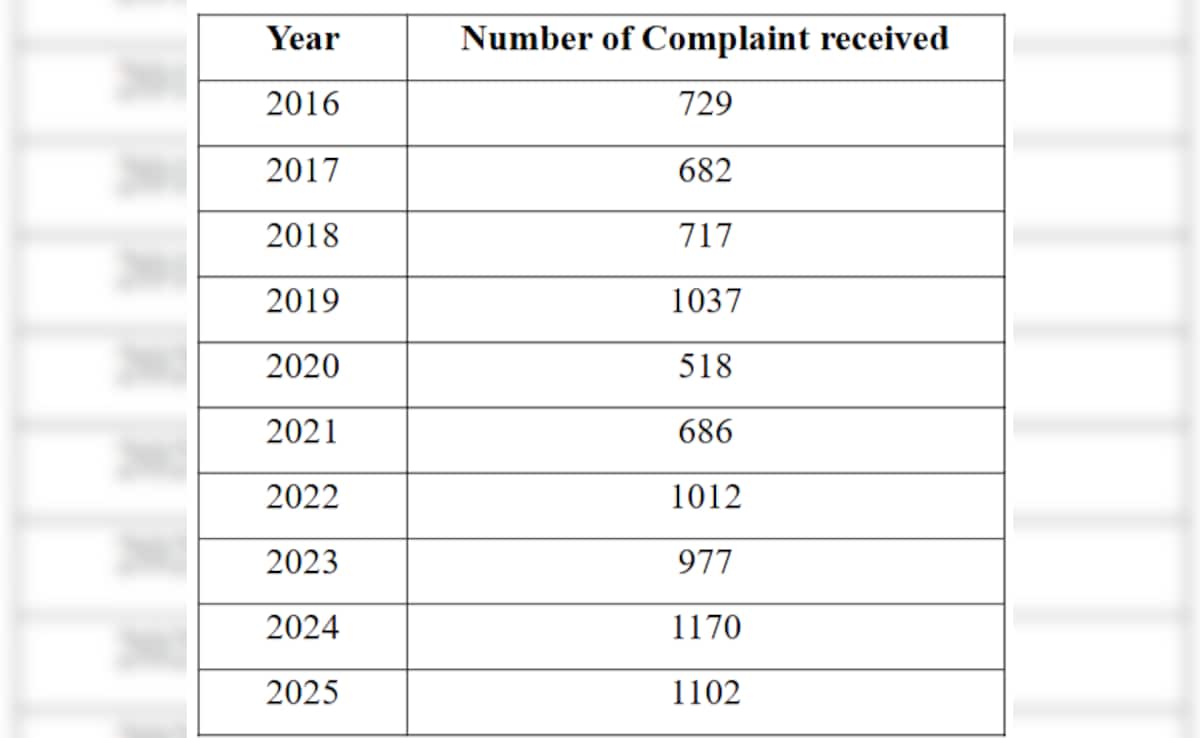
Source: Response to a question in the Lok Sabha in February 2026.
How does the judiciary handle complaints?
Starting from the top, the Chief Justice of India is authorised to receive complaints against judges assigned to the Supreme Court and also the Chief Justice of any High Court.
Complaints against a High Court judge are received by the Chief Justice of that court.
All complaints against High Court judges and Chief Justices are first investigated by an 'in-house mechanism' – as in the case of Justice Yashwant Varma.
Meanwhile, per Article 235 of the Constitution, disciplinary control over district and subordinate courts rests with the High Court of that state. Therefore, complaints against a district or lower court judge will be taken up by the Chief Justice of the state within which that court operates.
The Supreme Court's guidelines on this issue state that if a complaint is received, the Chief Justice will first seek a reply from the judge in question. If the Chief Justice is dissatisfied with the answer or feels the matter requires investigation, an internal committee will be set up.
And, during that inquiry, if the committee feels the alleged misconduct is of a 'grave' nature, i.e., one that requires the judge's removal, it can ask him/her to resign.
Notable cases of judicial corruption
The most recent, of course, is Justice Varma.
A large pile of burnt cash was found at his Delhi residence in March 2025; this was after firefighters were called out on Holi to put out a blaze that spread to an external storeroom.
The money – Rs 15 crore, by some estimates – was found in the storeroom. Justice Varma firmly denied link between the money and himself, or any other member of his family.
The Supreme Court, recognising this as a serious test of the judiciary's integrity, transferred the judge back to his parent court, the Allahabad High Court, and ordered an internal investigation.
The committee recommended his impeachment, which is now pending with the government.
Other major cases include a judge assigned to the National Company Law Appellate Tribunal.
Justice Sharad Kumar Sharma had recused himself from a case in August 2025 claiming pressure from a senior figure in the judiciary who wanted to influence the outcome of a hearing.
The hearing involved a plea by Byju's founder Byju Raveendran over an insolvency petition against his company. The NCLT, or National Company Law Tribunal, had ordered insolvency proceedings after the Board of Control of Cricket in India claimed a Rs 159 crore default.
"We are anguished to observe that one of us, Member (Judicial), has been approached by one of the most revered members of the higher judiciary of this country for seeking an order in favour of a particular party. Hence, I recuse (myself from) hearing the matter," Justice Sharma had said.
The recusal triggered a debate on corruption, influence peddling, and opacity in the judiciary.
And, in 2018, a tribunal judge, RK Mittal was linked to the fraudulent withdrawal of Rs 50 crore earmarked for compensations. The judge, it was alleged, colluded with five lawyers, who controlled 91 per cent of claimants, and siphoned funds meant for families of accident victims.
The Enforcement Directorate investigated the case and, in July 2019, after an inquiry by the Supreme Court also, Mittal was sacked from his post on the Railway Claims Tribunal, or RCT.
In March last year the federal agency attached 24 properties linked to Mittal.
Seven years before that, in 2011, Soumitra Sen became the first judge in independent India to be impeached by the Rajya Sabha over misappropriation of funds.
Sen, then with the Calcutta High Court, was accused of diverting Rs 33 lakh while serving as a court-appointed receiver in a legal dispute, and retaining the funds for personal use even after his elevation to the judiciary. He resigned before the Lok Sabha could impeach him.
After his resignation, he was not prosecuted.
Government vs judiciary flashpoints
The two sides clashed over the National Judicial Appointment Commission Act that sought to replace the collegium system currently used for the appointment of judges.
Nearly all parliamentary parties, with the exception of Tamil Nadu's AIADMK, ratified the law.
But, in October 2015, the Supreme Court struck down the amendment in a 4:1 ruling.
In April 2025 Jagdeep Dhankhar, then the Vice President of India, made comments about "judicial overreach", triggering a massive political and legal row.
It began with the Supreme Court using its inherent powers under Article 142 to resolve a standoff between the Tamil Nadu government and Governor RN Ravi over the delay in granting assent to bills. Dhankhar, who was also the de facto Rajya Sabha Chairperson hit out at the judiciary, comparing Article 142 to a "nuclear missile" available to it against democratic forces.
And Kiren Rijiju, when he was Union Law Minister, clashed with the Supreme Court several times, including once in March 2023 when he said, "Some retired judges and activists are part of 'anti-India' gang and are trying to make the judiciary play the role of an opposition party."
In September 2022 a retired top court judge, Justice BN Srikrishna, said, "Today, things are very bad. I must confess, if I were to stand in a public square and say I don't like the face of the Prime Minister… somebody might raid me, arrest me, throw me in jail without giving me any reason."
Rijiju criticised Justice Srikrishna, saying, "Those who speak all the time without any restrictions to abuse the popularly elected Prime Minister are crying about freedom of expression!”
In May 2023 Rijiju replaced as Law Minister.
Track Latest News Live on NDTV.com and get news updates from India and around the world

