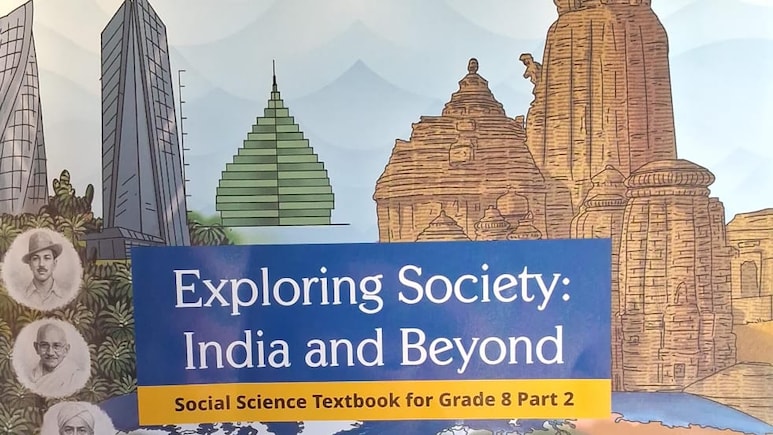
The Supreme Court of India has ordered the immediate withdrawal of a newly released Class 8 Social Science textbook by the National Council of Educational Research and Training (NCERT), calling a chapter on the judiciary a "calculated move to undermine" the institution and observing that it prima facie amounts to criminal contempt. The court has directed removal of all physical and digital copies and asked NCERT and state education authorities to file compliance reports within two weeks.
NCERT has termed the inclusion of the topic "purely unintentional," halted distribution, and said the chapter will be rewritten for the 2026-27 academic session.
What Triggered the Court's Intervention?
The controversy centres on Exploring Society: India and Beyond, Vol II, brought out on February 24, 2026. Chapter 4, "The Role of the Judiciary in Our Society" (pages 125-142), referred to corruption in the judiciary, hundreds of complaints against judges, alleged lack of transparency, and excerpts from a former Chief Justice of India's speech.
Taking note of a newspaper report, the top court said it was "nearly shocked" by the inclusion of such content in a foundational curriculum.
"The framers of our Constitution were profoundly conscious and took care that constitutional responsibilities are prescribed to legislature, judiciary and executive so that they remain capable of performing with autonomy and preserve the democratic fabric of our nation," the bench observed.
It added that presenting such material at the school level "warrants a rigorous review" for its potential impact on the functioning of the judiciary.
Court's Directions: Recall, Seizure, Compliance
The court's order is sweeping:
- All copies, hard and soft, must be removed from public access immediately.
- No instruction is to be imparted using the book in any form.
- NCERT, in coordination with Union and State education departments, must ensure complete withdrawal from schools and retail outlets.
- The Director of NCERT is responsible for immediate seizure of copies already supplied.
- Principal Secretaries of Education in all States must comply and submit reports within two weeks.
- A compliance report must be filed before the court.
The bench noted that after a February 24 news article flagged the issue, the Secretary General of the court was asked to verify whether NCERT had indeed released such a publication.
NCERT's Clarification: "Error of Judgement"
In a late-night statement, NCERT said it holds the judiciary in the "highest esteem" as the protector of Fundamental Rights and the upholder of the Constitution.
"The aforesaid error is purely unintentional and NCERT regrets the inclusion of inappropriate material in the said chapter," it said.
The council added that the Department of School Education & Literacy under the Ministry of Education had also observed the issue and directed that distribution be kept on strict hold, a direction it has complied with.
NCERT reiterated that the objective of the new textbooks is to strengthen constitutional literacy and informed democratic participation, not to question or diminish any constitutional authority. The chapter will be rewritten in consultation with appropriate authorities and made available for the academic session 2026-27.
How Does NCERT Publish Its Textbooks?
The episode has brought the textbook publishing process under scrutiny.
1. Anchored in the National Curriculum Framework
NCERT develops textbooks in line with the National Curriculum Framework (NCF). Expert committees comprising subject specialists, academics and educators draft the content.
2. Multi-Level Review
Draft chapters typically undergo internal review and consultation before approval. NCERT describes the process as academically rigorous and consultative.
3. Printing and Distribution
The Publication Division oversees printing in Hindi, English and Urdu through empanelled printers. Books are distributed via:
- Regional centres
- Wholesale agents
- Retail networks
- Digital editions are made available for free download.
4. Role of Boards and States
The Central Board of Secondary Education recommends NCERT textbooks for Classes 9-12.
Since education is in the Concurrent List of the Constitution, State Councils of Educational Research and Training (SCERTs) and State Boards may adopt, adapt or prepare their own textbooks. There is no move to impose a uniform curriculum across the country.
Beyond The Recall
For now, the focus is on compliance, seizure of copies, submission of reports, and rewriting the chapter. But the episode has sparked a larger debate about how constitutional institutions are portrayed in classrooms and how academic scrutiny is balanced with institutional respect.
As compliance reports are awaited, the controversy has not only halted a textbook's circulation but also placed NCERT's editorial processes under intense judicial and public scrutiny.
