





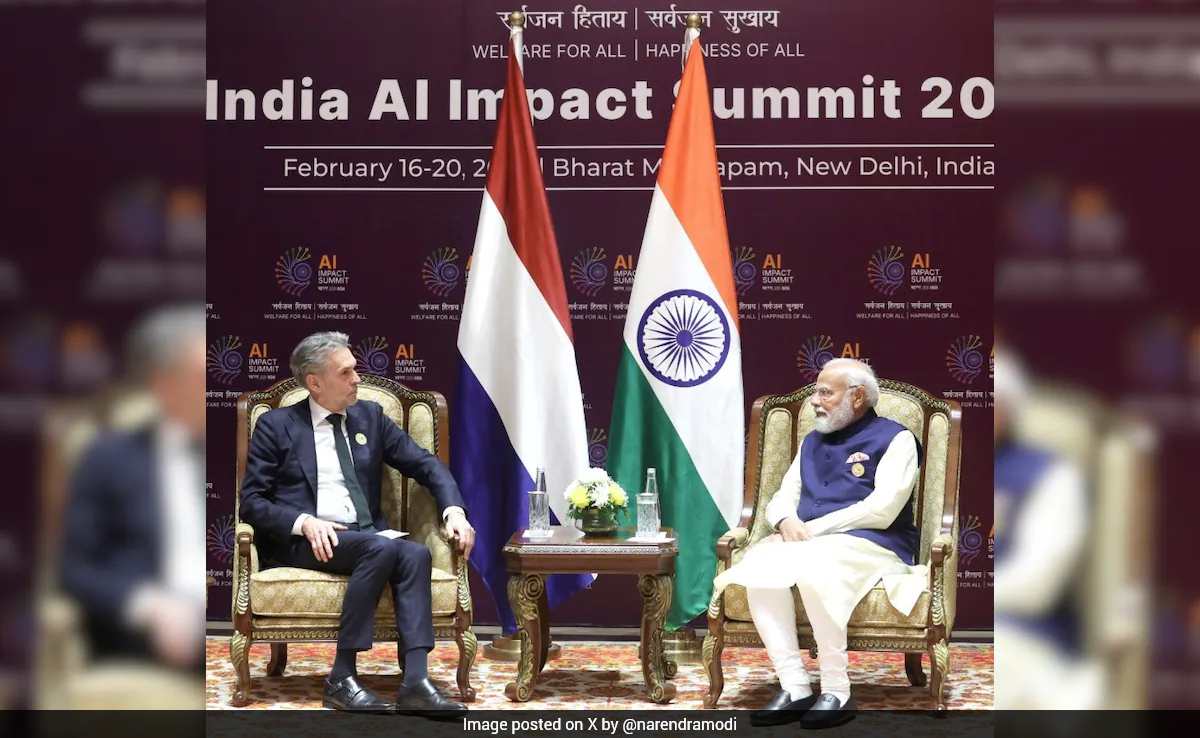
India and the Netherlands are setting the stage for a major expansion of their strategic partnership, with a sharp focus on artificial intelligence, semiconductors, water management and emerging technologies, following talks between Prime Minister Narendra Modi and his Dutch counterpart Dick Schoof on the sidelines of the AI Impact Summit in New Delhi.
Responding to a question from NDTV's Senior Executive Editor Aditya Raj Kaul after his meeting with Prime Minister Modi, Prime Minister Schoof said the two leaders held an extensive discussion covering technology, innovation and long-term cooperation, particularly looking ahead to the next decade of India-Netherlands relations.
"I just had a meeting with Prime Minister Modi a few moments ago, and we had a long conversation about different topics," Schoof said. "One of the key areas was the strategic arrangement between India and the Netherlands, especially in semiconductors, but also water management, defence, agriculture and other sectors."
Schoof, who is leading the Dutch delegation to the AI Impact Summit, said Dutch businesses are increasingly keen to invest and expand in India. He noted that sectors such as water management and semiconductors present natural areas of synergy, given Dutch technological expertise and India's scale and growing demand.
"I think that in the next decade we can see many new initiatives around these issues," he said, adding that India's rapid growth makes it an attractive destination for long-term partnerships.
Met Prime Minister Dick Schoof on the sidelines of the AI Impact Summit. The Netherlands has made significant strides in the digital and AI world and our nations will work together in these sectors. We deliberated on strengthening linkages in semiconductors, mega water projects,… pic.twitter.com/tLl9dsyPVp
— Narendra Modi (@narendramodi) February 19, 2026
A central theme of the discussions was cooperation in the semiconductor ecosystem. Schoof confirmed that India has been in talks with ASML, the Dutch firm that plays a critical role in the global chip manufacturing supply chain. He said there is a shared understanding of the need to build a robust semiconductor ecosystem, with participation from governments and industry on both sides.
"I know that India has talked with ASML about the responsibility to create an ecosystem together," Schoof said, pointing out that Indian companies, including Tata, have shown strong interest in the semiconductor space. "That would be very good for India, but of course also for the Netherlands. We've got the chip business, and ASML is absolutely crucial in that industry."
The remarks align closely with India's Ministry of External Affairs (MEA) statement on Prime Minister Schoof's visit, which said the two leaders discussed strengthening cooperation in emerging technologies, including AI, quantum technologies and semiconductors. The Netherlands, as Co-Chair of the Working Group on AI for Economic Growth and Social Good, has played a significant role in shaping the agenda of the AI Impact Summit.
According to the Ministry, PM Modi thanked Prime Minister Schoof for attending the summit and appreciated the Netherlands' contribution to global AI governance discussions. Prime Minister Schoof, in turn, expressed confidence that the Summit Declaration would help steer future international policy debates on AI.
Both leaders acknowledged that the rapid rise of artificial intelligence marks a pivotal moment in technological evolution, with transformative potential for societies worldwide. They agreed that India and the Netherlands should work closely to harness AI for social good and inclusive economic growth.
Beyond technology, the meeting reviewed the steady progress in the broader India-Netherlands partnership. The two leaders reaffirmed their commitment to deepen cooperation in water, agriculture and health, clean energy, green hydrogen, defence and security, education, and people-to-people ties. Water management, an area where Dutch expertise is globally recognised, featured prominently in the discussions.
The conclusion of negotiations on the India-EU Free Trade Agreement was also highlighted as a milestone that could unlock new opportunities for trade and investment between India and the Netherlands. Both sides agreed that the agreement provides a historic opportunity to realise the full potential of their economic partnership.
On regional and global issues, the leaders exchanged views on key international developments and reaffirmed their commitment to working together on multilateral platforms.
PM Modi reiterated India's position on the conflict in Ukraine, emphasising the need for its earliest possible cessation. Both leaders also agreed to strengthen global efforts to combat terrorism.
Over the years, the India-Netherlands relationship has expanded well beyond traditional trade and investment. The partnership now spans strategic sectors such as technology and innovation, defence and security, renewable energy, education and maritime cooperation, reflecting growing trust and convergence of interests.
With AI, semiconductors and sustainable technologies now at the heart of the agenda, the Modi-Schoof talks signal that India and the Netherlands are positioning themselves as long-term partners in shaping the technologies that will define the coming decade.
Track Latest News Live on NDTV.com and get news updates from India and around the world

