





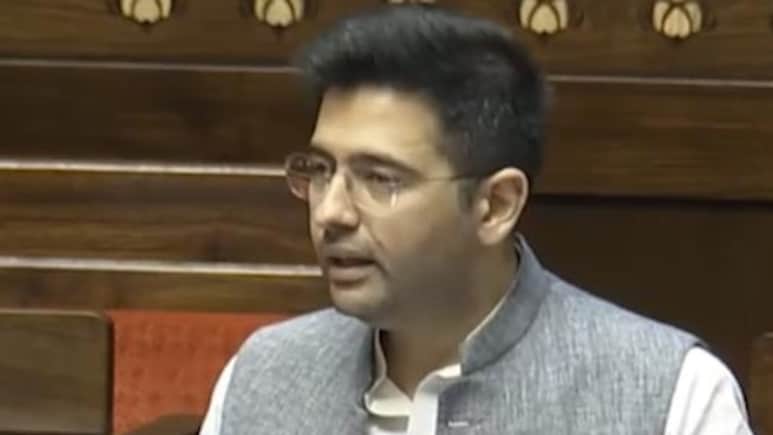
Aam Aadmi Party member Raghav Chadha in the Rajya Sabha on Monday demanded that the long-term capital gains (LTCG) tax should be abolished for individual investors in the equity market, arguing that it would boost household wealth and channel savings from gold and real estate into other productive assets.
Participating in the debate on the Union Budget 2026-27 in the Rajya Sabha, Chadha called for a statutory formula to ensure automatic inflation-based wage adjustments across corporates, factories, and gig workers, arguing that while government employees receive dearness allowance and pay commission benefits, a majority of India's formal workforce has no statutory inflation protection, leaving wage growth largely to employer discretion.
Chadha claimed that the Securities Transaction Tax, which was hiked in this Budget, was originally introduced to replace LTCG.
He reminded that STT was introduced when Long-Term Capital Gains (LTCG) tax on equities was zero and was meant to be a simple upfront levy irrespective of profit or loss. With both STT and LTCG now in place, investors are being disincentivised, Chadha observed.
He urged the government to make LTCG on equities nil for individual investors, citing global examples such as Switzerland, Singapore, the UAE, Hong Kong, New Zealand, Qatar and Malaysia, where long-term equity gains are largely tax-free.
"Long Term Capital Gains Tax on equities should be made nil in this country for individual investors... I would like the LTCG to be zero when STT is being raised," the AAP member said.
He said the increase in STT announced in the Budget was a good thing as it will dissuade retail investors from speculative trading.
Lauding the increase in NRIs investment limit, he urged that the government should also introspect on why FIIs (foreign institutional investors) are leaving India.
He claimed that the hike in NRI investment limit came after foreign portfolio investors withdrew nearly USD 23 billion in the previous financial year.
While the hike in NRI investment limit is positive, he urged the government to address the structural reasons behind continued foreign investor exits, rather than relying solely on NRI inflows.
Chadha termed the absence of income tax slab changes in the Budget 2026-27 a major disappointment for the salaried middle class.
He flagged the low allocation towards public healthcare as deeply concerning. India currently spends only about 2 per cent of total government expenditure on health.
He contrasted this with countries like the US, Germany, the UK and Japan, with much higher spending on healthcare as a percentage of their GDP.
Besides, Chadha proposed placing all land and property records on a blockchain-based digital registry. A transparent, time-stamped and tamper-proof system, he said, would reduce disputes and curb fraud.
(Except for the headline, this story has not been edited by NDTV staff and is published from a syndicated feed.)
Track Latest News Live on NDTV.com and get news updates from India and around the world

