





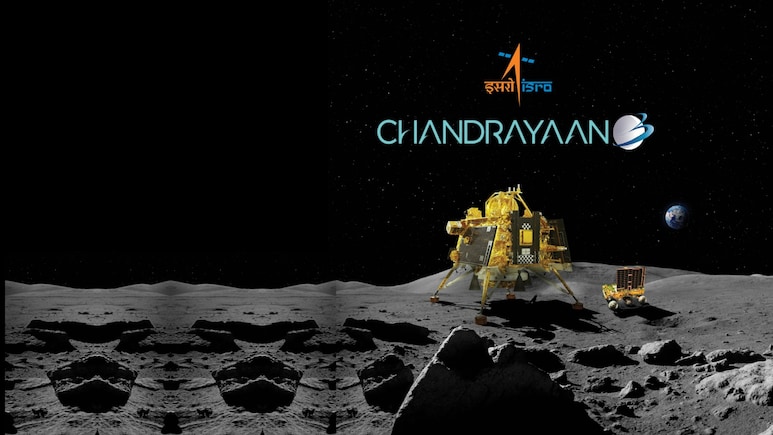
- Vikram lander's unplanned hop revealed lunar soil diversity at Moon's south pole
- Chandrayaan-3 landed near Moon's south pole, first to explore this region successfully
- Hop experiment disturbed regolith, exposing fresh layers beneath porous surface coating
One small hop for ISRO's Vikram lander and a giant leap towards deciphering secrets of lunar geology. India's Chandrayaan-3 mission continues to throw surprises well after it completed its historic mission. The new understanding opens doors for NASA to set up a permanent base on the lunar surface through its Artemis mission.
In the closing hours of one of India's most historic space missions, the Chandrayaan-3's Vikram lander performed an unplanned manoeuvre that is now reshaping scientific understanding of the Moon's south polar surface. What began as a last minute call to use leftover fuel has turned into a landmark experiment revealing that the lunar soil at Shiv Shakti Point is far more diverse and complex than previously believed.
Chandrayaan 3, launched on July 14, 2023, was designed to demonstrate India's ability to achieve a safe and soft landing on the lunar surface, a goal that had eluded the Chandrayaan 2 mission. On August 23, 2023, Vikram successfully touched down near the Moon's South Pole, making India the first country in the world to land in this unexplored region.
The mission, equipped with the Pragyan rover and multiple scientific payloads, was intended to operate for roughly one lunar day or about 14 Earth days. During this period, instruments such as the Chandra's Surface Thermophysical Experiment (ChaSTE) began examining the thermal and physical properties of lunar soil called lunar regolith, providing the first in situ measurements from this high latitude terrain.
As the mission approached its end, with the long and frigid lunar night looming, ISRO scientists faced a unique situation. The Vikram lander still had residual fuel. In a move that was not part of the original plan, engineers decided to attempt a controlled lift off, from the lunar surface. This resulted in the now famous Hop Experiment, where the lander fired its engines, lifted itself roughly 40 to 50 centimetres, and landed a short distance away from its original position.
At first glance, the manoeuvre was a technological demonstration. It proved that India could not only land on the Moon but also potentially take off from it, a capability that is crucial for future sample return missions. But scientifically, the impact was far deeper.
The hop shifted Vikram to a slightly different patch of the lunar surface. This allowed the on-board ChaSTE to penetrate and study the regolith at a second location. This seemingly small change unlocked a rare opportunity, because the lunar South Polar region has never been directly sampled either by humans or robotic missions before.
More importantly, the act of firing the engines disturbed the surface itself. The rocket plume blew away the topmost loose layer of regolith, stripping off about three centimetres of what scientists describe as a fluffy, porous coating. Beneath this layer, ChaSTE was able to access fresh material that had never been directly exposed before.
What emerged from the data is a striking picture of variability in the Moon's soil at Shiv Shakti Point. Scientists found that the lunar regolith is not uniform but layered, almost like a cake. The upper few centimetres consist of a loose, highly porous material, while just below lies a denser, more compact layer with very different thermal and mechanical properties.
This rapid change over just a few centimetres is critical. It shows that the Moon's surface at the South Pole is highly heterogeneous, meaning that its physical properties can vary significantly even across very short distances. Such variability has major implications for future missions that plan to drill, excavate, or build on the lunar surface.
The ChaSTE measurements during the post hop phase also captured how the surface behaves during lunar twilight, a slow transition from day to night that lasts for hours due to the Moon's long day-night cycle. This allowed scientists to observe how the regolith cools and radiates heat in real time, offering new insights into how the Moon manages solar energy.
These findings come at a crucial time in global space exploration. The lunar South Pole has become the focus of intense international interest, particularly under NASA's Artemis programme, which aims to send humans back to the Moon and eventually establish a sustained presence there. The region is believed to host water ice in permanently shadowed craters, making it a potential resource hub for future lunar bases.
Understanding the thermophysical and geotechnical properties of the regolith is essential for these ambitions. The discovery that the soil is highly variable means that landing stability, construction, mobility, and even astronaut safety will depend on precise, local scale measurements rather than broad assumptions.
In that sense, the Chandrayaan 3 hop experiment stands out as a rare case of opportunistic science delivering high value results. What was never planned as a major experiment has turned into one of the most unique datasets ever obtained from the Moon's South Pole.
For India, this adds another major scientific milestone to Chandrayaan's legacy. Chandrayaan 1 had changed global understanding of the Moon by discovering water molecules on its surface in 2008. Now Chandrayaan 3 is going deeper, revealing how the Moon's surface behaves at a granular level in one of its most extreme environments.
At Shiv Shakti Point, even a 50 centimeter hop has shown that the Moon still holds many secrets, waiting to be uncovered layer by layer.
Track Latest News Live on NDTV.com and get news updates from India and around the world

