



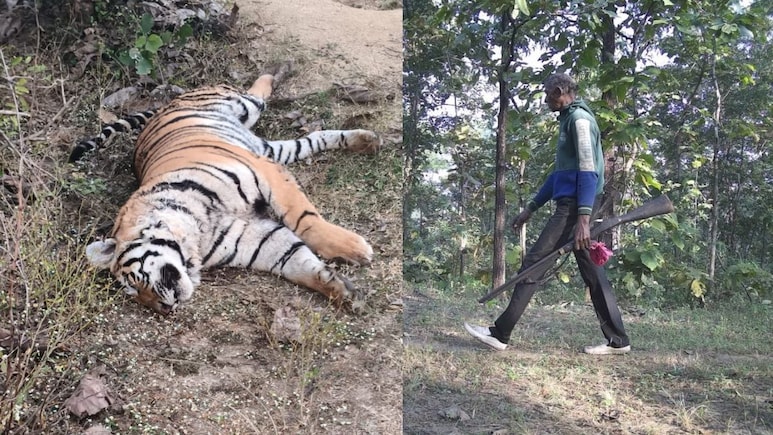
Long celebrated as India's "Tiger State," Madhya Pradesh is facing an unsettling and grim paradox. While official announcements continue to applaud the rise in tiger numbers, a darker narrative is unfolding in the state's forests, one marked not by conservation success, but by an alarming trail of tiger carcasses. One after another, tigers are dying under mysterious and often suspicious circumstances, raising serious questions about protection, enforcement, and accountability.
Madhya Pradesh has already lost 54 tigers in 2025. Since the launch of Project Tiger in 1973, the state has never recorded such a high number of tiger deaths in a single year.
In just one week, six tigers have died across the state. On Saturday, another tiger carcass was discovered in the Bandhavgarh Tiger Reserve, one of India's most prominent conservation landscapes. Official data reveal that nearly 57 per cent of these deaths are classified as "unnatural," attributed to causes such as poaching, electrocution, or unexplained circumstances.
The latest carcass was found during a field survey conducted under the All India Tiger Estimation exercise in the Chandia forest range of Umaria district. The tiger's body was located near a power line, immediately triggering suspicion. Forest officials have acknowledged that death due to electrocution cannot be ruled out. While authorities insist that the incident is under investigation, conservationists argue that this death is part of a much larger and deeply troubling pattern.
Responding to the incident, Minister of State for Forests Dilip Ahirwar said that the department takes every tiger death seriously. He stated that whenever such an incident occurs, expert teams are rushed to the site, investigations are conducted, and action is taken based on findings. He added that in the latest case, electrocution is being examined as a possible cause and assured that the department, along with the administration, is closely monitoring the situation.
Despite official assurances, the presence of poachers inside protected forests remains a persistent threat. Images and intelligence inputs indicating poaching activity are not uncommon in Madhya Pradesh's reserves. Recently, a high-profile international wildlife trafficking case underscored the scale of the problem.
In a joint operation by the Madhya Pradesh State Tiger Strike Force and the Wildlife Crime Control Bureau, Yangchen Lakhungpa, an alleged kingpin of international wildlife trafficking, was arrested on December 2, 2025, in Lachung, North Sikkim. Wanted under an Interpol Red Corner Notice, his arrest followed months of technical surveillance, and a dramatic operation conducted near the India-China border in sub-zero temperatures. Investigators say his network spanned India, Nepal, Tibet, and China.
The numbers show a steady and disturbing rise: 34 deaths in 2021, 43 in 2022, 45 in 2023, 46 in 2024, and already 54 deaths in 2025, with days still left in the year.
Forest officials have often attributed many of these deaths to territorial fights among tigers, but wildlife experts strongly contest this explanation. Wildlife activist Ajay Dubey has warned that the crisis extends beyond tigers, pointing out that a large number of leopards are also being killed. He alleges that poachers are operating inside reserves using electric wires and says the forest department's surveillance and intelligence mechanisms are failing. According to him, labelling this the highest number of tiger deaths in a single year since Project Tiger began should itself be a wake-up call.
In response to criticism, the Forest Department has announced stricter measures inside core zones. Tourists have been barred from carrying mobile phones, and notices have been issued to jeep drivers after videos surfaced showing vehicles approaching tigers too closely. However, conservationists argue that such measures may be misplaced. Dubey points out that guides and drivers often rely on mobile phones to report emergencies or breakdowns in remote forest areas, and banning phones could actually hamper safety and response time.
Adding to the controversy is an internal Forest Department report accessed by NDTV last year. The report highlighted serious negligence and procedural lapses in the handling of tiger death cases in major reserves like Bandhavgarh. It documented instances where Preliminary Offence Reports were not filed, post-mortems were conducted without videography, forensic investigations were left incomplete, and deaths were routinely classified as the result of animal fights without thorough examination.
Track Latest News Live on NDTV.com and get news updates from India and around the world

