

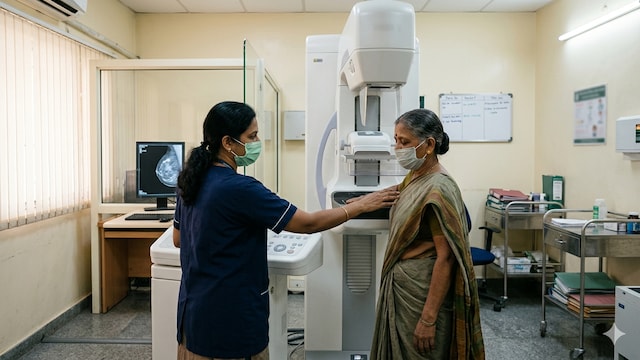
For many, a routine annual health check-up is a simple item to tick off a busy to-do list. For 70-year-old Mrs. K. P. Sarala, however, a proactive approach to her health proved to be life-saving. Though she felt entirely healthy and had no breast-related symptoms or palpable lump, she was aware of her increased risk: her mother had previously fought breast cancer. Given this background, her care team recommended a screening sono-mammography as part of her routine assessment.
The breast ultrasound revealed a tiny, 5 mm hypoechoic lesion. While easily dismissed as a harmless fibroadenoma, its subtle irregularities sparked clinical doubt. Guided by instinct and a concerning family history, the specialist refused to overlook it, classifying it as BI-RADS 4 for further investigation.
"A good radiologist doesn't just read an image they read when something quietly doesn't fit. That instinct, more than any measurement, is often what catches cancer early enough to matter," said Dr Shruthi P., Consultant Radiologist and Imaging, Manipal Hospital Electronics City.
A core biopsy initially revealed a duct papilloma with focal ductal carcinoma in situ (DCIS). Considering the biopsy findings, her family history, and clinical profile, breast-conserving surgery with wide local excision was planned. Because a 5 mm lesion is far too small to feel by hand, locating it during surgery required meticulous preparation. "Localising a lesion measuring just 5 mm requires extreme precision to avoid unnecessary tissue removal. We used intraoperative ultrasound to identify the lesion and placed a localisation wire across it to guide the excision with adequate margins," said Dr Abhinay Indrakumar Reddy, Consultant - Surgical Oncology, Manipal Hospital Electronics City.
Following excision, specimen mammography confirmed the lesion was completely removed, and a frozen-section examination showed no evidence of residual disease at the margins. Mrs. Sarala recovered smoothly and was discharged the next day.
However, the final histopathological examination delivered a vital revelation. Alongside the duct papilloma and DCIS, a very small focus of invasive ductal carcinoma was present. Given the extremely small size of the invasive component, her age, and overall clinical profile, a multidisciplinary team determined that additional systemic chemotherapy, radiotherapy, and axillary surgery were unnecessary. "The significance of early detection is that it allows us to de-escalate treatment. The smaller the cancer is when detected, the greater the opportunity for precise surgery. Detecting it at such an early stage spared this patient from extensive surgery and gruelling adjuvant therapies." explained Dr Abhinay Indrakumar Reddy.
Reflecting on her treatment journey, Mrs. Sarala commented, "I went for a routine health check-up at Manipal hospital and found that there was a small lesion during mammogram. The doctor asked to do a biopsy and IHC upon which it was instructed to remove it surgically. After surgery they did further tests on the tissue and found that it was early stage cancer. There were no symptoms but we identified it at the very beginning. Thank you health checkup up team and Dr Abhinay's team for taking the time in explaining everything and supporting us through a difficult phase."
In 2022, India recorded 1,92,020 new breast cancer cases (26.6% of female cancers) and 98,337 tragic deaths, highlighting its severe impact. Despite studies showing that Indian community screenings detect 1.6 cancers per 1,000 women, national NFHS-5 data reveals that a mere 9 per 1,000 women have ever undergone testing.
Mrs. Sarala's case starkly illustrates this gap: had her 5 mm occult lesion been left under observation, it could have progressed to a late-stage cancer requiring aggressive chemotherapy and radiation. Ultimately, her journey underscores how routine check-ups catch hidden risks early, transforming a potentially devastating diagnosis into a story of timely, life-saving recovery.
(By Dr Shruthi P., Consultant Radiologist and Imaging, Manipal Hospital Electronics City and Dr Abhinay Indrakumar Reddy, Consultant - Surgical Oncology, Manipal Hospital Electronics City)
Disclaimer: The opinions expressed within this article are the personal opinions of the author. NDTV is not responsible for the accuracy, completeness, suitability, or validity of any information on this article. All information is provided on an as-is basis. The information, facts or opinions appearing in the article do not reflect the views of NDTV and NDTV does not assume any responsibility or liability for the same.