

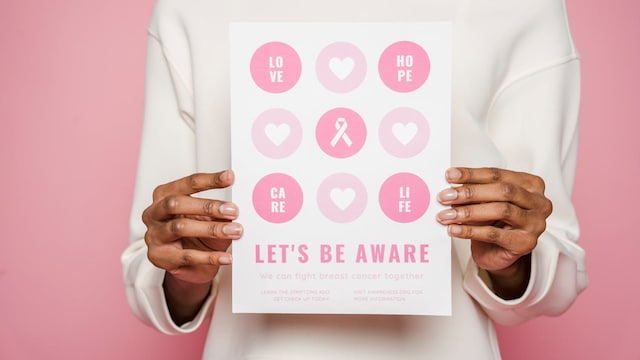
Two of my close friends have been diagnosed with breast cancer. Their journeys have not been easy. There have been difficult days, uncertainty, treatment and the emotional toll that a cancer diagnosis brings, not just for the person diagnosed but also for their loved ones. Today, both are doing well and have recovered with their treatment.
But I l also know women who have not been as fortunate. When breast cancer is detected at an advanced stage, treatment can become more challenging and the outcomes can be devastating.
These experiences have changed the way I personally look at breast cancer awareness. Behind every statistic is a woman, a family and a life that is suddenly interrupted by a diagnosis no one was prepared for.
Breast cancer is the most commonly diagnosed cancer among women globally. In India, it is also the leading cancer among women, and the numbers underline the scale of the challenge.
Estimates published by India's National Cancer Registry Programme projected approximately 2.39 lakh new breast cancer cases in the country in 2025.
Every year October, is breast cancer awareness month. Looking at the rising numbers it's important to improve awareness and also access to diagnosis and timely treatment remains critical. While, the conversation around breast cancer is often reduced to awareness ribbons, social media campaigns and reminders to get checked, how do we translate this awareness into action.
Do we know what changes in our breasts to look out for? Do we understand when we should speak to a doctor? And do we make time for screening when we feel perfectly healthy?
For many women, the answer may be no. I say this because I know of someone who delayed going to the doctor because her son was appearing for his board exams. By the time she finally went, it was too late. I also know someone who assumed her symptoms were just hormonal and delayed screening. By the time she reached out to her doctor, precious time had been lost.
As women, we often put our families first, dismiss symptoms as stress or hormones, or tell ourselves we'll get checked later. We are quick to schedule a doctor's appointment for a parent, a child or a partner, but far less proactive about our own health. Busy schedules, fear of a diagnosis, embarrassment and the assumption that being young or having no family history means being safe can all contribute to delays.
The problem is that breast cancer does not always announce itself with pain. A woman can feel well and still have an abnormality that needs medical attention.
Self-care is often associated with eating better, exercising, sleeping well or taking time off to recharge. But there is another aspect of self-care that deserves equal attention which is knowing your body and acting when something changes.
Being familiar with how your breasts normally look and feel can help you notice changes. These may include a new lump, a change in breast size or shape, skin dimpling, nipple inversion or unusual discharge.
READ | How Much Exercise Do You Really Need To Lower Your Breast Cancer Risk?
Not every breast lump or change is cancer. However, a new or persistent change should not be dismissed, even if it is painless. It deserves medical evaluation.
It is equally important to understand that being aware of changes is not the same as undergoing screening. Breast self-awareness cannot replace a mammogram or a clinical assessment when one is recommended.
Screening recommendations depend on factors such as age, family history and individual risk. Women should speak to their doctors about the most appropriate approach rather than assuming that one screening schedule suits everyone. And if you have a symptom, do not wait for your next routine screening appointment to get it checked.
As breast cancer awareness grows, technology is opening up new possibilities for earlier detection. One of the most promising developments is the use of artificial intelligence (AI) in mammography.
A mammogram which is an X-ray of the breast can identify suspicious changes before they become noticeable. AI systems can analyse these images, flag areas that may need closer examination and support radiologists in interpreting scans.
A 2025 study published in The Lancet Digital Health, involving more than 1 lakh women in Sweden, offers encouraging evidence. The study found that AI-supported mammography detected 6.4 cancers per 1,000 women screened, compared with 5.0 per 1,000 using standard screening. It also reported a reduction of approximately 44% in the radiologists' screen-reading workload.
The findings suggest that AI could help improve cancer detection while making screening more efficient. But the results of a Swedish screening programme cannot automatically be applied to India, where healthcare access, screening practices and available resources differ.
As Dr Raman Narang, Medical Oncologist and Hemato-Oncologist at MOC Cancer Care, New Delhi, explains, AI can act as an additional layer of support in breast imaging. "A mammogram is a special X-ray of the breast that helps detect cancer, sometimes even before a lump can be felt. AI works alongside radiologists by analysing these images and highlighting areas that may need closer attention."
The important distinction is that AI is not a replacement for medical expertise. It may flag an abnormality that needs further investigation, but it can also generate false alarms or miss cancer. A suspicious finding may require additional imaging or a biopsy before a diagnosis can be established.
Dr Ritu Dave, Medical Oncologist and Hemato-Oncologist at MOC Cancer Care, Pune, emphasises that the technology must be used in the right clinical context. "AI is not a substitute for a doctor's judgement. A suspicious scan does not automatically mean cancer, and a reassuring AI report cannot rule out cancer when symptoms persist." Even when it comes to mammogram's specifically, Dr Dave adds, "Women should also remember that mammography is not the only consideration. Any new breast lump, nipple discharge, nipple retraction, skin dimpling or unexplained change in breast shape warrants medical evaluation, regardless of age or a previous normal scan".
READ | No Lump, No Symptoms: Routine Check-Up Detects 5mm Breast Cancer In 70-Year-Old
For India, the promise of AI lies in supporting doctors and strengthening diagnostic services. But technology can make a difference only when women can access appropriate investigations, trained professionals and timely follow-up care.
Another question many women ask is - Can breast cancer be prevented?
There is no guaranteed way to prevent breast cancer. Some risk factors, including age, inherited genetic changes and family history, cannot be changed. Other factors, including alcohol consumption, physical inactivity and excess body weight after menopause, may influence risk.
Maintaining a healthy weight, staying physically active, limiting alcohol and discussing personal and family history with a doctor are a few steps towards reducing certain risks. However, even women who lead healthy lives can develop breast cancer.
Having no family history does not mean having no risk, either. Many women diagnosed with breast cancer do not have a known family history of the disease. This is why prevention, risk reduction, screening and early diagnosis must be understood as related but distinct parts of breast cancer care. No lifestyle change or screening test can offer complete protection.
Breast Cancer Awareness Month gives us an opportunity to start conversations that are often postponed. But the real measure of awareness is what happens after the pink ribbons come down. This conversation shouldn't end on the 31st of October.
Do we book the appointment we have been putting off? Do we ask our doctor about screening? Do we encourage a friend or family member to get a persistent breast change examined? Do we take symptoms seriously instead of waiting for them to become painful?
My friends' experiences have reminded me that a diagnosis can change a life in an instant, but the journey that follows is not the same for everyone. Early detection does not guarantee a cure, and an advanced diagnosis does not mean that treatment is futile. But timely medical attention can make a meaningful difference to the options available.
We cannot control every risk, and we cannot always prevent a diagnosis. What we can do is become more informed, recognise changes, seek medical advice promptly and make our health a priority.
Because for us women, self-care should be about living well. It must about giving ourselves the chance to act early, ask questions and seek help when something does not feel right.
Disclaimer: This content including advice provides generic information only. It is in no way a substitute for a qualified medical opinion. Always consult a specialist or your own doctor for more information. NDTV does not claim responsibility for this information.