

)
The human brain contains billions of nerve cells communicating through extraordinarily complex networks. Understanding how these cells work together to create memories, emotions, movement and behaviour has long been one of neuroscience's biggest challenges. The 2026 Nobel Prize in Physiology or Medicine has now recognised a technology that gave scientists an unprecedented way to study those networks: optogenetics.
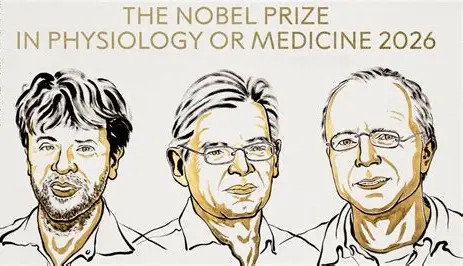
The Nobel Assembly at Karolinska Institutet on Monday awarded the prize jointly to US scientist Karl Deisseroth and German scientists Peter Hegemann and Georg Nagel for their discoveries concerning light-gated ion channels and optogenetics. The laureates will share prize money of 12 million Swedish kronor, according to the Nobel Assembly.
Their work brought together microbiology, genetics, neuroscience and optics to create something that once seemed almost impossible: making selected nerve cells respond to light and then using light to switch their activity on or off.
"Optogenetics provides opportunities for mapping the brain in a way that we could once only dream of," Per Svenningsson, Chair of the Nobel Committee for Physiology or Medicine, said. The technique has since become a major tool in neuroscience, allowing researchers to investigate neural circuits with extraordinary precision and opening possible new routes towards treating neurological and psychiatric disorders.
What is optogenetics and how does it work?
Optogenetics essentially combines genetics with light. The technique begins with genes encoding light-sensitive proteins known as opsins. Some of these proteins naturally occur in microorganisms, including certain algae. When the appropriate gene is introduced into a target cell, the cell can acquire the ability to respond to light.
One of the crucial discoveries behind the technology was channelrhodopsin.
In 2002, Georg Nagel, Peter Hegemann and colleagues reported channelrhodopsin-1, a light-gated proton channel found in the green alga Chlamydomonas reinhardtii. Their work helped establish how microbial proteins could convert light into changes in electrical activity.
Nagel and Hegemann's research showed that these proteins could act as light-controlled ion channels. In simple terms, illumination could cause the channels to open and allow ions to move across the cell membrane, changing the cell's electrical state.
That discovery provided the molecular building blocks for what came next.
How Karl Deisseroth turned the discovery into a neuroscience tool
Karl Deisseroth and his collaborators adapted channelrhodopsin-2 (ChR2) for use in mammalian neurons.
In a landmark 2005 study published in Nature Neuroscience, researchers introduced the gene encoding ChR2 into neurons and demonstrated that pulses of light could control neuronal activity with millisecond-scale precision. The technique allowed researchers to activate defined populations of neurons and influence excitatory and inhibitory signalling.
The significance was enormous. Traditional methods of stimulating the brain often affect groups of cells that may have different functions. Optogenetics offered researchers a much more targeted approach: genetically identify a particular population of neurons and then use light to manipulate their activity.
The technology subsequently evolved to include opsins capable of either activating or inhibiting neurons, alongside increasingly sophisticated methods for delivering light to specific areas of the brain.
A 2015 review by Deisseroth noted that the convergence of microbial opsin engineering, genetic targeting and optical technology had enabled increasingly precise control of defined cells in living organisms.
Why this matters for understanding memory, emotions and behaviour
The brain does not work through isolated neurons. Memories, emotions and behaviours emerge from interactions among networks of nerve cells. Optogenetics allows researchers to ask a much more precise question: What happens if this particular group of neurons is activated, or switched off, at this particular moment?
That makes it possible to investigate whether a particular neural pathway actually causes a behaviour rather than simply being associated with it.
Researchers have used optogenetic approaches to study neural circuits involved in processes such as sleep and wakefulness, reward, movement, learning and memory, as well as circuits implicated in neurological and psychiatric disorders.
The technique has also been used to create and investigate experimental models of conditions including Parkinson's disease, Alzheimer's disease, epilepsy and other neurological disorders. This causal approach is one of optogenetics' biggest contributions to neuroscience.
Could optogenetics treat brain disorders?
This is where the Nobel-winning technology becomes particularly intriguing, but also where caution is important.
Most optogenetic research remains preclinical, particularly for diseases involving deeper brain structures. Researchers still have to solve major challenges involving gene delivery, getting sufficient light to the correct cells, safety, long-term expression and avoiding unintended effects.
A 2025 roadmap published in Nature Neuroscience distinguishes between indirect translation, where optogenetic experiments reveal disease-related circuits that then guide conventional treatments, and direct translation, where optogenetic technology itself is used as a therapy.
The distinction matters because an important discovery in mice does not automatically become a treatment for humans. However, one area has already produced striking early human evidence: vision restoration.
In a 2021 Nature Medicine study, researchers reported partial recovery of visual function in a blind patient after treatment with an adeno-associated viral vector carrying the gene for the light-sensitive protein ChrimsonR. Special goggles were used to stimulate the treated retinal cells with light. The patient was able to perceive, locate and count objects using the treated eye while wearing the goggles.
The finding was an important proof of concept for direct optogenetic therapy, although it was based on a single patient and should not be interpreted as an established treatment for blindness.
More recent scientific work continues to explore how optogenetics could eventually contribute to therapies for neurological and neuromuscular disorders. Researchers emphasise that translation will require advances in gene delivery, optical devices, safety, durability and precise control of neural circuits.
What the Nobel-winning discovery means for medicine
The importance of the 2026 Nobel Prize is therefore not simply that scientists can "control the brain with light". It is that Hegemann and Nagel helped uncover the biological machinery that converts light into cellular electrical activity, while Deisseroth and collaborators demonstrated how that machinery could be harnessed to manipulate selected neurons with unprecedented temporal and cellular precision.
Together, these discoveries transformed neuroscience. They gave researchers a powerful experimental system for moving from observing brain activity to testing what individual neural circuits actually do. That has implications for understanding the biological basis of behaviour and for identifying potential targets for future therapies.
The Nobel Assembly described optogenetics as having opened a new era in neuroscience, with the method now used in laboratories around the world to investigate the brain's mysteries. The 2026 Nobel Prize in Physiology or Medicine recognises a scientific journey that began with a deceptively simple question: how do microorganisms sense light?
The answer ultimately gave neuroscience a new language, one in which light can be used to interrogate the activity of specific nerve cells and circuits.
For patients, the most important question is what comes next. Optogenetics is not yet a routine treatment for neurological or psychiatric disease, and significant scientific and safety barriers remain. But its ability to identify disease-relevant circuits and, in carefully selected settings, directly manipulate cells has already moved the field beyond what was previously possible.
From understanding how memories are formed to investigating the circuitry behind disease and exploring new approaches to restoring lost vision, the work of Karl Deisseroth, Peter Hegemann and Georg Nagel has changed the way scientists study the brain, by quite literally shining a new light on it.
(With inputs from AFP, IANS)
Disclaimer: This content including advice provides generic information only. It is in no way a substitute for a qualified medical opinion. Always consult a specialist or your own doctor for more information. NDTV does not claim responsibility for this information.