

)
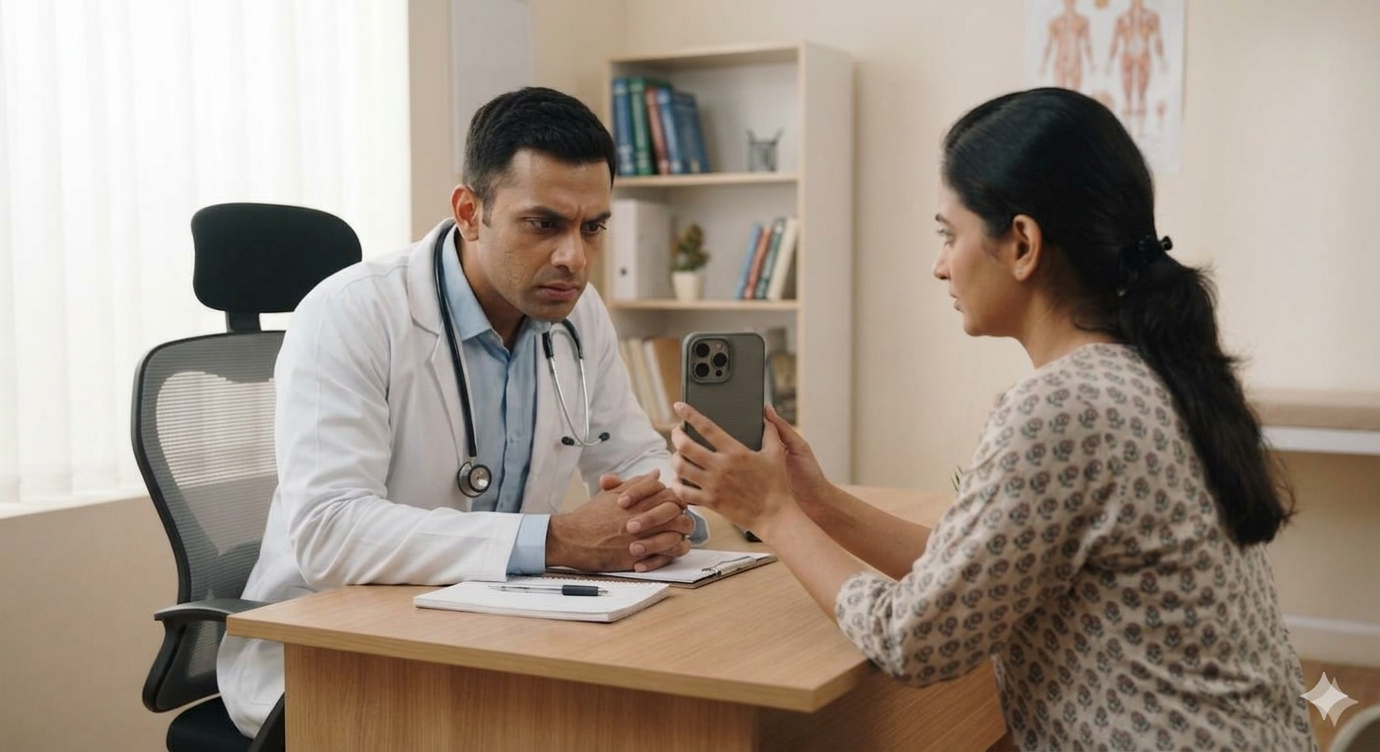
A woman in her fifties with newly diagnosed HER2-positive breast cancer sits across from me, and her son does the talking. He has a printout of a chatbot's answer. It says a targeted drug will handle the tumour, that radiation is unnecessary, and that radiation causes heart damage and second cancers. Each claim is wrong for a different reason. This has started happening across the clinics nationwide.
What therapy entails?
Targeted therapy is the most misunderstood term in oncology. Patients read "targeted" as precise but in reality it means that a specific drug (for example, Trastuzumab) will bind to a receptor on cancer cells wherever they happen to be. It does not sterilise the tumour bed, the axilla or the chest wall. The bot did not say so because the son asked what targeted therapy does, and the machine answered only that.
Radiation Therapy is curative; major studies have revealed its survival benefits in the treatment matrix (either alone or in combination with surgery and chemotherapy). The grey areas exist because clinical trials cannot accommodate every permutation of clinical presentation. For example, a decision to omit radiation in an older woman with a small, node-negative, hormone-positive cancer is argued at every tumour board in the world. A chatbot does not understand these nuances. It does not hold a position provisionally, and it delivers whichever one it picks "confidently". In one instance, a bot was tested on a medical journal's contested "Gray Zone" cases, ChatGPT-4 produced confident plans for precisely the situations in which experts disagree. In yet another study, when graded on sixty breast cancer questions, three models averaged 44 per cent accuracy on treatment questions.
Risk without a denominator
When a bot is asked about the side effects of breast radiotherapy you get cardiac damage, risk of second malignancies, lymphoedema (swelling), pneumonitis (lung-damage) and brachial plexopathy (nerve damage). These are real side effects that may accrue over long term. Yet, these are reported toxicities from studies published in 1970s and 80s with older era machines and modern radiation therapy (e.g., Volumetric Arc Therapy) has almost eliminated these effects. This author hasn't seen the effects happening in his clinical practice because treatment planning has now become patient-specific and personalised through improved algorithms and highly complex treatment delivery platforms. The bots fail to explain the skewed output because training corpora are not published. A system that reproduces inflated toxicity cannot be trusted.
The number no AI can produce
Treatment costs, especially for uninsured, are a major constraint and no chatbot can answer it. The reason: most patient-facing text these systems were trained on, was written for North America. It assumes that patients have insurance approval and access to a nurse navigator. The reality is different for India; ask what six months of treatment costs in New Delhi (or any other state) and the machine has nothing.
This author has been building a financial risk calculator alongside a rectal cancer decision tool, and the difficulty is instructive. CGHS package rates are the only national baseline that exists, and they stood unrevised from 2014 until October 2025 while medical inflation ran at twelve to fourteen per cent a year, roughly triple the general rate. Existing data yields no figure for a course of chemoradiation (as an example) normalised across India. Toxicity rates from Western trials are under-reported and Indian resource-constrained settings frequently show higher rates of treatment interruption, nutritional compromise, infection, and acute toxicities. No chatbot would produce an individualised forward-looking risk assessment (toxicity driven admissions which are difficult to predict, health scheme eligibility or categorise catastrophic expenses) because training data doesn't exist.
Why the belief will not move
The bots output depends on the phrasing context: asking whether radiation is "recommended" after breast conservation produces a different answer from asking whether it is "really necessary". Researchers call this sycophancy, the tendency to prioritise agreement over accuracy. Patients rephrase until the answer matches what they hoped for. A language model assembles text by probability without reference to meaning; and therefore they are called as "stochastic parrots".
A belief the family appears to have "reasoned" their way by "talking to the bot" gets cemented. I only talk about the challenges ahead for families by guiding them around possibilities of effects and mitigating them.
A guide for patients
Do not upload your reports. A biopsy report carries your name, hospital number, phone number and diagnosis on one page. Indian law treats health information as sensitive and consent-bound but most users remain unaware.
Be careful on WhatsApp. Meta AI sits in the same app you use for family photographs, and from 16 December 2025 Meta began using AI interactions to personalise the content and advertising you see. There is no full opt-out. While Meta claims it will not target ads on health topics; it does not say the conversation goes unprocessed.
Ask about the disease, not your treatment. "What is HER2-positive breast cancer" is a reasonable question. "Do I need radiation" is not because its difficult to categorise complex histopathological nuances (e.g., margins, nodes, receptors, age and other illnesses, none of which the bot "understands").
Compliance depends on understanding what the treatment is for. The bot isn't a replacement for patient-doctor trust.
(Dr. Abhishek Puri, Associate Consultant Radiation Oncology, Fortis Mohali)
Disclaimer: The opinions expressed within this article are the personal opinions of the author. NDTV is not responsible for the accuracy, completeness, suitability, or validity of any information on this article. All information is provided on an as-is basis. The information, facts or opinions appearing in the article do not reflect the views of NDTV and NDTV does not assume any responsibility or liability for the same.