

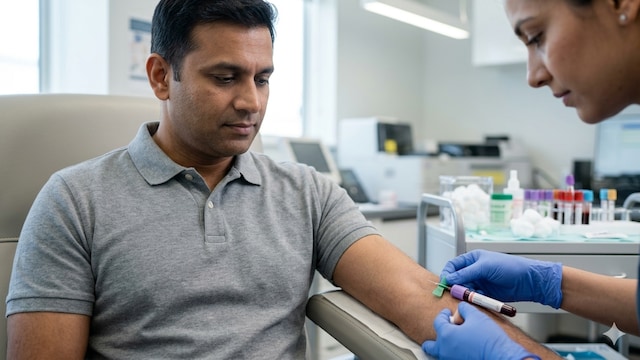
Your HbA1c is normal. Does that mean you can rule out diabetes? Not always.
One of the most commonly used tests for diagnosing diabetes may sometimes give misleading results. Conditions such as iron deficiency anaemia and inherited haemoglobin variants can affect HbA1c readings, making them appear falsely high or low.
This means some people could be incorrectly classified as diabetic or prediabetic, while others may have their blood sugar problems overlooked.
Ahead of World Diabetes Day on November 14, NDTV Lifeline spoke exclusively to Dr Navin Dang, Founder & Director of Dr. Dangs Lab, to understand when HbA1c can give an inaccurate picture, why certain haemoglobin variants matter and when another test may be needed.
The issue is particularly relevant in India, where haemoglobin variants such as HbE, HbD-Punjab and HbS are found in different population groups.
What Does HbA1c Actually Measure?
HbA1c measures the amount of glucose attached to haemoglobin, the protein in red blood cells that carries oxygen.
Since red blood cells typically live for around 120 days, the test gives an estimate of average blood sugar over the previous two to three months.
- Below 5.7%: Normal range
- 5.7%-6.4%: Prediabetes range
- 6.5% or higher: Diabetes range
These are commonly used American
Diabetes Association diagnostic thresholds.
Unlike a fasting sugar test, HbA1c does not require fasting. But there is a catch: its accuracy can be affected by certain blood conditions. Dr Dang explains, "Haemoglobin variants are inherited structural changes in the globin chains. They can interfere with HbA1c measurement, either by affecting the laboratory method or by altering red blood cell survival. This can lead to inaccurate results that do not reflect a person's actual blood glucose levels."
READ | HbA1c To Ferritin: 5 Health Markers Worth Checking In Your Lab Report
Can Your Haemoglobin Type Affect Your HbA1c?
Yes. This is one of the lesser-known reasons why HbA1c results may sometimes be inaccurate. Certain inherited changes in haemoglobin, known as haemoglobin variants, can interfere with the laboratory methods used to measure HbA1c. They can also affect how long red blood cells survive.
Three important variants are:
HbE: Commonly encountered in eastern and northeastern India, including Assam. In people with two copies of the HbE variant, conventional HbA1c measurement may be unreliable because little or no normal HbA is available.
HbD-Punjab: Found in northwestern India. It can interfere with some HbA1c testing methods, although other validated methods can provide accurate results.
HbS: Found in several parts of India, including central, western and southern regions. In sickle cell disorders, shortened red blood cell survival can result in falsely low HbA1c readings.
Dr Dang explains the Indian context, "This is particularly relevant in India. HbE is commonly encountered in eastern and northeastern India, HbD-Punjab in northwestern India, while HbS is found in central, western and southern Indian populations. In homozygous variants, HbA1c assessment may become unreliable. In heterozygous cases, accurate results may still be possible if the laboratory uses a validated method."
READ | Leg Trembling After Long Sitting: Is It Linked To Diabetes?
Why Your Laboratory Method Matters
Not all HbA1c testing methods work in exactly the same way. One commonly used technique is High-Performance Liquid Chromatography (HPLC). Apart from measuring HbA1c, it can also help identify certain abnormal haemoglobin patterns.
Dr Dang highlights the importance of examining the HPLC chromatogram, or graph, carefully. "HPLC is an important method for estimating HbA1c. However, the chromatogram must be examined by a trained pathologist to identify any haemoglobin variants that could interfere with the result."
The important point here is not to look at the HbA1c number alone. The laboratory method and any abnormalities flagged in the report matter too. The specific analyser and testing method must be suitable for the haemoglobin variant.
Can Iron Deficiency Anaemia Also Affect Your Reading?
Yes. And this is particularly relevant in India, where iron deficiency is common.
Iron deficiency anaemia can sometimes cause HbA1c levels to appear falsely elevated, even when actual blood glucose levels may not be high enough to explain the result.
This could lead to someone being incorrectly classified as prediabetic or diabetic.
On the other hand, conditions that shorten red blood cell survival can make HbA1c appear falsely low.
These include:
- Haemolytic anaemia
- Recent blood loss
- Certain haemoglobin disorders
This is why doctors may recommend checking haemoglobin and iron levels when HbA1c results do not match a person's clinical picture or other blood sugar readings.
READ | Metabolic Surgery May Offer Remission In Some Patients With Uncontrolled Diabetes: AIIMS Doctor
If HbA1c Is Unreliable, Which Test Should You Get?
If a person's haemoglobin type or red blood cell condition affects HbA1c accuracy, doctors can consider other tests.
1. Fasting plasma glucose
This measures glucose after at least eight hours without food or caloric drinks. A reading of 126 mg/dL or higher falls in the diabetes range.
2. Oral Glucose Tolerance Test (OGTT)
This checks how well the body processes sugar. After fasting, a person drinks a solution containing 75 grams of glucose. Blood sugar is measured two hours later.
A reading of 200 mg/dL or higher indicates diabetes.
OGTT can be particularly useful when fasting sugar is borderline but doctors still suspect diabetes.
3. Fructosamine test
This measures sugar attached to proteins in the blood, mainly albumin.
Unlike HbA1c, it reflects average blood sugar over approximately two to three weeks and is not affected by haemoglobin variants or red blood cell lifespan.
It can be useful for monitoring blood sugar when HbA1c is unreliable, although it is not a standard diagnostic replacement for HbA1c.
Dr Dang explains, "When HbA1c becomes unreliable because of significant anaemia, altered red blood cell turnover or haemoglobin variants, alternative tests should be considered. Fasting plasma glucose and OGTT are preferred for diagnosis. OGTT is particularly helpful when fasting glucose is borderline but clinical suspicion remains high. Fructosamine can be used to monitor glucose control over the preceding two to three weeks."
HbA1c Vs Fasting Sugar Vs OGTT: What Is The Difference?
All three tests assess blood sugar, but they measure different things.
HbA1c Average blood sugar over 2-3 months
Fasting plasma glucose Blood sugar after fasting
OGTT How the body responds to a glucose load
A person may have a normal or borderline HbA1c and fasting sugar but an abnormal OGTT. This is because the body may struggle to process a glucose load even when fasting sugar appears relatively normal.
The different tests do not always identify exactly the same individuals. The choice of test needs to take into account a person's risk factors, medical history and the possibility of conditions affecting test accuracy.
So, Are We Diagnosing Diabetes Correctly?
HbA1c remains a valuable and widely accepted diagnostic test. But it is not infallible. A normal result does not always rule out diabetes, particularly when symptoms or risk factors suggest otherwise. Similarly, a high reading may need further investigation if the person has anaemia or a haemoglobin variant.
Doctors may recommend repeating the test or using fasting plasma glucose or OGTT to confirm a diagnosis.
So remember, don't just look at your HbA1c number. Understand what it measures and whether your blood condition could affect its accuracy. Sometimes, the right diagnosis needs more than one blood test.
Ahead of World Diabetes Day, the message is simple - Get tested, but make sure you understand what your test is telling you.
Disclaimer: This content including advice provides generic information only. It is in no way a substitute for a qualified medical opinion. Always consult a specialist or your own doctor for more information. NDTV does not claim responsibility for this information.