

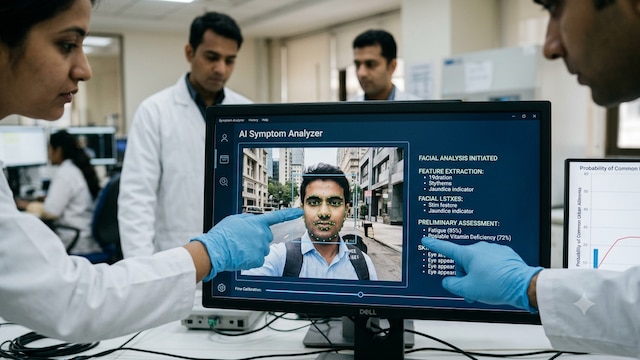
Could a photograph of your face reveal clues about how well you might respond to cancer treatment? Researchers at Mass General Brigham, a healthcare system in the United States, have developed an artificial intelligence (AI) model that can estimate a person's biological age and predict survival outcomes among cancer patients using a single facial photograph. The findings, published in The Lancet Digital Health, suggest that facial features may contain information about a patient's underlying health and physical resilience that could eventually help doctors make more informed treatment decisions.
The AI system, called Foundation Artificial Intelligence for Health Recognition (FAHR-Face), was trained on more than 40 million facial images. Researchers developed two complementary tools from the model: one estimates biological age, while the other directly assesses cancer survival risk.
The findings are particularly relevant as cancer care increasingly focuses on personalised treatment, balancing the potential benefits of intensive therapies against a patient's overall health. However, the technology is still being evaluated and is not ready to replace established clinical assessments.
For India, where cancer care spans a wide range of healthcare settings and resources, the possibility of an accessible, non-invasive risk-assessment AI tool is intriguing. But its usefulness will depend on whether it performs reliably across Indian populations and can improve decisions without introducing new risks or inequalities.
How Does The AI Tool Predict Cancer Survival From A Face Photograph?
The FAHR-Face model uses deep learning, a form of AI that identifies patterns in large datasets. Researchers adapted the model to develop two tools that analyse different facial characteristics and provide complementary information about health.
FAHR-FaceAge estimates biological age, which refers to how old a person's body appears to be functioning relative to their chronological age. FAHR-FaceSurvival, meanwhile, predicts cancer survival outcomes directly from a facial photograph rather than relying on biological age as an intermediate measure.
The algorithms also focus on different facial regions. FAHR-FaceAge examines features including the forehead, temples and creases running from the nose towards the corners of the mouth. FAHR-FaceSurvival places greater emphasis on the area beneath the eyes and around the bridge of the nose.
The researchers have not established exactly which biological processes account for these associations. The AI identifies statistical patterns in photographs; it does not diagnose cancer, identify a tumour or determine an individual's precise life expectancy.
Hugo Aerts, co-senior author of the study and director of the Artificial Intelligence in Medicine programme at Mass General Brigham, said: "To our knowledge, this is the first demonstration that an AI model can directly predict cancer survival from a simple photograph."
What Did The Study Find About Biological Age And Cancer Survival?
The researchers reported a significant association between estimated biological age and mortality among cancer patients who received radiotherapy in the United States.
During an average follow-up of approximately four years, patients whose estimated facial age was at least five years older than their actual age had a 21% higher risk of dying than the comparison group. Patients who appeared at least five years younger had a 17% lower risk.
These findings suggest that facial appearance may capture aspects of a person's health that are not fully reflected by chronological age alone.
However, the percentages describe differences in risk between groups. They do not mean that a patient whose face appears older has a 21% probability of dying, or that someone who looks younger has a guaranteed survival advantage.
The researchers also found associations between lifestyle factors and estimated facial ageing. Smoking, heavy alcohol consumption and drug use were linked to appearing biologically older in the AI analysis. These findings do not establish that facial ageing itself causes poorer cancer outcomes.
The research indicates that the two AI tools capture complementary information, potentially allowing clinicians to obtain a more consistent assessment of health-related risk than relying on visual impressions alone.
READ | AI Addiction May Be India's Next Big Mental Health Challenge: Leading Experts Explain
How Could AI-Based Cancer Prognosis Help Doctors?
Estimating a patient's physical reserve and ability to tolerate treatment is an important part of cancer care, particularly when considering surgery, radiotherapy or systemic treatments such as chemotherapy and other cancer medicines.
A treatment that offers substantial benefits to one patient may carry different risks for another, depending on factors such as frailty, existing medical conditions and overall physical health.
Dr Raymond Mak, a radiation oncologist at Mass General Brigham Cancer Institute and a corresponding author of the research, said: "Our goal is to make face photograph-based health assessment more quantitative, consistent and scalable so it can support personalised treatment decisions rather than replace physician judgment."
If further studies establish its reliability, facial analysis could potentially provide an additional source of information when doctors assess patients before intensive treatment. It might also help identify patients who need closer assessment of their physical condition.
However, the model cannot independently establish whether a particular cancer treatment is appropriate. Doctors must continue to consider the cancer's type and stage, tumour characteristics, treatment history, laboratory results, imaging findings, functional status and the patient's preferences.
What Could The Findings Mean For Cancer Patients In India?
India faces a substantial cancer burden, making improvements in early detection, treatment planning and access to appropriate care important public health priorities. An AI tool that requires only a photograph could eventually offer a relatively accessible way to gather additional information about patients' health.
But accessibility alone does not establish clinical usefulness. A model trained and evaluated using data from other populations may not perform equally well among Indian patients, whose facial characteristics, demographic profiles, disease patterns and healthcare experiences can differ from those represented in the original datasets.
Before the technology is considered for routine use in India, researchers would need to validate it across diverse Indian populations, cancer types, treatment settings and stages of disease. They would also need to assess whether it improves predictions beyond established clinical measures.
There are ethical concerns as well. Facial photographs are sensitive personal data, and any clinical application would require appropriate consent, privacy safeguards and transparency about how information is collected and used.
The Indian Council of Medical Research's ethical guidance on artificial intelligence in biomedical research and healthcare provides a relevant framework for considering issues such as patient safety, accountability and responsible implementation.
Crucially, the technology must not become a reason to deny treatment based on an algorithmic risk score. A statistical prediction should support a clinical conversation, not determine a patient's access to care.
READ | The Machine Can Read Scans, But It Can't Read Patients: Why AI Tools Fail To Match Medical Realities
Is The AI Tool Ready For Clinical Use?
Not yet. The researchers have emphasised that additional work is needed before facial photographs can be used widely to guide personalised treatment decisions.
A model may identify patterns associated with survival without revealing why those patterns exist or whether acting on its predictions improves patient outcomes. Researchers must establish its performance in independent populations and assess whether it adds meaningful information to existing clinical assessments.
Patients should therefore not interpret facial appearance, or an AI-generated estimate of biological age, as a reliable measure of their individual cancer prognosis.
The FAHR-Face study offers an intriguing glimpse into how AI could expand the information available to doctors when assessing cancer patients. By estimating biological age and identifying patterns associated with survival, facial analysis may eventually complement established methods of evaluating treatment risks.
For India, the next step is rigorous local validation, accompanied by safeguards against bias, misuse and unequal access to care. A selfie may one day contribute to a more personalised cancer assessment, but it cannot replace a detailed medical evaluation, a patient's clinical history or a doctor's judgement.
Disclaimer: This content including advice provides generic information only. It is in no way a substitute for a qualified medical opinion. Always consult a specialist or your own doctor for more information. NDTV does not claim responsibility for this information.