

)
When a patient walks into a hospital with a heart attack, the first goal of the heart team and the emergency team is to ensure that he gets immediate treatment, which includes multiple drugs and a rapid shift to the cath lab. There, he will undergo an angiogram to identify the reason for the heart attack, and appropriate steps will be taken with medicines, angioplasty, or a bypass to get his artery flowing again. Following the procedure, he will be shifted to the ICU for 24 to 48 hours, depending on the intensity of the heart attack, and subsequently moved to the ward. The process of cardiac rehabilitation starts immediately when the patient reaches the ward.
In-Hospital Counselling and Early Mobilisation
First, detailed counselling of the patient takes place where he is told what the dos and don'ts are, and diet counselling is completed. The first question the patient usually asks is, "When can I get back to my normal activities?" It is very important that we address this issue, as returning to normal life is of prime importance to the patient.
Therefore, we in the cardiac rehab team try to get him walking within 24 to 48 hours of the attack. He is made to walk in the room, followed by a supervised walk with the guidance of a physiotherapist inside the hospital corridor at a gentle pace. The physiotherapist, who is part of the cardiac rehab team, will also teach the patient simple breathing exercises to aid the recovery process, as well as light exercises that can be started from day two in the hospital.
Discharge Criteria and Immediate Precautions
As part of our hospital protocol, we have the patient climb a flight of stairs once or twice. We ask them to do it slowly and not rush. When a patient can walk about 100 metres in the corridor and climb a couple of flights of stairs without chest pain or breathlessness, they are deemed fit for discharge.
Detailed counselling then occurs regarding the dos and don'ts at home, specifically, the activities they must avoid. One of the primary things we ask patients to avoid is heavy, strenuous exercise and lifting weights.
Transitioning to Home Recovery
Once the patient reaches home, the rehab process continues. During the initial week, we ask them to walk at a slow speed for a distance of roughly half to one kilometre. They can do this once or a couple of times a day.
Walking is the best form of exercise after a heart attack. There are no rigid, one-size-fits-all guidelines on how a person should walk or how far they can go, as it depends on the individual and the intensity of the heart attack.
Patients who have had a mild heart attack can return to all their normal activities within a period of one to two weeks. The best exercise remains a gentle walk, and the pace can be gradually increased over time. You can start with half a kilometre in the morning and half a kilometre in the evening, stepping it up over a period of two weeks to a distance of two kilometres.
Gradual Progression and Everyday Activities
Initially, walking should be done at a slow speed, which can later be increased. Simple exercises like yoga are permitted within two to three weeks. However, any exercise involving significant bending down or frequent changes in neck position should preferably be avoided.
Climbing stairs is encouraged. The person should climb at a slow speed initially, but taking a couple of flights of stairs is definitely permitted. The only main restriction during this initial period is avoiding lifting heavy weights, which puts unnecessary strain on the heart.
Once patients return to the doctor for a follow-up, usually at two weeks, the intensity of exercise can be adjusted. A physical examination, along with an ECG and an echocardiogram, will determine their fitness level. Most patients can resume normal daily activities and return to work within one week of discharge. For individuals whose work involves heavy physical exertion (such as labourers or masons) or extensive travel, we prefer them to take it slow and wait until after two weeks.
Long-Term Fitness and Outdoor Walking
Walking is the best exercise for overall cardiac well-being. The speed can be increased over time, and I strongly advise patients to walk outside in a park, as it promotes a sense of mental well-being. In addition to yoga and meditation, walking is probably the finest exercise for the heart.
Returning to the Gym and High-Intensity Sport
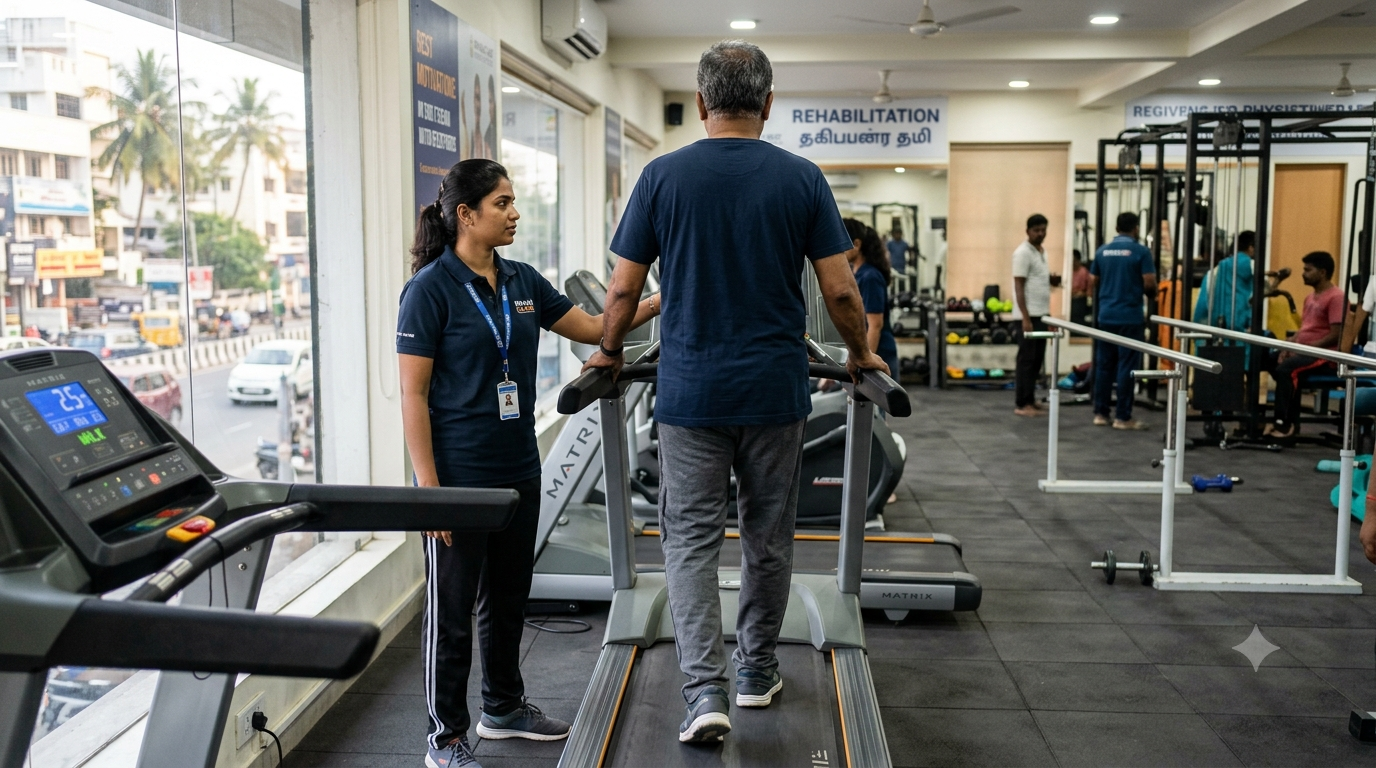
We recommend avoiding the gym for at least six to eight weeks. Upon returning, patients should initially stick to cardio exercises such as the treadmill. Strength training and resistance exercises should wait for eight to ten weeks.
For individuals who engaged in high-intensity exercise prior to their heart attack, our protocol involves a supervised treadmill test in the hospital to evaluate their readiness. If they complete the treadmill test well, without chest pain, discomfort, or breathlessness, they are fit to return to their gym routine, though under no circumstances should they be lifting heavy weights.
Simple gym exercises can usually be started within six to eight weeks, whereas higher-intensity sports activities will generally take two to three months. We have many marathon runners who suffered a heart attack and subsequently returned to running, ranging in age from 35 to 70. They participate in 10k marathons, but this level of recovery is built up over time and does not happen overnight.
The primary goal of cardiac rehabilitation is to help patients feel fully fit and confident that they can lead a normal life. A structured cardiac rehabilitation programme goes a long way towards safely restoring a patient's physical activity.
(By Dr. K. P. Srihari Das, Senior Consultant-Interventional Cardiology, Manipal Hospital, Jayanagar)
Disclaimer: The opinions expressed within this article are the personal opinions of the author. NDTV is not responsible for the accuracy, completeness, suitability, or validity of any information on this article. All information is provided on an as-is basis. The information, facts or opinions appearing in the article do not reflect the views of NDTV and NDTV does not assume any responsibility or liability for the same.