

)
You do not need a gym membership, expensive equipment, or a complicated workout routine to build strength and improve your fitness. With the right combination of bodyweight exercises, you can train your legs, chest, back, shoulders, arms and core from the comfort of your home. A well-designed bodyweight workout can improve muscular strength, mobility, balance, and cardiovascular fitness. The key is not doing as many repetitions as possible but choosing exercises that challenge different muscle groups and gradually increasing the difficulty as your fitness improves. According to a study in Journal of Education and Health Promotion, home-based physical activity (PA) programs have emerged as a promising strategy for reducing sedentary behavior and improving overall physical health.
Why Bodyweight Workouts Can Be Effective
Bodyweight exercises use your own weight as resistance. Movements such as squats, push-ups, lunges and planks can challenge multiple muscles simultaneously while also requiring your body to maintain balance and stability. For beginners, these exercises can provide enough resistance to build foundational strength. As you become stronger, you can increase repetitions, slow down the movement, add pauses or progress to more difficult variations. The biggest advantage is accessibility. You can perform these movements in a small space and adjust the intensity according to your fitness level.
Start With Squats
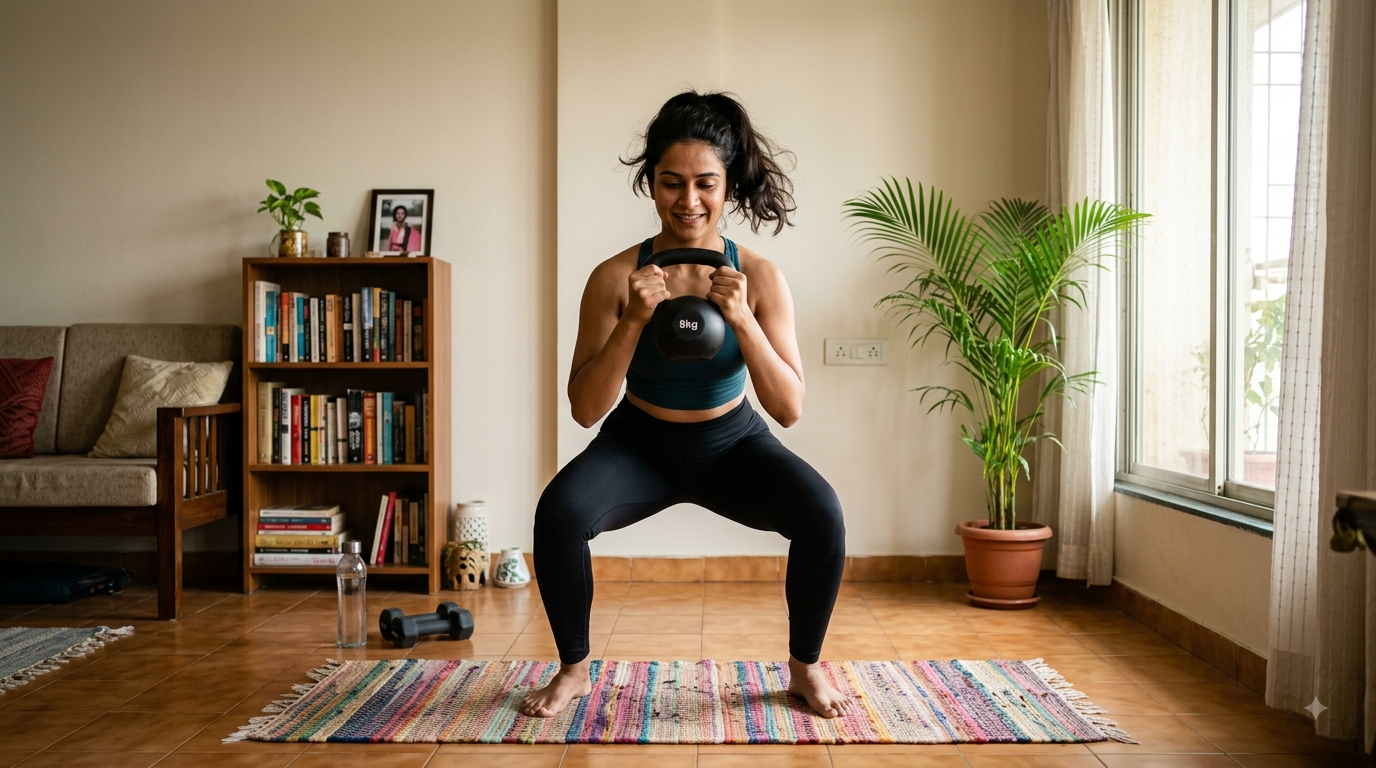
Squats are one of the most useful lower-body exercises you can perform without equipment. They primarily work the quadriceps, hamstrings and glutes while also requiring your core muscles to stabilise the body. Stand with your feet approximately shoulder-width apart. Keep your chest lifted, push your hips back and bend your knees as you lower your body. Go as low as is comfortable while maintaining control, then push through your feet to return to the starting position. Beginners can start with 2-3 sets of 10-15 repetitions. Once regular squats become easy, you can make them more challenging with pause squats or jump squats.
Push-Ups For Upper-Body Strength
Push-ups are a simple but effective way to train the chest, shoulders and triceps. They also require your abdominal and lower-back muscles to work to keep your body stable. Start in a high-plank position with your hands slightly wider than your shoulders. Keep your body in a straight line as you bend your elbows and lower your chest towards the floor. Push yourself back up while maintaining control. If standard push-ups are difficult, begin with wall or incline push-ups before progressing to knee push-ups and eventually standard push-ups. Aim for 2-3 sets of 6-15 repetitions, depending on your fitness level.
Lunges To Build Stronger Legs
Lunges add a single-leg component to your workout and can challenge your balance and coordination. Stand upright and take a controlled step forward. Lower your body until both knees are bent comfortably, then push through the front foot to return to the starting position. Alternate legs with each repetition. Lunges can strengthen the glutes, quadriceps and hamstrings while improving lower-body stability. Start with 2-3 sets of 8-12 repetitions per leg. If your balance is poor, perform the movement near a wall or sturdy surface for support.
Glute Bridges For The Hips And Lower Body
Glute bridges are particularly useful for strengthening the glute muscles and the muscles around the hips. Lie on your back with your knees bent and feet flat on the floor. Keep your arms beside your body and lift your hips towards the ceiling by squeezing your glutes. Pause briefly at the top before slowly lowering your hips.
Perform 2-3 sets of 12-15 repetitions.
As you become stronger, you can progress to single-leg glute bridges. Planks For Core Strength. A strong core is important for stability, posture and efficient movement. The plank works several muscles around the abdomen, back and hips while requiring you to maintain a stable position. Place your forearms on the floor and extend your legs behind you. Keep your body aligned from your shoulders to your heels and tighten your abdominal muscles. Instead of holding the position for as long as possible, focus on maintaining good technique. Beginners can start with 15-30 seconds for 2-3 sets and gradually increase the duration.
Mountain Climbers For A Cardio Boost
If you want to increase the cardiovascular challenge without running or using a treadmill, mountain climbers can be added to the workout. Start in a high-plank position and bring one knee towards your chest. Return it to the starting position and alternate with the other leg. Keep your core engaged and control the movement rather than simply trying to move as quickly as possible. Try 20-30 seconds for 2-3 rounds.
Superman Exercise For The Back
Bodyweight workouts can sometimes focus heavily on the muscles at the front of the body. The Superman exercise can add posterior-chain work. Lie face down with your arms extended in front of you. Gently lift your arms and legs off the floor while keeping the movement controlled. Hold briefly and return to the starting position.
Perform 2-3 sets of 8-12 repetitions.
Avoid excessive lifting or arching of the lower back. Try This Full-Body Home Circuit. If you want to combine these exercises into one routine, try the following circuit:
- Squats - 15 repetitions
- Push-ups - 8-12 repetitions
- Reverse lunges - 10 repetitions per leg
- Glute bridges - 15 repetitions
- Plank - 20-30 seconds
- Mountain climbers - 20 seconds
- Superman - 10 repetitions
Rest for around 30-60 seconds between exercises if needed and take a longer break between rounds. Beginners can start with 2 rounds, while people with more experience can gradually work towards 3-4 rounds.
How Often Should You Do It?
You do not need to perform a full-body workout every day. For most people, strength-focused training can be performed around 2-3 times a week, allowing adequate recovery between sessions. On other days, you can stay active through walking, mobility exercises, stretching, cycling or other activities you enjoy. The goal is to build a routine that you can maintain rather than exhausting yourself for a few days and then stopping.
How To Make A Home Workout More Effective
The biggest challenge with bodyweight training is that your muscles eventually adapt. When an exercise becomes too easy, increase the difficulty rather than simply performing hundreds of repetitions. You can slow down the lowering phase, add a pause at the hardest point, increase the range of motion or move to a more advanced variation. For example, you can progress from regular squats to pause squats and eventually single-leg variations. Push-ups can progress from incline push-ups to standard push-ups and then more challenging variations. This gradual progression gives your muscles a reason to continue adapting.
Do Not Ignore Recovery
Exercise is only one part of fitness. Your body needs adequate protein, carbohydrates, healthy fats, fluids and sleep to recover from training. A balanced diet containing vegetables, fruits, whole grains, pulses, dairy products, eggs, lean meats, nuts and seeds can provide important nutrients. Getting enough sleep is equally important, particularly if you are exercising regularly. And remember that muscle soreness is not the only indicator of an effective workout. You do not need to be extremely sore after every session to make progress.
When Should You Stop?
Bodyweight exercises are generally accessible, but they are not risk-free. Stop exercising if you experience sharp or severe pain, dizziness, chest discomfort, unusual breathlessness or sudden weakness. People with existing injuries or medical conditions should also consider speaking with a healthcare professional before starting a new exercise programme.
A gym can provide useful equipment and variety, but it is not essential for getting started with fitness. A combination of squats, push-ups, lunges, glute bridges, planks, mountain climbers and back-focused movements can provide a challenging full-body workout using nothing more than your own body weight. The real secret is consistency. Start at a level you can manage, focus on proper form and gradually increase the challenge as your strength improves. With regular training, good nutrition and adequate recovery, your living room can become a surprisingly effective place to build strength and fitness.
Disclaimer: This content including advice provides generic information only. It is in no way a substitute for a qualified medical opinion. Always consult a specialist or your own doctor for more information. NDTV does not claim responsibility for this information.