

)
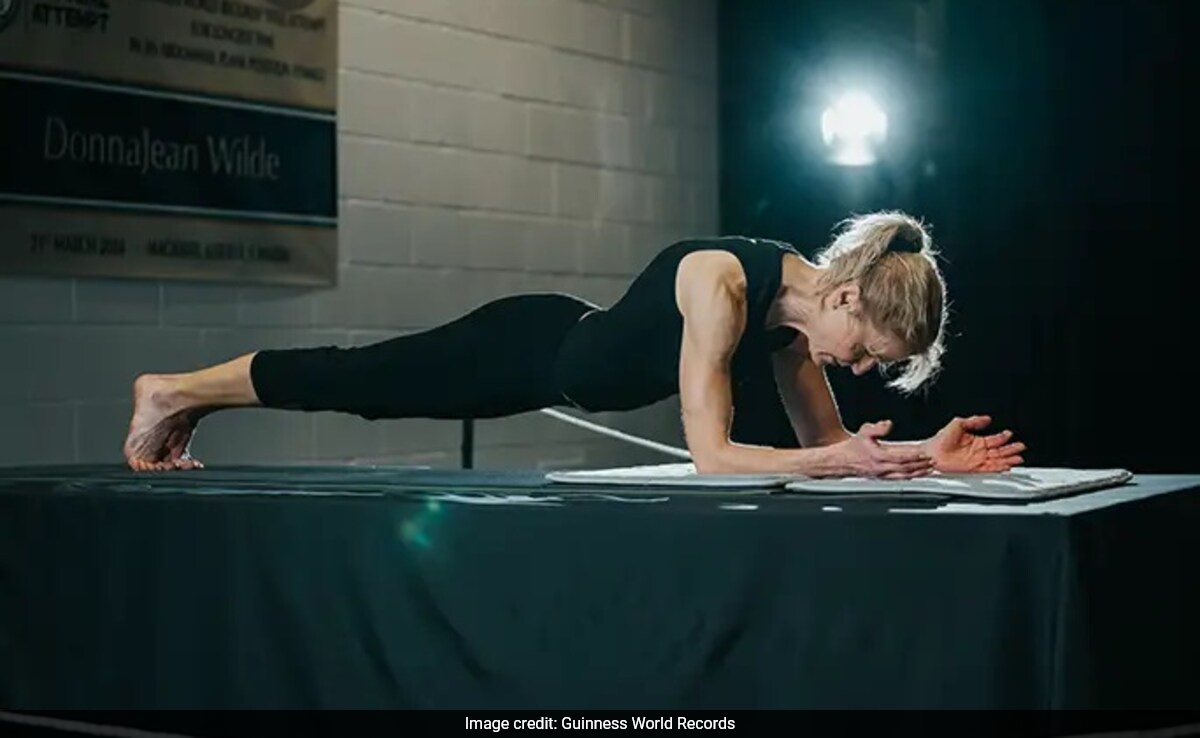
Holding a plank for a few minutes can leave even regular gym-goers shaking. Now imagine staying in the same position for five hours. A 61-year-old woman in the United States has stunned fitness enthusiasts after completing a five-hour abdominal plank at the Huntsman World Senior Games. DonnaJean Wilde set a new world record for the longest female abdominal plank, turning an otherwise simple-looking exercise into an extraordinary test of muscular endurance. The event organisers shared a video of Wilde's record-breaking attempt online. In the clip, she can be seen holding the plank position with intense concentration as the timer continues to run. "At age 61, DonnaJean Wilde breaks the WORLD RECORD for the longest female abdominal plank with a time of 5 hours," the organisers wrote in the caption. While most people would not need to come anywhere close to such a duration, Wilde's achievement raises an interesting question: What actually happens to your body when you hold a plank, and how can this simple exercise benefit your fitness?
What Muscles Does A Plank Work?
A plank may look like a static exercise, but several muscle groups have to work continuously to keep the body in position. The primary focus is the core, including the abdominal muscles and deeper muscles around the trunk. The exercise also engages the lower back, glutes and muscles around the pelvis. Your shoulders and arms also contribute to maintaining the position, while the quadriceps and other muscles of the lower body help keep the body stable. Unlike exercises where you repeatedly move through a range of motion, a plank requires the muscles to maintain tension while the body remains relatively still.
How Does A Plank Strengthen The Core?
The core does much more than give you visible abdominal muscles. It helps stabilise the spine and pelvis and provides a strong base for movements involving the arms and legs. During a plank, the abdominal and trunk muscles contract to prevent the body from sagging or rotating. Over time, appropriately performed core exercises can improve your ability to maintain control of the trunk during everyday movements and exercise. This is one reason planks are commonly included in strength and conditioning programmes.
Can Planks Improve Posture?
A strong core can contribute to better control of the trunk and pelvis, which may support good posture. However, doing planks alone does not automatically correct poor posture. Posture is influenced by several factors, including muscle strength, mobility, habits and how a person sits, stands and moves throughout the day. A balanced exercise routine that includes core strengthening, upper- and lower-body strength work and mobility exercises is generally more useful than relying on one exercise.
Does Holding A Plank Burn A Lot Of Calories?
Not compared with activities such as running, cycling or other forms of sustained cardiovascular exercise. A plank is primarily a strength and muscular-endurance exercise, rather than a calorie-burning workout. Because several muscles are working simultaneously, the body does expend energy to maintain the position. However, spending longer in a plank should not be viewed as a shortcut for weight loss. If your goal is fat loss, overall calorie balance, diet, daily physical activity and a combination of resistance and cardiovascular exercise matter much more.
Is A Longer Plank Always Better?
Wilde's five-hour record represents an exceptional level of muscular endurance. It does not mean that holding a plank for hours is necessary, or even desirable, for most people. For general fitness, the quality of the movement matters more than chasing an extreme duration. Once fatigue causes the hips to drop, the lower back to arch excessively or the body to rotate, the exercise is no longer being performed with optimal technique. Increasing difficulty through better form, controlled variations or progressive resistance may be more useful than simply trying to extend the duration indefinitely.
What Happens When You Hold A Plank For Too Long?
As muscles fatigue, maintaining the correct position becomes increasingly difficult. You may start feeling shaking or burning in the abdominal muscles, shoulders, legs or other areas involved in stabilising the body. Continuing beyond your ability to maintain proper form can place unnecessary stress on the lower back, shoulders or wrists, depending on the variation. Pain is different from normal muscular fatigue. If you experience sharp pain, significant back discomfort, dizziness, breathing difficulty or another unusual symptom, stop the exercise.
How Long Should You Hold A Plank?
There is no single ideal plank duration for everyone. Beginners can start with short, controlled holds and gradually increase the duration as their strength and endurance improve. Someone who can maintain a technically sound plank for 20-30 seconds does not necessarily need to jump immediately to several minutes. The goal should be progressive improvement while maintaining good form. Instead of asking, "How long can I hold a plank?", a better question is: "Can I maintain a strong and controlled position throughout the exercise?"
How To Do A Plank Correctly
To perform a basic forearm plank:
- Place your forearms on the floor with your elbows approximately underneath your shoulders.
- Extend your legs behind you and support your body on your forearms and toes.
- Keep your body in a relatively straight line from your head to your heels.
- Brace your abdominal muscles without holding your breath.
- Keep your hips from dropping towards the floor or rising excessively.
- Maintain controlled breathing throughout the hold.
Beginners can modify the movement by keeping their knees on the floor while maintaining a straight line through the torso.
What Can You Do Instead Of Holding A Plank For Longer?
Core training does not have to mean staying in one position for as long as possible. Exercises such as dead bugs, bird dogs, side planks and controlled carries can challenge different aspects of core strength and stability. Adding variety can also help prevent your routine from becoming unnecessarily repetitive.
DonnaJean Wilde's five-hour plank is an extraordinary demonstration of muscular endurance, but it should not be treated as a fitness target for the average person. The humble plank can strengthen the core, improve muscular endurance and contribute to better trunk stability when performed correctly. But longer does not automatically mean better. For most people, a short, well-controlled plank performed consistently is likely to be far more useful than attempting to hold the position for hours. Wilde's record may be about pushing the limits of human endurance. Your fitness routine, however, only needs to push your own limits safely and progressively.
Disclaimer: This content including advice provides generic information only. It is in no way a substitute for a qualified medical opinion. Always consult a specialist or your own doctor for more information. NDTV does not claim responsibility for this information.